

THRYVE Team
Wellness Clinic
Most TRT timelines list benefits week by week. The published review they all cite shows something more useful: different effects arrive on very different schedules, some stop improving at a known point, and one of them is the reason you get monitored.
Updated October 2026.
There is no single answer, because different effects of testosterone replacement therapy appear on very different schedules. A widely cited 2011 review of published studies found that effects on sexual interest appear after about three weeks, changes in erections may require up to six months, changes in body composition occur within twelve to sixteen weeks, and effects on bone are detectable after six months and continue for years. For patients starting TRT in San Antonio, knowing which effect you are waiting for matters more than knowing an overall timeline, because different outcomes may develop over weeks, months or even years.
That spread is the reason timelines disagree with each other. They often describing different outcomes.
This covers what the published evidence shows for each effect, which effects stop improving at a known point, what the first signs tend to be, and what monitoring runs alongside all of it.
What Published Evidence Actually Shows
The table below summarizes findings from a 2011 review published in the European Journal of Endocrinology that examined published studies to establish when effects of testosterone treatment first appear and when they reach their maximum. Most timelines you will find online draw on this review, frequently without saying so.
Effect | First detected | Maximum effect |
Sexual interest | Around 3 weeks | Plateaus at around 6 weeks, with no further increments expected beyond |
Erections and ejaculation | Onset varies; timing requires clinical verification | May require up to 6 months |
Quality of life | Within 3 to 4 weeks | Maximum benefits take longer |
Depressive mood | Detectable after 3 to 6 weeks | Maximum after 18 to 30 weeks |
Lipids | After 4 weeks | Maximal after 6 to 12 months |
Inflammation markers | Within 3 to 12 weeks | Not stated as a single point |
Fat mass, lean body mass, muscle strength | Within 12 to 16 weeks | Stabilize at 6 to 12 months, with marginal continuation over years |
Red blood cell production | Evident at 3 months | Peaks at 9 to 12 months |
Bone | Detectable after 6 months | Continuing at least 3 years |
These findings come from a review of published studies involving groups of participants. They do not predict an individual's treatment timeline. Responses vary, and the reported figures describe when effects became detectable in studies, not when any particular person will notice changes.
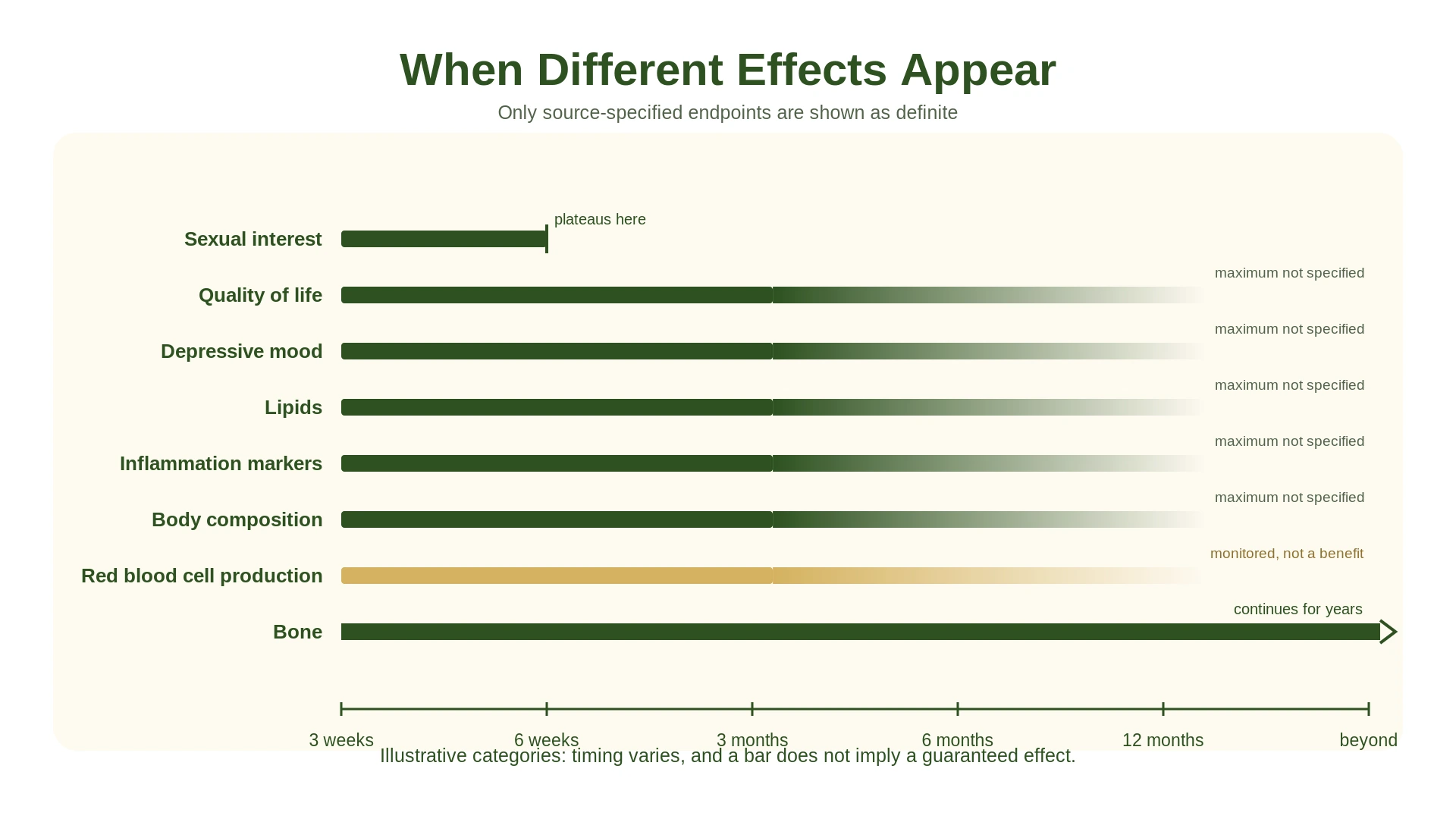
The Two Rows Most Timelines Leave Out
Two findings in that table rarely appear in the week-by-week timelines published by clinics, and both are useful to a patient.
Some effects plateau, and knowing when is practical
The review describes effects on sexual interest as appearing after about three weeks and plateauing at around six weeks, with no further increments expected beyond that point.
That is useful context for a follow-up conversation. If an expected improvement has not appeared within the timeframe described in published studies, discuss it with your prescribing clinician. These findings can help guide follow-up conversations, but they do not establish a deadline for an individual response.
A timeline suggesting that all effects continue improving for twelve months can imply that waiting is always the right response. The published findings are more varied than that, which is worth knowing when deciding what to raise at a review.
One row on the timeline is the reason for monitoring
Review times effects red blood cell production alongside the benefits: evident at around three months, peaking at nine to twelve months.
Increased red blood cell production is not a treatment benefit patients should seek. Testosterone therapy can raise hemoglobin and hematocrit, which is one reason clinicians monitor blood counts during treatment. This effect develops alongside other treatment-related changes, which is part of why follow-up testing continues past the point at which someone feels better.
Our guide to TRT benefits, risks and candidacy covers what the monitoring involves and why.
What Are the First Signs That TRT Is Working?
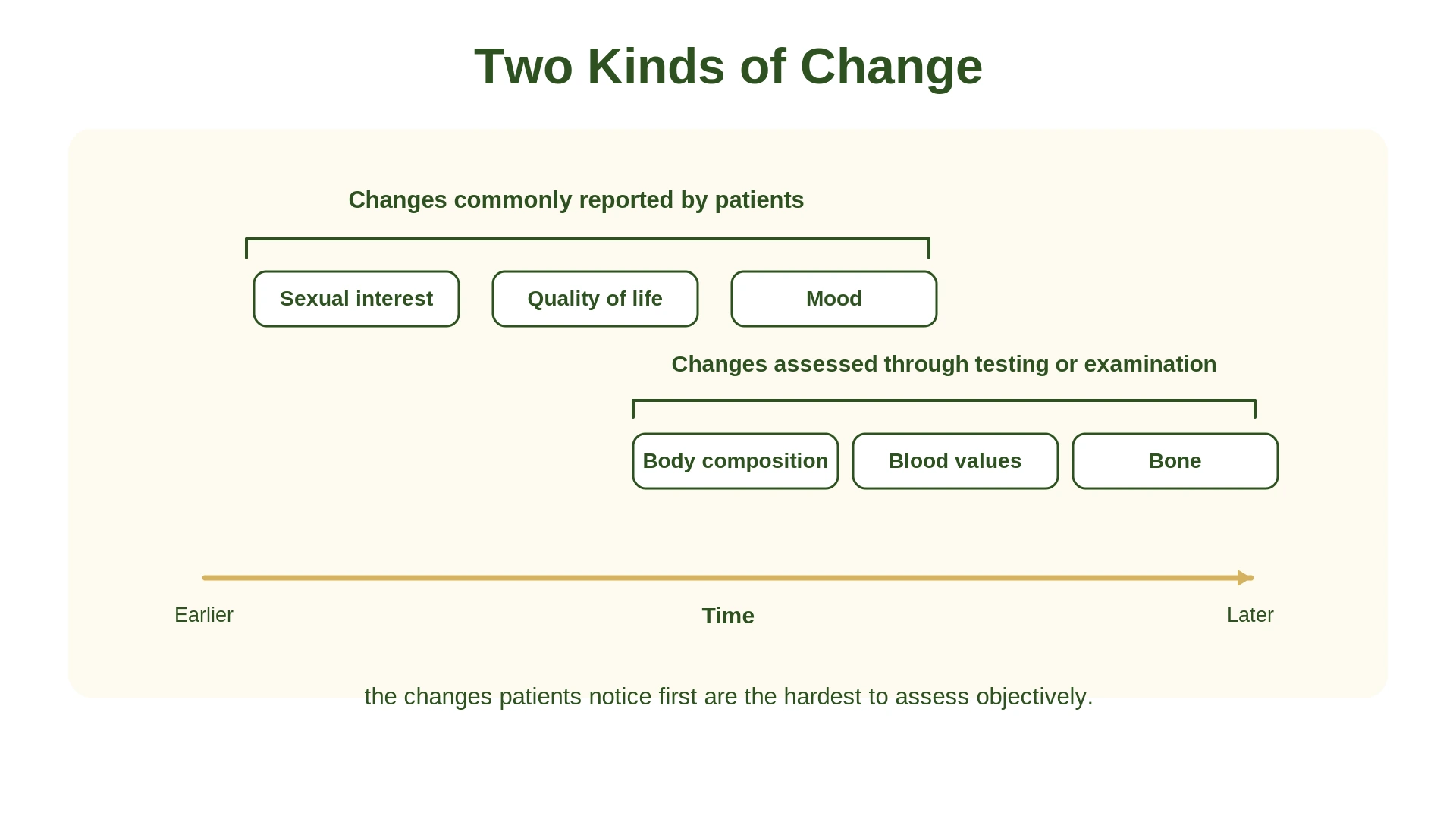
Based on the published review, the earliest detectable changes were in sexual interest at around three weeks, quality of life within three to four weeks, and depressive mood from three to six weeks. These are also the effects most difficult to assess objectively, since they depend on how someone feels rather than on a measurement.
The honest difficulty here is that the earliest effects are subjective ones. Improvements in body composition and bone, which can be measured, arrive considerably later.
One consequence is that early impressions are genuinely hard to interpret. Feeling better in the first few weeks may reflect treatment and may reflect the effect of having addressed something that was worrying you. Both are real, and separating them is part of what follow-up testing and review are for.
What to expect in the first two weeks
The review describes several effects that become detectable after approximately three weeks or longer. However, individuals may notice changes at different times, and the absence of noticeable improvement during the first two weeks does not establish whether treatment will be effective. Where preparation is being used that takes time to reach steady levels, the early period may be more about the medication establishing itself than about effects appearing. Our guide to testosterone delivery methods covers how preparation affects this.
Will I Lose Belly Fat on TRT?
The review found changes in fat mass and lean body mass within twelve to sixteen weeks, stabilizing at six to twelve months. It also notes that because fat mass decreases while lean body mass increases, total body weight often does not show major changes.
That last point is worth holding onto. Someone watching the scale may conclude nothing is happening while body composition is in fact changing, because the two movements partly offset each other.
Testosterone replacement therapy is a treatment for diagnosed testosterone deficiency, not a weight-loss treatment. Body composition changes are an observed effect in people being treated for a clinical indication, and that is a different thing from a reason to seek treatment.
Why Timelines Differ Between Sources
Four reasons, which explain most of the variation you will find.
They describe different effects
A page saying three weeks and a page saying six months may both be accurate about different outcomes. This is the largest single source of apparent disagreement.
Preparation affects how quickly levels stabilize
Different delivery methods reach steady levels over different periods, which shifts the early part of any timeline. A timeline that does not state which preparation it describes is less useful than one that does.
Starting point and individual factors vary
Baseline levels, age, other conditions and other medications all affect response. Review findings describe what happened across study populations, not what will happen to one person.
Some sources are summarizing the same review without saying so
A figure appearing on many pages can look like independent corroboration when those pages are drawing on one source. That is worth knowing when a number seems well established.
If Nothing Has Changed Yet
A common and reasonable question, and the answer depends on where you are and on what you are measuring.
Check which affects you are assessing
The timeline above spans from around three weeks to several years. At eight weeks, it may be reasonable to discuss an expected early effect that has not appeared. However, the absence of improvement at a particular week does not establish treatment failure. Other effects may take considerably longer, and the overall response requires clinical assessment.
Check whether levels have been confirmed
Whether the treatment has achieved what it is supposed to achieve is a separate question from whether you feel different, and it is answered by testing rather than by waiting. If follow-up testing has not yet occurred, ask your prescribing clinician whether it is due. The timing of laboratory monitoring depends on the treatment formulation, clinical circumstances and follow-up plan.
Consider whether the original question has been answered
If the symptom that prompted treatment has not improved, one possibility is that the treatment needs adjusting. Another is that the symptoms had a different cause, which is a question worth reopening rather than treating harder. Fatigue, low mood and reduced libido all have several possible explanations.
Raise it at a review rather than acting alone
Stopping or changing treatment independently is not advisable, and the period when someone is discouraged is exactly when that becomes tempting. A scheduled review is the right place for this conversation, and it can usually be brought forward.
What Monitoring Runs Alongside the Timeline
Treatment and monitoring proceed together rather than sequentially.
Follow-up testing after starting treatment assesses whether levels are where they should be and whether anything requires attention, including the red blood cell effect described above. Testing recurs through the first year and continues afterwards at a frequency your clinician determines.
The practical point for someone tracking their own progress is that the question is not only whether you feel better. It is whether the measurements support continuing as you are, and those two can diverge in both directions.
Our guide to blood tests before HRT or TRT covers what the initial evaluation involves.
What TRT Costs in San Antonio
Updated October 2026.
When comparing testosterone treatment services in San Antonio, you may encounter different billing arrangements. Some providers charge separately for consultations, medication and laboratory testing. Others offer membership or subscription arrangements that may include selected services for a recurring fee. The services included and any additional charges should be confirmed directly with the provider.
Neither is inherently cheaper. Which costs less a year depends on how many consultations and how much laboratory work you use, and the timeline above is relevant to that: the first year of treatment generally involves more consultations and more testing than a settled year.
Our detailed comparison of TRT billing models in San Antonio works through the arithmetic, including what to ask about charges beyond what a membership includes.
Frequently Asked Questions
How long does it take for TRT to start working?
The earliest effects described in the published review began at around three weeks, with effects on sexual interest and quality of life among the first to appear. Effects on body composition were first detected within twelve to sixteen weeks, and effects on bone after six months. Which answer applies depends on which effect you are waiting for.
Does insurance cover TRT?
It may, where testosterone deficiency has been diagnosed to the clinical standard. Coverage varies by plan, by the preparation prescribed and by what is being billed, and consultations, laboratory testing and medication may each be treated differently by the same plan. Many specialized men's health clinics operate outside insurance entirely. Verify with your own insurer directly rather than relying on a general statement.
How much is TRT therapy per month?
The monthly figure depends substantially on the preparation and on whether the quote covers medication alone or includes consultations and laboratory work. A first-year total is a more useful figure than a monthly one, because the initial evaluation and baseline testing land at the start. Our guide to TRT billing models covers how to make quotes comparable.
What is the best TRT treatment?
There is no single best option. The appropriate preparation depends on the clinical situation, what else you take, practical considerations around administration and individual preference. Different preparations also reach steady levels over different periods, which affects the early part of the timeline. Which suits an individual is a clinical decision rather than a ranking.
Is TRT used for women?
Searches for TRT therapy for women are common. Testosterone therapy in women is a distinct clinical area from testosterone replacement in men, with different considerations, and there is no FDA-approved testosterone product indicated for women in the United States. Anyone with questions about testosterone in the context of women's health should raise them with a clinician who works in that area rather than applying information written about men.
How long should I wait before deciding whether TRT is not working?
This is worth deciding with your provider rather than alone, and the answer depends on which effect you are assessing. The published review indicates that some effects plateau at a known point while others continue improving for months or years, so a single waiting period does not apply to everything. Raise it at a scheduled review rather than stopping treatment independently.
Testosterone Treatment in San Antonio
San Antonio has an active men's health market, with testosterone treatment available through dedicated men's health clinics, urology practices, primary care and telehealth services. Providers differ in their billing models, in what their service includes and in how monitoring is arranged.
THRYVE Wellness Clinic is a provider-led telehealth service with mobile phlebotomy, offering access to 300+ lab tests, with at-home blood collection available in supported San Antonio service areas when appropriate for the tests ordered.
Final Thoughts
How long TRT takes to work depends entirely on which effect you mean. Published evidence places the earliest at around three weeks and the slowest continuing for years, which is why timelines appear to contradict each other when they are frequently describing different things.
Two details matter more than the headline figures. Some effects may reach a plateau earlier than others, which can help guide conversations with your prescribing clinician about treatment response. And one item on the timeline is the reason monitoring continues rather than a benefit you are waiting for.
Both of those are in the evidence most timelines cite, and neither tends to appear in them.
Testosterone Evaluation in San Antonio
THRYVE Wellness Clinic provides provider-led evaluation through secure telehealth, with at-home blood collection available in supported San Antonio service areas when appropriate for the tests ordered.