

THRYVE Team
Wellness Clinic
Baseline blood testing before hormone therapy is not a fixed panel everyone receives. Which tests a clinician order depends on the symptoms being investigated and whether the question is menopausal or testosterone related. Here is what may be considered and why.
Baseline blood testing before hormone therapy helps a clinician assess symptoms, identify other possible causes and determine whether treatment is appropriate. There is no single panel everyone receives. Which tests are ordered depends on the clinical question being asked, and the tests relevant to menopausal hormone therapy differ from those relevant to suspected testosterone deficiency. For patients in San Antonio, collection can sometimes happen at home, though the testing itself is only one part of the evaluation.
When researching hormone therapy in San Antonio, it can be tempting to look for a standard list of blood tests. The more accurate picture is that testing follows the clinical question rather than preceding it.
This covers what may be considered and why, how the approach differs between HRT and TRT, the sequence from testing to a treatment decision, and where at-home collection fits into that sequence.
Which Blood Tests May Be Needed Before HRT or TRT?
Testing is selected to answer specific clinical questions. The table below describes what those questions typically are and which tests may help address them. It is not a panel to request.
Clinical question | Possible tests | Why they may be ordered |
Is testosterone deficiency present? | Serum testosterone, measured in the early morning and generally repeated on a separate occasion | Professional guidance describes testosterone deficiency as requiring consistently low measurements alongside compatible symptoms, rather than a single result |
Is there a baseline red blood cell concern? | Complete blood count, including hematocrit | Testosterone therapy is associated with increased hematocrit, so a baseline matter before starting and for comparison afterwards |
Is something else producing these symptoms? | Thyroid function testing, and other tests depending on the presentation | Fatigue, mood change, weight change and low libido have several possible explanations, and hormone therapy would not address a different underlying cause |
Are there metabolic factors to account for? | Selected metabolic testing where the clinical picture suggests it | Metabolic conditions can both contribute to symptoms and affect which treatments are suitable |
What is the prostate baseline? | Prostate-related testing where appropriate to the individual | Relevant before and during testosterone therapy in some men, determined by age and clinical history |
Is estradiol relevant to this question? | Estradiol, in selected circumstances | Routine estradiol measurement is not required for every menopause-related evaluation; it has a role in specific situations |
This table describes tests that may be considered, not a mandatory panel. A clinician selects tests based on symptoms, history and the specific question being investigated. Requesting a broad panel without that context produces results that are harder rather than easier to interpret.
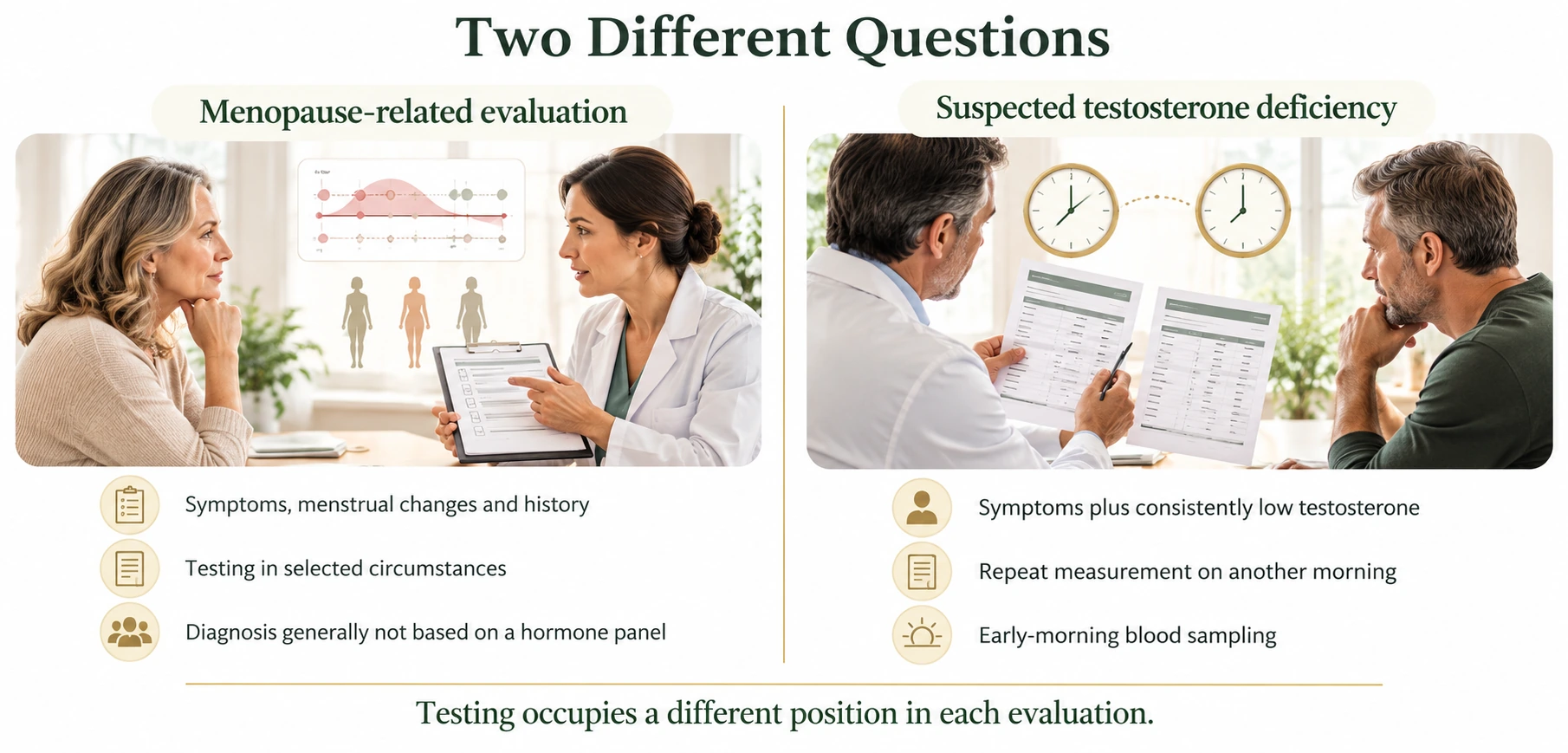
How Testing Differs for HRT and TRT
The distinction between menopausal hormone therapy and testosterone replacement therapy changes which tests may be useful and how results are interpreted.
Menopause-related evaluation
Professional guidance describes menopausal assessment as relying substantially on symptoms, menstrual changes, age and clinical history rather than on routine hormone measurement. Hormone levels fluctuate considerably during the menopausal transition, which limits what a single measurement establishes.
Testing has a role in particular circumstances, including younger patients and situations where another explanation needs to be investigated. It is not that testing is irrelevant; it is that the diagnosis is generally not made from a hormone panel.
Our guide to perimenopause and menopause covers why the stage affects the clinical picture.
Suspected testosterone deficiency
The position here is different. Professional guidance describes diagnosis as requiring symptoms or signs alongside consistently low testosterone, confirmed by measurement on more than one occasion, with samples taken in the early morning.
The Endocrine Society clinical practice guideline recommends diagnosing hypogonadism only when compatible symptoms and signs are present alongside consistently low testosterone concentrations, with repeat morning testing to confirm the initial result.
That makes the testing step more structurally important in a TRT evaluation than in a menopause evaluation, and it explains why the timing of a blood draw matters here in a way it does not always elsewhere.
Diagnostic testing and monitoring are different stages
The comparison table includes tests used for different purposes, making it important to distinguish diagnosis from baseline assessment and ongoing monitoring.
Testing done before treatment answers whether a condition is present and whether treatment would be appropriate. Testing done after treatment begins answers whether the treatment is having the intended effect and whether anything needs adjusting.
Not every test in the table above is part of establishing a diagnosis. A baseline measurement may be taken specifically so that a later result can be compared against it, which makes it a monitoring input gathered early rather than a diagnostic test. Your clinician can say which is which for the tests they order.
Our guide to TRT benefits, risks and candidacy covers the diagnostic criteria and what the evidence supports.
The practical consequences: an HRT evaluation and a TRT evaluation are not the same process with different tests. They ask different questions, and testing occupies a different position in each.
From Blood Tests to a Treatment Decision, Step by Step
Testing sits inside a sequence rather than at the start of one. Treatment is not a guaranteed outcome of that sequence.
1. Symptom and history review
The evaluation begins with what you are experiencing, how long it has been going on, your medical history and your current medications. This determines which questions are worth asking and therefore which tests are worth ordering.
2. Clinician-selected testing
Tests are chosen to address the questions identified in step one. Timing may be specified, particularly where early-morning collection is relevant, and the clinician indicates whether any preparation is needed. Where care is delivered remotely, this happens through telehealth consultations.
3. Collection
The sample is collected, either at a collection site or, where arrangements allow, at your address. Collection is a procedure; it is not an evaluation, and the person collecting the sample is not interpreting it.
4. Interpretation alongside the clinical picture
Results are reviewed against symptoms, history and the original question. A result outside a reference range is not automatically a diagnosis, and a result inside one does not automatically close a question.
5. An individualized plan, and follow-up
What follows depends on what the evaluation establishes. That may be hormone therapy, a different treatment, further investigation, or monitoring over time. Where treatment does begin, follow-up testing is part of it rather than an optional addition.

Can You Get Hormone Blood Tests at Home in San Antonio?
Sometimes, depending on the tests ordered and the collection address.
At-home collection means a trained phlebotomy professional travels to you rather than you traveling to a collection site. The sample is then transported to a laboratory for analysis.
Our mobile phlebotomy services page explains how collection is arranged.
Where it fits in the sequence
When available and appropriate, at-home blood collection can serve as the step within a broader clinical evaluation. Test selection, interpretation and treatment decisions remain separate responsibilities.
That distinction matters because the two are sometimes marketed together in a way that blurs them. A blood draw at your kitchen table is still a blood draw; what makes the testing useful is the clinical question it was ordered to answer.
What affects whether it is available
The specific tests ordered, since some have handling or timing requirements that affect how and where collection can happen
The collection address, because mobile collection coverage is address-specific rather than citywide
Timing, particularly where early-morning collection has been specified
Current service coverage, which changes and should be confirmed rather than assumed
Availability cannot be promised in general terms. Confirm for your specific tests and address rather than relying on a service area named on a website, which is advice this article would give about any provider including ours.
What Results Do and Do Not Establish
Understanding what laboratory results can and cannot establish helps patients prepare for a more informed discussion with their provider.
A reference range describes a population
Laboratory reference ranges are derived from populations rather than individuals. A result inside a range is not automatically normal for you, and a result slightly outside one is not automatically a diagnosis. Interpretation involves the clinical picture, which is why results are reviewed in a consultation rather than sent without context.
One measurement is a point, not a pattern
Several hormones vary throughout the day, between days, and across a cycle. That variation is the reason timing instructions exist and the reason some measurements are repeated. A single value describes the moment the sample was taken.
Testing can rule things in as well as out
Part of what pre-treatment testing does is identify explanations other than the one being considered. Finding a different cause is a useful outcome rather than a failed test, and it changes what treatment would actually help.
Results inform a decision rather than making one
Laboratory findings are one part of the decision. A clinician interprets them alongside symptoms, medical history, current medications, treatment goals and other relevant factors before recommending next steps. The available lab testing options are one input among several.
What to Ask a Hormone Specialist in San Antonio
Whether you are consulting a dedicated hormone clinic, a primary care provider, a urology or gynecology practice, or a telehealth service, the same questions are worth asking.
How will you establish whether hormone therapy is appropriate for me, and what would rule it out
Which tests are you ordering and what question is each one answering
Does timing matter for any of these, and what preparation is needed
Who interprets the results, and will we discuss them together
What are the risks relevant to my situation specifically
If I may want children, how does that affect the options (relevant to testosterone therapy in particular)
What monitoring follows if treatment starts, and how often
Asking why each test is recommended can help patients understand how their symptoms, medical history and treatment considerations influence the evaluation.
How THRYVE fits
THRYVE Wellness Clinic is a provider-led telehealth service rather than an in-person specialist clinic. Consultations and results review happen remotely, and at-home blood collection may be available in supported San Antonio service areas when appropriate for the tests ordered.
Patients exploring hormone evaluation in San Antonio should compare how providers establish a diagnosis, which tests they order and why, and what monitoring follows.
Frequently Asked Questions
Do I need blood tests before HRT?
It depends on the clinical question. Menopausal assessment relies substantially on symptoms, menstrual changes, age and history rather than on routine hormone measurement, though testing has a role in particular circumstances including younger patients. Evaluations involving suspected testosterone deficiency place more weight on measurement. A clinician determines what is needed for your situation.
Why are two testosterone tests sometimes needed?
Professional guidance describes testosterone deficiency as requiring consistently low measurements rather than a single result, with samples generally taken in the early morning. Testosterone varies through the day and between days, so one measurement captures a moment rather than establishing a pattern. Repeating it on a separate occasion is how a consistent picture is established.
Can I get blood drawn at home in San Antonio?
Sometimes. It depends on the tests ordered, the collection address and current service coverage, which is address-specific rather than citywide. Confirm availability for your particular situation rather than assuming a city-wide service. At-home collection covers the sample collection step only; the evaluation and interpretation still involve a provider.
Do I need to fast before hormone blood tests?
It depends on which tests are ordered. Some tests require fasting and others do not, and some have timing requirements unrelated to fasting, such as early-morning collection. Your clinician or the collection service will tell you what preparation applies to your specific tests. Follow those instructions rather than general advice.
How soon are results available?
Turnaround varies by test and by laboratory. Some results are available within a few days and others take longer. Your provider can give a realistic expectation for the specific tests ordered, and results are typically discussed in a follow-up consultation rather than sent without context.
Can normal results rule out a hormone-related concern?
Not necessarily. A result within a reference range is one piece of information rather than a conclusion, and symptoms that remain unexplained warranty continued investigation. Reference ranges describe populations rather than individuals, and some conditions involve patterns that a single measurement does not capture. Discuss persisting symptoms with your provider rather than treating a normal result as the end of the question.
Final Thoughts
There is no universal pre-treatment panel. Testing before hormone therapy is selected to answer specific clinical questions, and which questions apply depends on what is being investigated.
The approach differs meaningfully between menopausal evaluation and suspected testosterone deficiency, which is why a general hormone panel is a weaker starting point than a conversation about symptoms.
Blood collection is only one step in the evaluation. Whether it happens at home or at a collection site, the more important clinical questions are which tests were ordered, why they were selected and how the results will be interpreted.
Hormone Evaluation in San Antonio, TX
THRYVE Wellness Clinic provides provider-led hormone evaluation through secure telehealth, with at-home blood collection available in supported San Antonio service areas when appropriate for the tests ordered.