

THRYVE Team
Wellness Clinic
Most pages about testosterone therapy in San Antonio describe the benefits and stop. The trial evidence also documents effects on fertility, testicular volume and red blood cell concentration. Here is what the research shows about both sides, and who the guidelines say is a candidate.
Testosterone replacement therapy (TRT) is a prescription treatment considered for men with symptoms of testosterone deficiency and consistently low testosterone levels confirmed through appropriate testing. Treatment may improve certain symptoms, but it can suppress sperm production, reduce testicular volume and increase hematocrit. The TRAVERSE trial found no greater rate of major adverse cardiovascular events with testosterone gel than placebo within its studied population and follow-up period. A clinical evaluation is necessary to determine whether TRT is appropriate.
Searching for testosterone replacement therapy in San Antonio TX returns a page of clinic sites. Most describe energy, muscle mass and libido, and most do not mention what the same treatment does to fertility, testicular volume or red blood cell concentration.
Those effects are documented, mechanistically understood, and relevant to the decision. This article covers both sides and what the guidelines say about who is a candidate.

Where Can I Get Testosterone Replacement Therapy in San Antonio?
San Antonio has four distinct types of providers for this: specialized men's health and low-T clinics, urology practices, primary care and internal medicine, and telehealth providers with at-home collection. They differ in how the diagnosis is reached and how care is monitored, more than in which treatments they offer.
Provider type | Approach | Where care happens |
Specialized men's health clinics | Focused on hormone treatment, often with on-site testing | In clinic, with some at-home options |
Urology practices | Evaluate low testosterone within broader urological assessment | Typically in person; telehealth may be available |
Primary care and internal medicine | Hormone care within general medical care, alongside other conditions | Typically in person; telehealth may be available |
Telehealth with at-home collection | Consultation and review remotely, collection at your address | Home, with telehealth consultation |
The fourth category is the newest and the one most often absent from comparison lists. It matters here because testosterone evaluation requires at least two early-morning blood draws, which is the part of the process most affected by whether collection comes to you.
Our guide to low testosterone symptoms and testing covers the diagnostic requirement in detail.
What Does the Evidence Show About Benefits?
Stated carefully, because this is where most pages overstate.
Testosterone therapy is prescribed to address symptoms associated with confirmed testosterone deficiency. In men who meet the diagnostic criteria, it raises testosterone into the physiological range and is used to address the symptoms attributed to the deficiency.
Clinical studies have examined several potential outcomes of testosterone therapy, including sexual symptoms, anemia, bone health and metabolic measures. Findings differ by outcome, study population and treatment duration. Evidence for one benefit should not be assumed to establish improvements in energy, physical performance or long-term health for every patient. Treatment decisions should focus on confirmed testosterone deficiency, symptoms, individual risks and realistic treatment goals.
What the evidence does NOT establish is benefit in men who do not meet the diagnostic criteria. TRAVERSE enrolled men with confirmed hypogonadism. Published commentary on the trial is explicit that its reassurance applies to men in whom testosterone is clinically indicated, not to testosterone use generally.
How Small Do Balls Get on TRT?
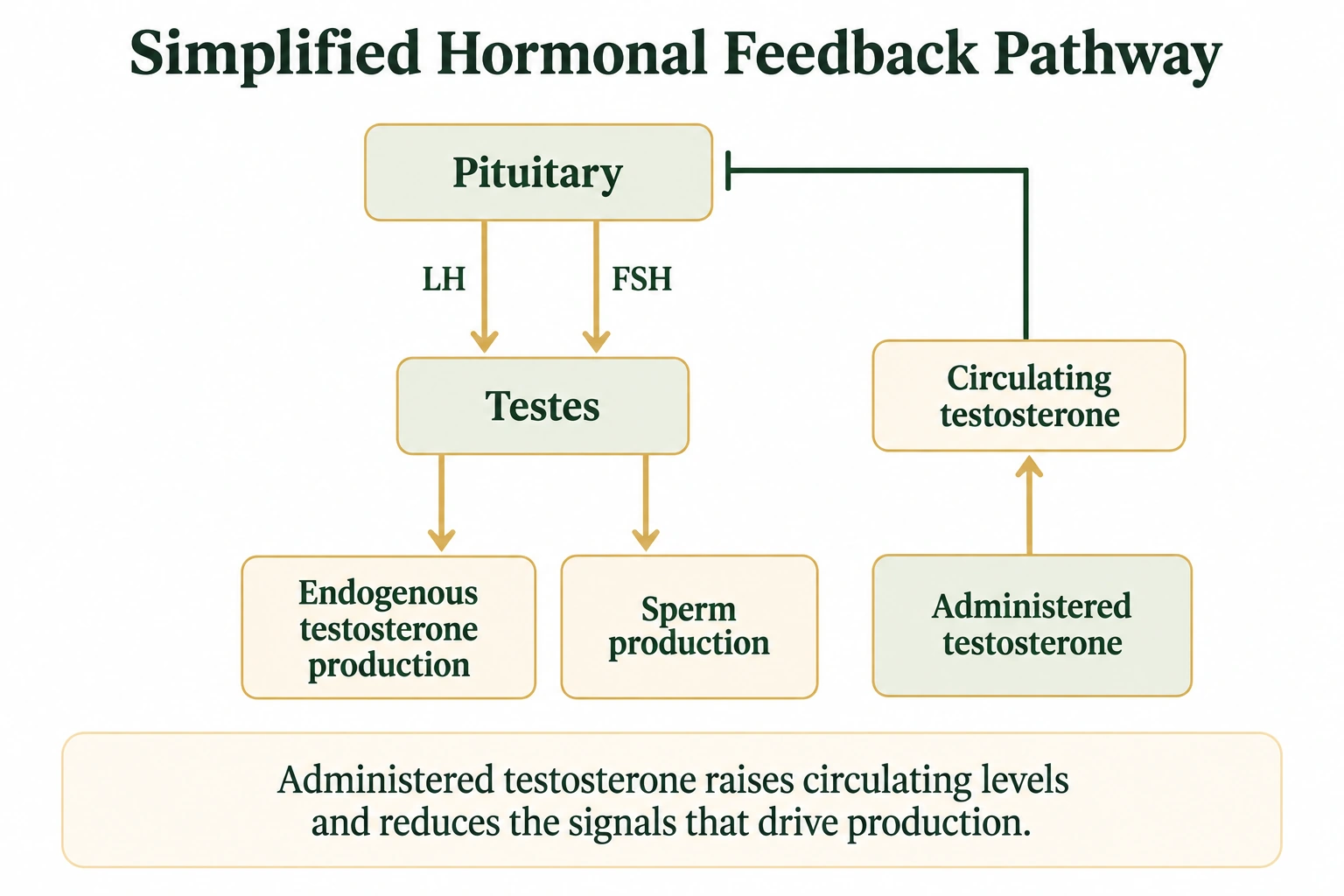
Testicular volume commonly decreases during testosterone therapy. The mechanism is well understood: testosterone taken from outside the body suppresses the pituitary hormones LH and FSH, which are the signals that drive the testes to produce testosterone and sperm. With those signals reduced, both production and testicular volume decline. The degree varies considerably between individuals, and published figures differ enough that a specific percentage should not be relied on.
Two things follow from that mechanism, and they are the reason this question deserves a straight answer rather than reassurance.
The effect is not cosmetic in isolation. It reflects suppression of the same pathway that produces sperm, which is why testicular volume and fertility are discussed together
It is frequently described as reversible on discontinuation, though recovery time varies and is not guaranteed for every individual
Some fertility-preserving approaches may be considered in particular clinical circumstances, but they require specialist assessment and are not a guarantee of maintained sperm production or testicular function. Whether a provider raises the topic at all is worth noticing.
What About Fertility?
This follows directly from the section above and deserves its own heading because it changes the decision for some men entirely.
Testosterone therapy suppresses the hormonal signals that drive sperm production. Published descriptions of the mechanism note that reduced FSH leads to reduced spermatogenesis, and that sperm counts can fall substantially, in some cases to zero.
Anyone who may want to father children should raise this before starting therapy, not after. It is a different conversation once treatment is underway, and some approaches to preserving fertility are easier to implement before suppression has occurred.
The Risk the Trial Documented Most Clearly
Erythrocytosis refers to an increase in red blood cell mass, commonly assessed during testosterone therapy through hematocrit measurements. A published review of TRAVERSE reported hematocrit levels of at least 54 percent in 17.0 percent of men receiving testosterone, compared with 3.3 percent receiving placebo. This is an important reason clinicians monitor hematocrit during treatment.
Published analysis describes erythrocytosis as a consistent and clinically established adverse effect of testosterone therapy. It is manageable, and management requires that somebody is measuring it.
What About Cardiovascular Risk?
This question dominated the field for more than a decade and now has a direct answer, with limits worth understanding.
TRAVERSE was an FDA-mandated trial that randomized 5,246 men aged 45 to 80 with confirmed hypogonadism and either established cardiovascular disease or elevated cardiovascular risk. Participants received transdermal testosterone gel or placebo, with dosing adjusted to maintain physiological levels. Median follow-up was approximately 33 months.
Outcome | Testosterone | Placebo |
Major adverse cardiovascular events | 7.0 percent | 7.3 percent |
Hazard ratio, testosterone vs placebo | 0.96 (95% CI 0.78 to 1.17), non-inferior |
|
TRAVERSE also identified safety signals beyond its primary cardiovascular endpoint. Atrial fibrillation and acute kidney injury were reported more frequently in the testosterone group, with statistically significant differences in the trial's adverse-event analyses. Pulmonary embolism was also observed more frequently. These findings should be considered alongside the primary noninferiority result rather than interpreted as proof that testosterone therapy carries no cardiovascular risks.
The trial's reassurance is specific. It applies to men with confirmed hypogonadism, treated to physiological levels, over the duration studied. Published commentary states the findings provide reassurance for men in whom testosterone is clinically indicated. There is no evidence about testosterone use outside that group.
What Does the FDA Say About Testosterone Therapy?
The FDA has updated testosterone product labeling as new safety evidence has become available. In 2025, the agency removed language about increased major cardiovascular risk from the boxed warning following its review of TRAVERSE, while requiring warnings about increased blood pressure.
Further prescribing-information changes were requested in 2026, including changes relating to age-associated testosterone deficiency and prostate-related safety information.
These updates do not mean testosterone therapy is appropriate for everyone. Diagnosis, prescribing decisions and monitoring still require individualized clinical assessment, and patients should discuss the current labeling for their specific medication with their provider.
Is Taking Testosterone Legal in Texas?
Yes, with a valid prescription. Testosterone is a Schedule III controlled substance under federal law, which means it is legal to possess and use when prescribed by a licensed provider for a legitimate medical purpose. Obtaining or using it without a prescription is not legal. Texas follows the federal scheduling.
The practical implications of that status are worth understanding, because they explain several things about how legitimate providers operate:
A prescription requires an actual evaluation. A provider who prescribes without establishing a diagnosis is not following the expected standard
Controlled substance prescriptions carry record-keeping and refill requirements that differ from ordinary medications
A provider delivering care by telehealth must be licensed in the state where the patient is located

How Much Does It Cost to Get Testosterone Replacement Therapy?
Cost depends on the preparation, the delivery method, how often monitoring occurs, and whether any part is billed to insurance. A quoted figure may cover the medication, the consultations, the laboratory testing, or some combination, which is why comparing figures between providers requires establishing what each one includes first.
Four components typically make up the total, and providers bundle them differently:
Initial evaluation, including consultation and baseline testing
The medication itself, which varies substantially by preparation
Ongoing monitoring, which is not optional given the erythrocytosis finding above
Follow-up consultations and any dose adjustment
Insurance coverage varies by plan and by what is being billed. Some providers bill laboratory testing to insurance while charging directly for consultations, and some operate outside insurance entirely. Confirm which specific components can be billed rather than whether the service is covered in general.
Our guide to what lab testing costs explains why identical services can carry very different totals.
Who Is a Candidate?
Candidacy is established through evaluation rather than by matching a symptom list.
The American Urological Association requires symptoms alongside consistently low testosterone, confirmed by at least two measurements taken on separate occasions, both in the early morning. A low number without symptoms does not establish the condition, and symptoms without confirmed low levels point toward investigating other explanations.
Factors that affect suitability
Whether the diagnosis has been confirmed to guideline standard
Whether you may want to father children, given the fertility effects described above
Whether you are currently trying to conceive, since the AUA advises against prescribing exogenous testosterone to men in that situation
Baseline red blood cell concentration, given the erythrocytosis finding
Cardiovascular history, which the TRAVERSE evidence informs without removing from the discussion
Prostate history, which is assessed before and monitored during therapy
Whether other explanations for the same symptoms have been considered, including sleep disorders, thyroid conditions, depression and medication effects
A point the trial evidence raises directly
Published analysis of TRAVERSE distinguishes organic hypogonadism, where the cause lies in the testes or pituitary, from functional hypogonadism, which is associated with factors such as obesity and metabolic conditions.
When low testosterone is associated with obesity, metabolic conditions or other potentially reversible factors, addressing those factors may be an important part of evaluation and treatment planning. Whether testosterone therapy is appropriate depends on the full clinical picture.
Testosterone Replacement Therapy in San Antonio
San Antonio has a developed market for this, including dedicated men's health clinics, urology practices, integrative medicine providers and telehealth services. The variation between them is less about which treatments are available than about how thoroughly the diagnosis is established and what monitoring follows. Patients exploring hormone care in San Antonio should compare how providers establish a diagnosis, discuss fertility and other risks, arrange testing and monitor treatment over time.
Questions worth asking any provider here
How many blood draws before a diagnosis, and at what time of day
What else is assessed to rule out other causes of the same symptoms
What monitoring follows once treatment starts, and how often
How fertility is discussed, and when
Whether you will work alongside my existing providers
The first and fourth are the most revealing. A provider following the guideline will describe two early-morning draws without being prompted, and one that takes fertility seriously will raise it before you do.
A practical point about testing
Testosterone evaluation requires early-morning collection on at least two separate occasions, and monitoring requires further draws afterward. In supported San Antonio service areas, at-home blood collection may be available when appropriate for the tests ordered, with consultations and results review delivered through secure telehealth. Availability depends on the test ordered, the collection address and current service coverage.
Frequently Asked Questions
What is testosterone replacement therapy?
A prescription treatment that raises testosterone levels in men with symptoms of testosterone deficiency confirmed by testing. It is available in several preparations including injections, topical gels, patches and implanted pellets. It is not appropriate for everyone, and candidacy is established through clinical evaluation.
Does insurance cover testosterone replacement therapy?
Coverage varies by health plan and by what is being billed. Laboratory testing, consultations and medication may be treated differently by the same plan, and some providers operate outside insurance entirely. Ask which specific components a given provider can bill rather than whether the service is covered overall, and verify with your insurer directly. THRYVE's current pricing and payment options should be confirmed directly through its care team.
Does TRT affect fertility?
Yes. Testosterone therapy suppresses the hormonal signals that drive sperm production, and sperm counts can fall substantially. Anyone who may want to father children should raise this before starting therapy rather than after, since some approaches to preserving fertility are easier to implement before suppression has occurred.
What monitoring is required during testosterone therapy?
Blood monitoring is standard. Hematocrit, testosterone levels and prostate-related factors are commonly monitored as clinically appropriate, and blood pressure monitoring is also relevant given the FDA labeling changes described above. Frequency is determined by the clinical situation. A provider who does not describe a monitoring plan is describing an incomplete service.
Final Thoughts
Testosterone therapy has stronger safety evidence than it did five years ago. TRAVERSE provided important cardiovascular safety evidence for men with confirmed hypogonadism who met the trial's inclusion criteria. Its findings offer reassurance about major adverse cardiovascular events during the period studied, while leaving other safety considerations and longer-term questions relevant to treatment decisions.
Testosterone therapy can also raise hematocrit, while suppressing sperm production and affecting testicular volume. These effects make appropriate monitoring and discussion of fertility plans important before treatment. None of that makes it a bad treatment. It makes it a treatment with defined effects that require monitoring and a conversation before starting.
Which leaves the practical question where it belongs. Not whether testosterone therapy works, but whether you meet the criteria, what the trade-offs mean for your situation, and whether the provider you are considering raises them before you do.
Testosterone Evaluation in San Antonio
THRYVE Wellness Clinic provides provider-guided evaluation in supported San Antonio service areas, with early-morning at-home blood collection where available and care delivered through secure telehealth. If you are weighing up testosterone therapy, an evaluation establishes whether the criteria are met before any treatment decision.