

THRYVE Team
Wellness Clinic
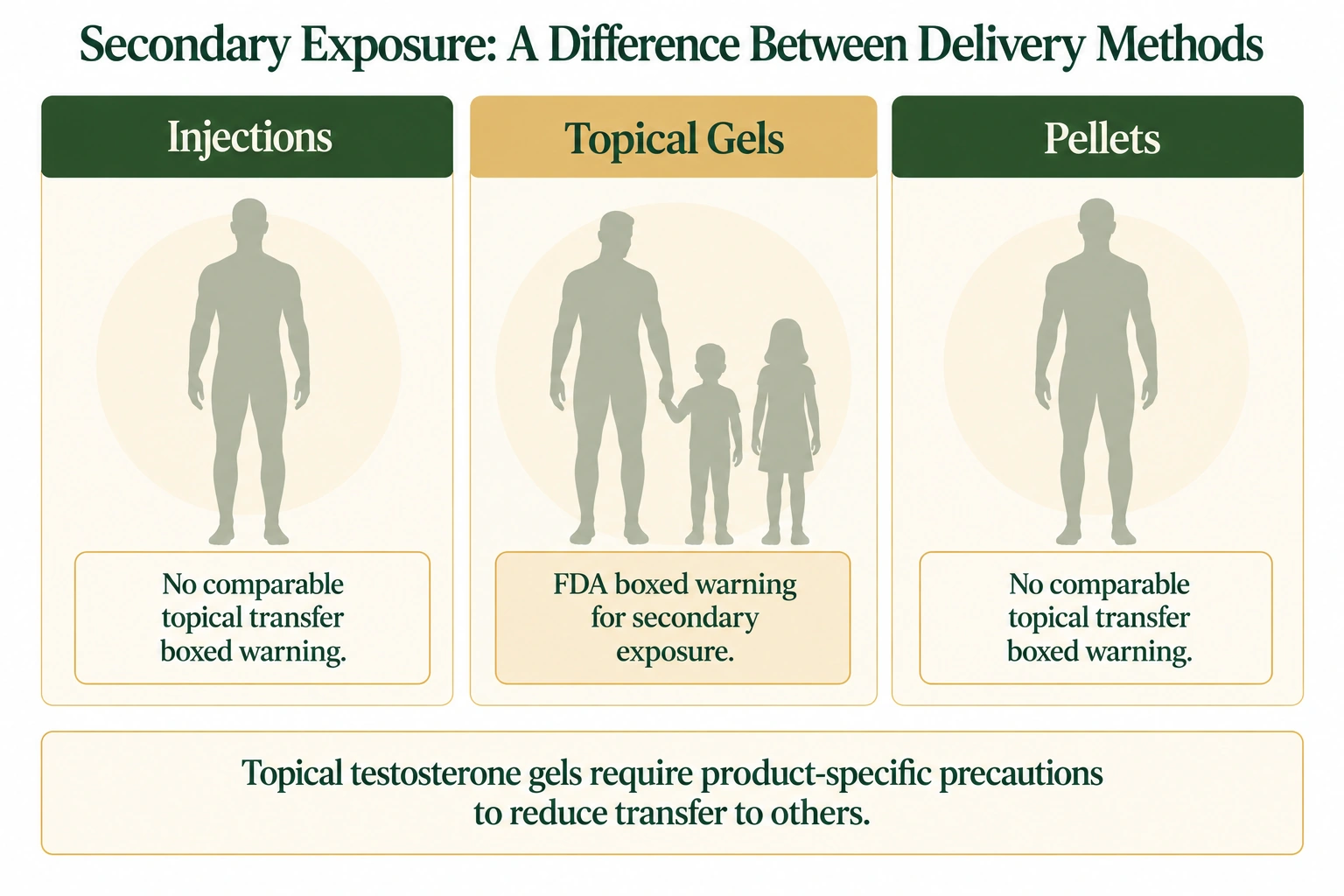
Testosterone is delivered by injection, topical gel or implanted pellet. Comparisons usually cover convenience and dosing patterns. One difference is rarely mentioned: topical gels carry an FDA boxed warning because the hormone can be transferred to other people through contact.
Testosterone injections, topical gels and implanted pellets are different delivery methods for prescription testosterone therapy. They differ in dosing pattern, how readily treatment can be adjusted and whether other people may be exposed. Topical gels carry an FDA boxed warning about secondary exposure through contact with treated skin.
Most comparisons of these three-cover frequency and convenience. Those matter, and they are not the only thing that differs.
This covers how the delivery methods compare what the FDA requires on topical products and why, and the questions worth asking before choosing one.
Whether testosterone therapy is appropriate at all is a separate question. Our guide to testosterone therapy benefits, risks and candidacy covers that, including what the diagnostic criteria require.

The Three Methods at a Glance
Comparison factor | Injections | Topical gels | Pellets |
How it is given | Intramuscular or subcutaneous injection at set intervals | Applied to the skin, typically daily | Implanted under the skin in a minor procedure |
Who administers it | A clinician, or the patient after training by a prescriber | The patient | A clinician |
Dosing pattern | Levels generally rise after each dose and decline before the next | Daily application, with absorption varying between individuals | Released over an extended period |
Changing the dose | A prescriber can change the dose or interval | A prescriber can change the amount or product | The implanted dose cannot be readily adjusted |
Secondary exposure | No comparable topical transfer boxed warning | FDA boxed warning for secondary exposure | No comparable topical transfer boxed warning |
Typical interval | Product-dependent, commonly weekly to every few weeks | Daily | Product-dependent, commonly every few months |
These are general differences between delivery methods, not instructions to change prescribed treatment. Product-specific directions and clinical circumstances take priority.
The Difference That Involves Other People
One row in that table is unlike the others, because it describes a risk that does not belong to the person being treated.
FDA-approved topical testosterone gels carry a boxed warning for secondary exposure. The warning states that virilization has been reported in children who were secondarily exposed to testosterone gel, and that children should avoid contact with unwashed or unclothed application sites in men using it.
A boxed warning is the FDA's most prominent safety alert. This one exists because cases of secondary exposure resulting in virilization of children were identified in post marketing surveillance after the products were approved. It describes events that occurred, not a theoretical concern.
What the labeling describes
Secondary exposure can occur in both children and women through contact with treated skin
Published case reports describe virilization in adult partners as well as in children
Transfer through contaminated clothing or bed linens has also been described in published literature, so skin-to-skin contact is not the only route
Product labeling sets out specific precautions intended to reduce the risk, and those precautions are product-specific
If you use a topical testosterone product and anyone in your household shows signs of unexpected hormonal change, the labeling directs that this be raised with a healthcare provider. Do not wait to see whether it is resolved, and do not stop or change a prescription on your own.
None of this makes gels the wrong choice. They are FDA-approved products used appropriately by many people. Product-specific precautions are intended to reduce the risk of secondary exposure, but they do not eliminate the need for careful use. For people using topical gels, secondary exposure precautions may make household circumstances an important part of treatment planning. This specific topical-transfer consideration does not apply in the same way to injections or pellets.
Why Injections Involve a Dosing Pattern
Injectable testosterone is given at intervals rather than continuously, which produces a pattern rather than a flat level.
Levels generally rise following a dose and decline before the next one is due. How pronounced that pattern is depends on the specific ester, the dose, the interval and the individual. Some people notice the variation, and some do not.
Where the pattern is a problem, the available responses are clinical ones: a prescriber may adjust the dose, the interval, or the product. That is a conversation to have rather than something to manage independently.
This article does not provide injection technique, injection site guidance, dose figures or interval recommendations. Administering an injectable medication is a procedure taught by the prescribing clinician for the specific product prescribed. If you have been prescribed injectable testosterone and are unsure how to administer it, ask your prescriber or pharmacist rather than relying on general information.
Pellets and What Professional Guidance Says
Pellets are implanted under the skin and release testosterone over an extended period, removing the need for a daily or weekly routine.
In guidance concerning compounded hormone therapy for menopausal symptoms, ACOG recommends testosterone preparations other than pellets because of limited safety data and the difficulty of removing an implanted pellet. This recommendation should not be presented as a universal rule for testosterone treatment in men. The regulatory status and evidence for specific pellet preparation also matter.
Two further considerations, separate from that recommendation:
The implanted dose cannot be readily adjusted. Where it turns out to be wrong, the options are narrower than with a daily or interval-based product
Many pellet preparations are compounded rather than FDA-approved manufactured products, which affects what testing and oversight the specific preparation has been subject to. Our guide to what bioidentical means covers that distinction
Guidance about testosterone pellets should not be generalized to pellets containing other hormones, and vice versa. The evidence and the recommendations differ by preparation.
What Actually Differs Between Them
Stripped with the marketing language, the three differ on four things worth weighing.
Consideration | Why it matters |
Dosing pattern | Interval-based delivery produces variation between doses. Daily application and extended-release implants produce different patterns again |
Adjustability | How readily can a prescriber change the dose if it turns out not to suit you, which varies substantially between the three |
Who administers it | Whether the routine involves a clinic visit, a daily step at home, or a procedure every few months |
Whether it affects others | Topical gels carry specific secondary-exposure warnings because testosterone can transfer to other people through contact with treated skin. |
Convenience is often emphasized in treatment comparisons. The fourth consideration is easy to overlook, yet it changes who may be affected by the decision.

What Changing Methods Involves
A change in delivery method may be considered when treatment response, tolerability or practical circumstances warrant it. The practicalities differ depending on which method is being used, and which is being considered.
Switching is a clinical decision, not a preference
Changing from one method to another involves different products, potentially different dosing, and a period of monitoring afterwards. It is not a matter of simply picking the other option, and a prescriber manages the transition.
Some changes are easier than others
Moving between methods that are administered regularly is generally more straightforward than changing course when an implant is already in place. That asymmetry is worth understanding before choosing rather than after.
Monitoring usually accompanies a change
A different delivery method can produce a different pattern of levels, which is why blood work typically follows a switch. A provider who proposes a change without describing what monitoring follows has described half the plan.
The reason for switching matters
Changing because of side effects, because of inconvenience, or because levels are not where a clinician wants them are three different situations with different answers. Being specific about which one applies makes the conversation considerably more useful.
Testosterone Therapy in San Antonio
San Antonio has a developed market for this, including dedicated men's health clinics, urology practices, primary care providers and telehealth services. Several local providers emphasize one delivery method, which makes it worth asking why rather than assuming the recommendation is neutral.
Questions worth asking any provider here
Which delivery methods do you offer, and which would you suggest for me specifically
If a topical product is suggested, how do the secondary exposure precautions apply to my household
How is the dose adjusted if it turns out not to suit me, and how quickly
Is what you are proposing an FDA-approved product or a compounded preparation
What monitoring follows once treatment starts, and how often
The second question is the one most likely to be skipped, and it is the one that affects people who are not in the room.
A practical point about testing
Testosterone evaluation and monitoring both involve laboratory testing. In supported San Antonio service areas, at-home blood collection may be available when appropriate for the tests ordered, with consultations and results review delivered through secure telehealth. Availability depends on the test ordered, the collection address and current service coverage.
What Monitoring Involves
Monitoring is part of testosterone therapy regardless of delivery method, and the method affects when samples are taken rather than whether they are.
Because interval-based delivery produces a pattern, when a blood sample is drawn relative to the last dose affects what the result shows. Clinicians account for that by specifying when to come in, which is why a monitoring appointment may be scheduled at a particular point rather than whenever is convenient.
Three things worth knowing about monitoring generally:
Timing instructions for a monitoring draw are not arbitrary, and changing when you attend can change what the result means
What is monitored extends beyond testosterone levels. Our guide to testosterone therapy covers the specific markers and why they are tracked
Monitoring frequency is typically higher at the start and during any change, and settles once a regimen is established
A provider who describes a treatment without describing its monitoring schedule has described an incomplete service, and that applies to all three delivery methods.
Frequently Asked Questions
Are testosterone injections better than gels?
Neither is universally better. They differ in dosing pattern, in how the medication is administered, and in whether the product can affect other people. Topical gels carry an FDA boxed warning for secondary exposure through contact with treated skin, which injections do not. Which suits an individual depends on medical circumstances, household considerations and practical factors, and is a decision made with a prescriber.
Can testosterone gel be transferred to other people?
Yes. FDA labeling for topical testosterone gels carries a boxed warning stating that virilization has been reported in children secondarily exposed to testosterone gel, and that children should avoid contact with unwashed or unclothed application sites. Secondary exposure affecting adults has also been described. Product labeling sets out specific precautions, and those should be followed for the exact product prescribed.
How often are testosterone injections given?
The interval depends on the specific preparation and is set by the prescribing clinician. Different esters have different dosing schedules, and the interval may be adjusted based on response and monitoring. Follow the schedule prescribed for your product rather than a general figure and raise any questions about timing with your prescriber.
Final Thoughts
Injections, gels and pellets all deliver testosterone. They differ in the pattern of delivery, in how readily a prescriber can change course, and in who administers the treatment.
They also differ in one respect that is easy to lose: only topical products carry a boxed warning about affecting other people. That makes a gel a different kind of decision from the other two, particularly in a household with children.
So, the question at a consultation is not simply which is most convenient. It is which fits your circumstances, including the circumstances of the people you live with.
Testosterone Evaluation in San Antonio
THRYVE Wellness Clinic provides provider-guided evaluation in supported San Antonio service areas, with at-home blood collection where available and care delivered through secure telehealth.