

THRYVE Team
Wellness Clinic
Most comparisons of HRT delivery methods list features. The more useful question is how reversible each decision is, because that determines what happens if the dose is wrong. Here is how patches, pills and pellets differ, and what the evidence actually supports.
HRT patches deliver estradiol through the skin, bypassing first-pass liver metabolism. Pills are taken orally and processed by the liver first. Pellets are implanted under the skin and release hormones over several months. Observational evidence indicates a higher risk of venous thromboembolism with oral estrogen than with transdermal, though the authors of that analysis describe the confidence in it as low. The three options also differ substantially in how quickly a dose can be changed or stopped.
Comparisons of these three usually produce a feature table. Those are useful, and they tend to leave out the thing that matters most when a dose turns out to be wrong.
This covers how the three differ, what the evidence supports and how strongly, the practical questions about patches that most guides skip, and what it costs in San Antonio.
The Three Options at a Glance
Comparison Factor | Pills | Patches | Pellets |
How it is taken | Orally, daily | Applied to skin, changed once or twice weekly | Implanted under the skin in a minor procedure |
Route | Through the digestive system and liver first | Absorbed through the skin directly into the bloodstream | Released directly into the bloodstream |
Hormone levels | Vary according to the oral formulation and dosing schedule | Ongoing transdermal delivery between scheduled changes | Released over an extended period; levels and absorption can vary |
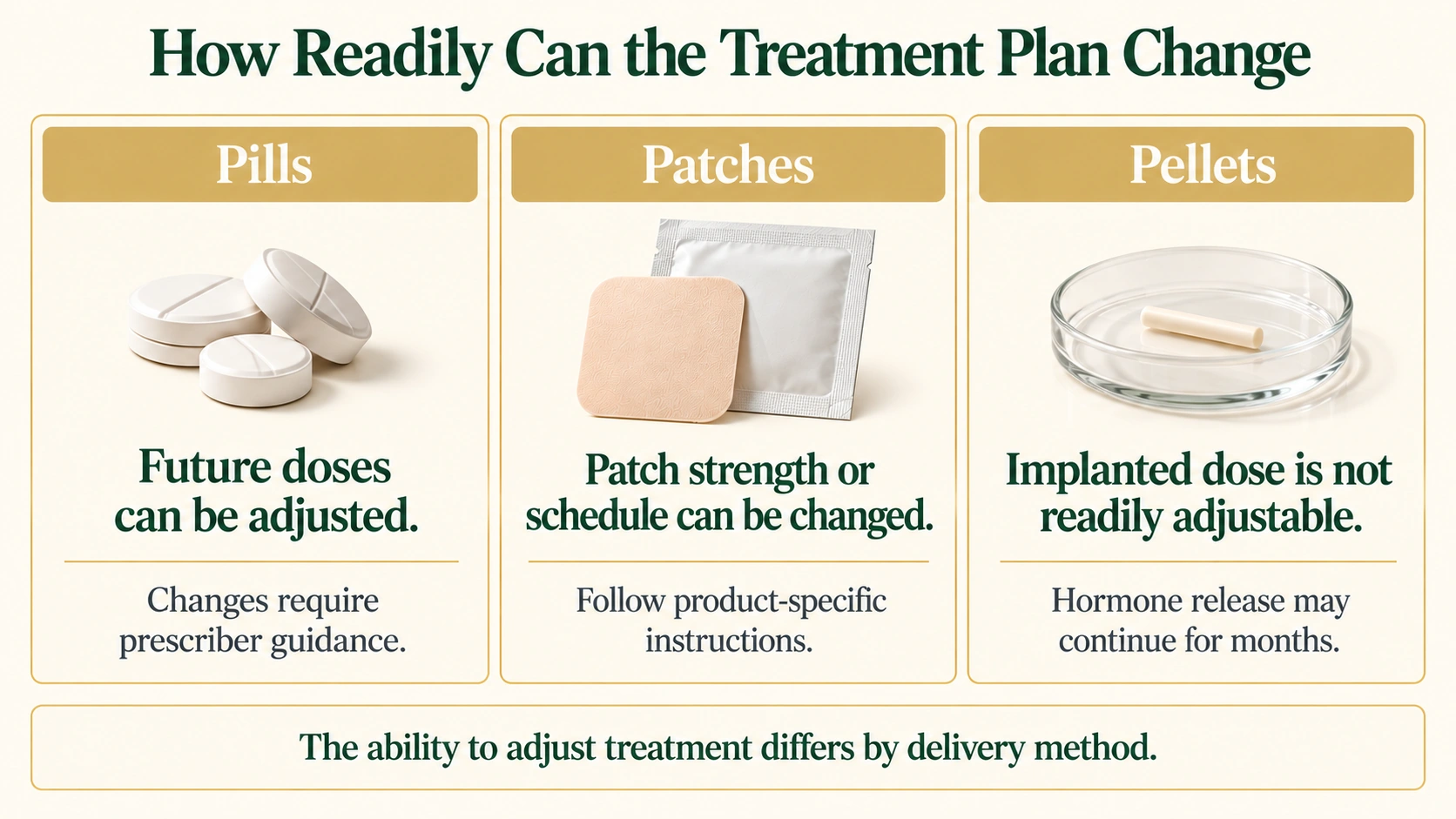
Changing the dose | A prescriber can change a subsequent dose | A prescriber can change the patch strength or schedule | The implanted dose cannot be readily adjusted |
Stopping | Future doses can be discontinued under clinical guidance | The patch can be removed under clinical guidance | Hormone release generally continues as the implant dissolves; removal is not straightforward |
Typical interval | Usually taken daily | Product-dependent, commonly once or twice weekly | Product- and preparation-dependent; effects may last several months |
These are general differences between delivery methods, not instructions to change prescribed treatment. Product-specific directions and clinical circumstances take priority.
Delivery method is only one part of choosing menopausal hormone therapy. For someone with a uterus, systemic estrogen generally requires appropriate progestogen protection to reduce the risk of endometrial hyperplasia and cancer. Whether a particular regimen is appropriate depends on medical history, symptoms and clinical assessment.
The First-Pass Difference, and What the Evidence Shows
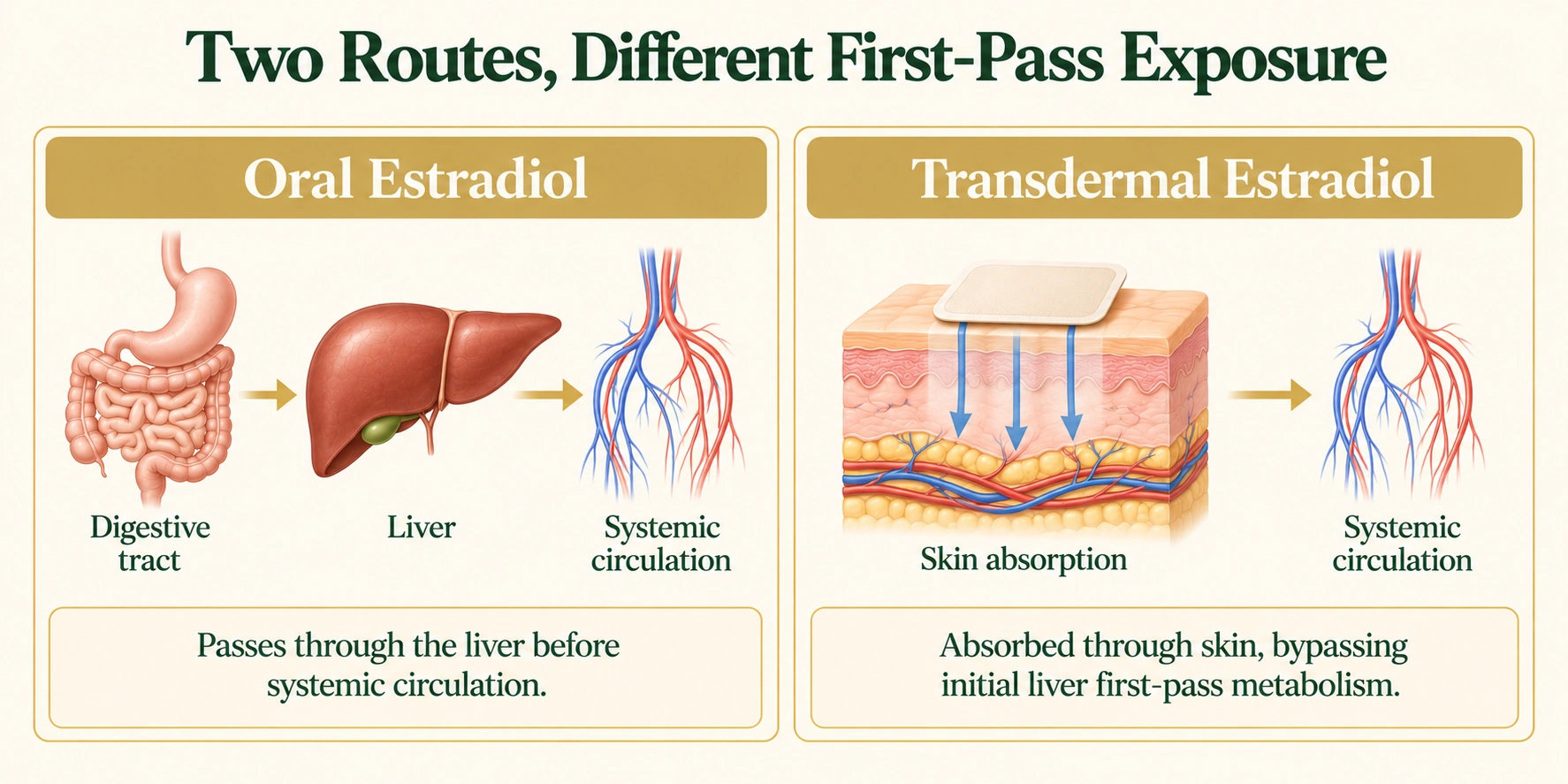
The clearest physiological difference between oral and transdermal delivery is what happens before the hormone reaches circulation.
Oral estradiol is absorbed through the digestive system and passes through the liver before entering general circulation. That first-pass metabolism affects clotting factors: published descriptions note it raises prothrombin fragments, reduces antithrombin and promotes resistance to activated protein C. Transdermal delivery bypasses that step.
What comparative research found
A systematic review and meta-analysis published through the Endocrine Society comparing oral and transdermal estrogen therapy. Oral was associated with an increased risk of a first episode of venous thromboembolism relative to transdermal, with a relative risk of 1.63 and a confidence interval of 1.40 to 1.90, and an increased risk of deep vein thrombosis at a relative risk of 2.09.
Two qualifications matter and are frequently omitted. First, the analysis did not demonstrate a statistically significant difference in myocardial infarction between oral and transdermal estrogen. Second, the authors describe the evidence as observational and warranting low confidence. A separate systematic review concluded that VTE is the only outcome for which comparative literature provides clear evidence.
A rapid review of 2025 reached a similar position, reporting that most studies favored transdermal over oral on VTE risk, with the difference most relevant for people already at higher VTE risk, and that the elevated stroke risk associated with oral estrogen was unlikely to apply to transdermal.
In practical terms: the route difference is real, is strongest for one specific outcome, and matters most for people whose baseline risk is already raised. It is not a general statement that one route is safe, and another is not.
The Difference Most Comparisons Leave Out
Every feature table covers convenience, frequency and steadiness of levels. Few treat the most consequential difference as a category of its own.
The delivery methods differ in how readily future exposure can be changed. A prescriber can adjust subsequent oral doses or change a transdermal patch regimen, while an implanted pellet continues releasing hormone over an extended period and cannot be readily adjusted. These differences matter when discussing side effects, monitoring and treatment changes.
This is not an argument against any one method. It is the axis on which the three differ most, and it is the one that becomes relevant when a treatment plan needs to change.
Why it matters more at the start
Finding an appropriate regimen generally involves adjustment. A method that allows ready adjustment is relevant during a period when adjustment is likely. An implant may reduce the frequency of administration, but convenience must be weighed against limited dose adjustability, product regulation and the available safety evidence.
Framed that way, the question is less which is best and more what the clinical situation requires, which is a discussion to have with a prescriber rather than a conclusion to reach from a comparison table.
Where Do You Put an HRT Patch?
One of the most searched practical questions about patches, and one most comparison guides skip entirely.
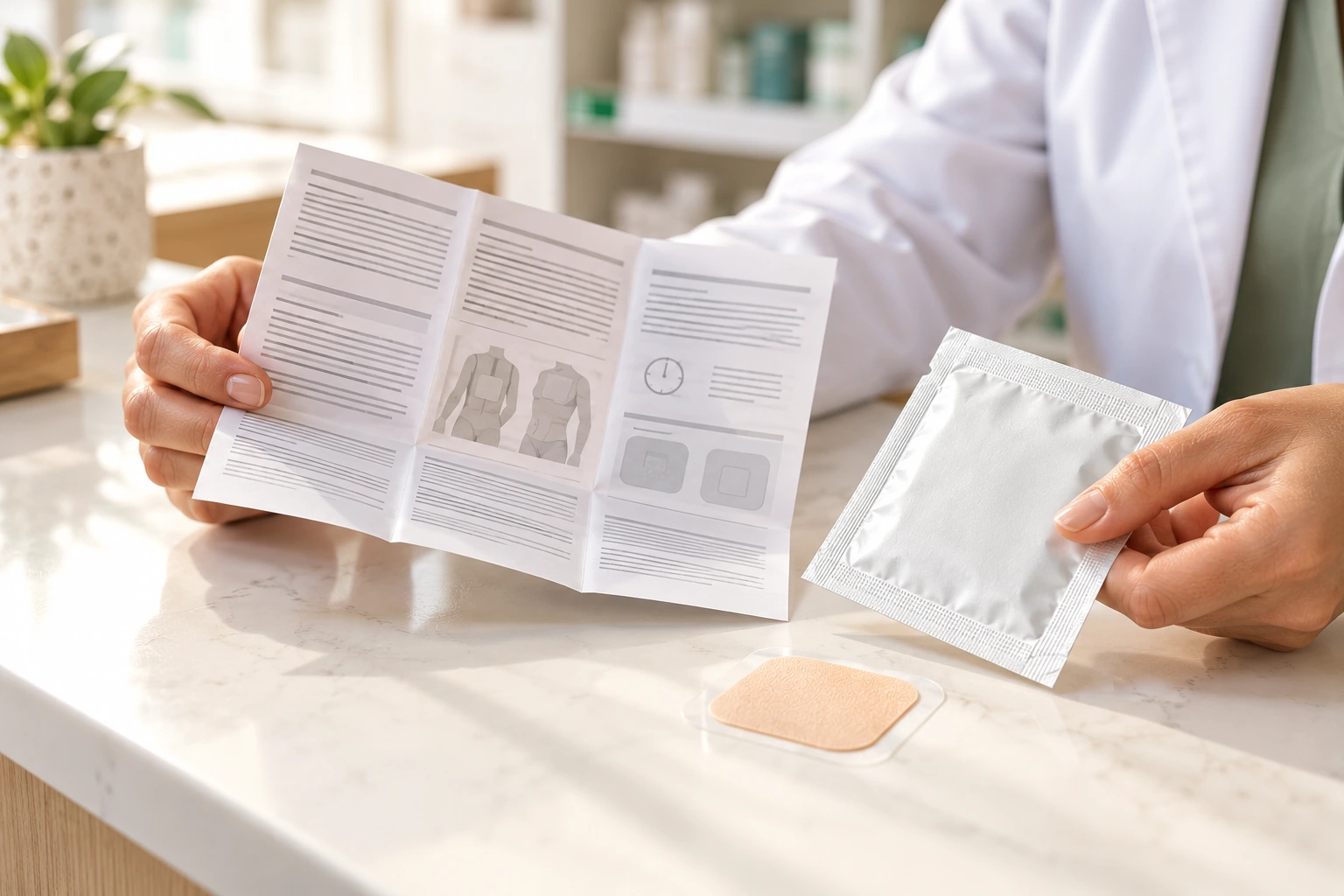
Different estradiol patches have different approved application sites and schedules. Follow the instructions for the exact product prescribed rather than assuming guidance for another patch applies. The prescribing information for your patch is the authority rather than general advice. What is broadly consistent across products:
Patches are applied to clean, dry, intact skin, below the waist on areas such as the lower abdomen or buttock, depending on the product
Application sites are generally rotated rather than reused immediately, to reduce skin irritation
The breasts are not an application site for estradiol patches
Areas that crease substantially when sitting are usually avoided, since movement affects adhesion
What If the Patch Falls Off?
Common enough to be a frequent search, and rarely addressed on clinic pages.
Adhesion is affected by heat, humidity, water, body oils and skin preparation. Guidance on what to do when a patch loosens or detaches is product-specific, and the prescribing information for your patch covers it. If a patch falls off and you are unsure what to do, your prescribing provider or pharmacist can answer that directly rather than leaving you to estimate.
Preventive points that come up consistently across product guidance include applying to skin that is clean and free of lotion or oil, pressing the patch firmly for the specified time after application, and considering placement relative to clothing and activity.
Do You Still Have Periods on HRT Patches?
This depends on the regimen rather than on the patch itself.
Hormone therapy regimens are broadly described as sequential or continuous. Sequential regimens, used more commonly where periods are still occurring, typically produce a predictable withdrawal bleed. Continuous regimens are generally used after menopause is established and are not intended to produce a bleed, though irregular bleeding can occur particularly in the first months.
Unexpected, persistent or heavy bleeding on hormone therapy is a reason to contact your provider rather than to wait. That applies regardless of delivery method and regardless of how long you have been on treatment.
Our guide to perimenopause and menopause covers why the stage affects which regimen is used.
Pellets: The Balanced View
Pellets attract both strong advocacy and strong criticism, and the published picture is more measured than either.
A 2026 review describes subcutaneous estradiol implants as one of the oldest and, in its own words, most controversial routes of hormone replacement, in documented use since the 1940s. The same review notes they bypass first-pass hepatic metabolism and describes them as potentially suiting people with poor transdermal absorption, low adherence to daily regimens, or surgical menopause.
The criticisms are also substantive. Dose cannot be adjusted once implanted, removal is a procedure, insertion carries the risks associated with a minor procedure including site infection, and absorption can vary.
An important distinction is whether a pellet contains estradiol, testosterone or another hormone. Evidence and professional recommendations for one preparation should not automatically be applied to another.
What professional guidance says
ACOG advises against routinely using compounded menopausal hormone preparations when FDA-approved options are available. For testosterone therapy, ACOG recommends preparations other than pellets because of limited safety data and the difficulty of removing an implant.
Many pellet preparations are compounded rather than FDA-approved manufactured products. That distinction is separate from whether pellets work, and it affects what testing and oversight the specific preparation has been subject to. Our guide to what bioidentical means covers that distinction in detail.
What Does Each Option Cost?
Updated October 2026.
Cost depends on the preparation, whether it is an FDA-approved product or a compounded one, whether insurance applies, and what the surrounding care costs. Three components usually make up the total and providers bundle them differently:
The evaluation and any baseline testing before a prescription
The medication or preparation itself, which varies substantially between the three options
Ongoing review and monitoring, plus the insertion procedure where pellets are used
FDA-approved patches and oral preparations are more commonly covered by insurance than compounded preparations, though coverage varies by plan and by specific product. Pellet costs are frequently quoted per insertion, which makes an annual comparison more informative than a single figure.
Our guide to what lab testing costs explains why identical services carry different totals depending on what is included.
Membership or Pay Per Visit?
MEMBERSHIP VERSUS PAY-PER-VISIT COMPARISON, per brief
Hormone care involves evaluation, a period of adjustment and ongoing review, which is why some providers bill it as a recurring arrangement and others per visit. Neither is better in general.
Comparison Factor | Membership | Pay per visit |
Cost pattern | Predictable recurring amount | Variable, tied to what you use |
Suits | Ongoing care with regular review | An initial evaluation, or established care needing little adjustment |
Testing | Often bundled at a set frequency | Ordered and billed as needed |
Commitment | May involve a minimum term | None beyond the visit |
During dose adjustment | Review is already covered | Each adjustment visit is a separate cost |
What THRYVE currently offers
THRYVE Wellness Clinic offers an ongoing membership, a one-time Comprehensive Health Assessment, and a standalone telehealth consultation. These are broader wellness-care arrangements rather than hormone-specific packages, so whether hormone therapy is appropriate still depends on individual clinical assessment.
Option | What it currently includes | Current price |
THRYVE Membership | A 20-minute telemedicine consultation, $100 in diagnostic credits per quarter toward lab tests covered by the membership terms, four 15-minute follow-up consultations per year, at-home blood draws by licensed phlebotomists, and discounts on selected products and add-ons, as described in the current membership terms | $149 to start, then $89 per month, cancellable at any time |
Comprehensive Health Assessment | A 30-minute telemedicine consultation, at-home mobile phlebotomy, $150 in diagnostic credits, and a 15-minute follow-up consultation | $399 one-time, reduced from $429 |
One-Time Telehealth Consultation | A 20-minute consultation with a board-certified medical provider | $69, reduced from $89 |
Pricing shown reflects the membership page as of October 2026. Promotional pricing changes, so confirm the current amount and exactly what is included before enrolling.
HRT in San Antonio
San Antonio has a developed market for hormone care, including dedicated hormone clinics, gynecology practices, integrative medicine providers and telehealth services. Several local providers emphasize pellet therapy specifically, which makes the reversibility question above worth raising directly rather than assuming it will be covered.
Three questions worth asking any provider here:
Which delivery methods do you offer, and which would you suggest for me specifically
Is what you are proposing an FDA-approved product or a compounded preparation
How is the dose adjusted if it turns out not to be right, and how quickly
The third question is the practical form of this article's main point, and the answer differs substantially by method.
In supported San Antonio service areas, at-home blood collection may be available when appropriate for the tests ordered, with consultations and results review delivered through secure telehealth. Availability depends on the test ordered, the collection address and current service coverage.
Frequently Asked Questions
Is an HRT patch better than tablets?
Neither is universally better. Observational evidence indicates a higher risk of venous thromboembolism with oral estrogen than transdermal, with the authors of that analysis describing confidence in it as low, and no corresponding difference was found for myocardial infarction. The route difference matters most for people whose baseline clotting risk is already raised. Which suits an individual depends on medical history, absorption, preference and practical factors, which is what an evaluation establishes.
Which form of HRT is most effective?
Effectiveness depends on the symptoms being addressed, the dose achieved and whether the person uses the treatment consistently. All three delivery methods can deliver estradiol into the bloodstream. Differences between them concern absorption route, steadiness of levels, convenience and how quickly a dose can be changed rather than a simple ranking.
Which is better, HRT patches or pellets?
They suit different situations. Patches allow a dose to be changed at the next patch and stopped by removal. Pellets deliver steadily for months without a daily or weekly routine, and the dose cannot be adjusted once implanted. Published sources describe pellets as potentially suiting people with poor transdermal absorption, low adherence to daily regimens, or surgical menopause. Many pellet preparations are compounded rather than FDA-approved, which is a separate consideration.
Can you buy HRT patches over the counter?
No. Estradiol patches are prescription medications in the United States and require a prescription from a licensed provider, which requires a clinical evaluation.
Final Thoughts
The three delivery methods differ in absorption route, in how steady the levels are, and in convenience. The comparative evidence is clearest on one point: oral estrogen is associated with higher VTE risk than transdermal, from observational data the researchers themselves describe as low confidence.
The difference between the feature tables underweight is reversibility. A pill changes tomorrow, a patch changes at the next application, and a pellet stays for months. That determines what happens when a dose is wrong, which is a routine part of starting rather than an unlikely event.
So the useful question at a consultation is not which is best. It is which suits where you are now, and how quickly the plan can change if it needs to.
THRYVE Wellness Clinic provides provider-guided hormone evaluation in supported San Antonio service areas, with at-home blood collection where available and care delivered through secure telehealth.