

THRYVE Team
Wellness Clinic
Learn how perimenopause differs from menopause, when hormone therapy may be considered, and what San Antonio women should know about HRT.
Perimenopause is the menopausal transition surrounding the final menstrual period, during which hormone levels fluctuate and periods often become irregular. Menopause is confirmed retrospectively after twelve consecutive months without a menstrual period, when there is no other explanation. The distinction matters clinically because hormone therapy regimens may differ by stage. Menopausal hormone therapy is not contraception, so patients who could become pregnant should discuss appropriate contraception and when it can safely be stopped with their clinician.
The two words get used as though they describe the same thing. They describe different stages with a specific boundary between them, and that boundary changes more than terminology.
This covers what separates the two, how hormone replacement therapy for perimenopause differs from therapy after menopause, the safety point most pages omit, and what the process involves for women in San Antonio.

What Is Perimenopause?
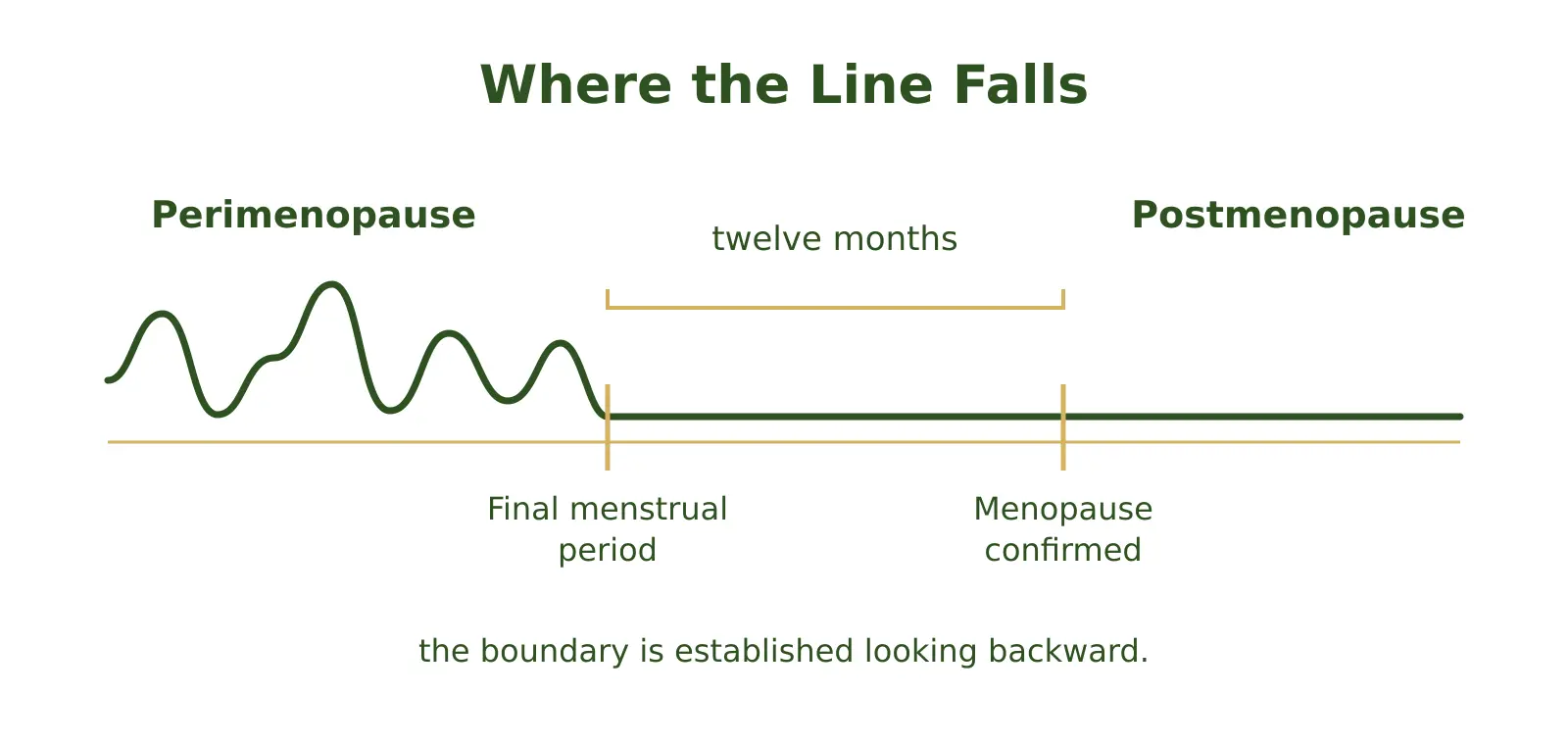
Perimenopause is the menopausal transition surrounding the final menstrual period. During this stage, hormone levels fluctuate and menstrual cycles often become increasingly irregular. Menopause is confirmed retrospectively after twelve consecutive months without a menstrual period, when there is no other explanation for the absence of periods.
Changes in menstrual timing are often among the earliest signs of the transition. Cycles may become shorter, longer, or less predictable, although the pattern varies between individuals.
Duration varies considerably. Clinical sources describe it as lasting anywhere from a few months to around a decade, which is one reason it is difficult to recognize while it is happening.
What Is Menopause?
Menopause is a single point in time, defined retrospectively as twelve consecutive months without a menstrual period, with no other explanation for their absence.
That definition has a practical consequence worth noticing. You cannot know you have reached menopause at the time. It is confirmed only by looking back at a year in which nothing happened, which means the boundary is established after the fact rather than announced.
The period after that point is post menopause. Hormone levels, which fluctuated throughout perimenopause, settle at consistently lower levels and remain there.
The Difference at a Glance
Comparison Terms | Perimenopause | Menopause and after |
What it is | A transitional phase | A point in time, then the period after it |
Periods | Still occurring, increasingly irregular | Absent for twelve consecutive months or more |
Hormone levels | Fluctuating, sometimes substantially | Consistently lower |
How it is identified | By pattern of symptoms and cycle changes | Retrospectively, after twelve months |
Pregnancy possible | Can still occur | Natural pregnancy becomes extremely unlikely after menopause |
Contraception | May still be needed if pregnancy is possible | When contraception can be stopped depends on age and individual circumstances |
Typical therapy pattern | May include sequential regimens | Continuous regimens generally used |
The symptoms themselves are largely the same across both stages. What differs is the hormonal pattern underneath them, which fluctuates during perimenopause and then stays low afterward.
The Safety Point Most Pages Omit
Menopausal hormone therapy is not contraceptive and does not reliably prevent pregnancy. Pregnancy can still occur during perimenopause, including when periods have become irregular or infrequent. Patients who could become pregnant should therefore discuss contraception with their clinician and confirm when it can safely be stopped based on their age and individual circumstances.
This matters because the assumption runs the other way quite naturally. A treatment that involves hormones, prescribed around the end of reproductive life, sounds as though it would cover both. It does not.
Clinical sources are consistent on this. Women may still be having ovulatory cycles during perimenopause and should be counselled about the ongoing need for contraception. Hormone therapy addresses symptoms of fluctuating or declining hormone levels. It does not suppress ovulation the way contraception does.
There is a related distinction worth understanding. Combined hormonal contraception contains substantially higher hormone doses than typical hormone therapy regimens, and in some women, it may be used during perimenopause where pregnancy prevention is also needed. Which approach suits an individual is a clinical judgment involving age, medical history and whether contraception is required.
How Hormone Therapy Differs Between the Stages
The stage a woman is in genuinely changes what is prescribed, not only what it is called.
Sequential regimen
During perimenopause, where periods are still occurring, regimens may be structured so that progestogen is taken for part of the cycle. This commonly results in a withdrawal bleed after the progestogen phase.
Continuous regimen
After menopause, estrogen and progesterone may be taken continuously without a break. Clinical sources describe continuous combined therapy as generally used from about a year after the final period, or after a period of sequential therapy.
Why Progesterone is included at all
For patients with a uterus who use systemic estrogen, a progestogen is generally included to protect the endometrium from the effects of estrogen. This is one reason HRT regimen differ depending on whether someone has had a hysterectomy.
None of which is a decision to make from an article. It is context for the conversation, and knowing which stage you are in is the first thing that conversation establishes.
When Is Hormone Therapy Considered?
Hormone therapy is considered for symptoms, not for the transition itself. Perimenopause is a normal physiological stage rather than a condition requiring treatment, and many women move through it without needing intervention.
Where symptoms are affecting daily life, therapy becomes a conversation worth having. The assessment typically covers:
Which symptoms are present and how much they are affecting you
Where you are in the transition, established through cycle history rather than a single test
Medical and family history, including anything that affects suitability
Whether contraception is still needed
What else could be contributing, since several conditions produce overlapping symptoms
That last point is not a formality. Thyroid conditions, sleep disorders, depression, anemia and medication effects all produce symptoms that overlap with the menopause transition. An assessment that does not consider them is incomplete.
Why Perimenopause Can Be Difficult to Recognize
Several things make the perimenopausal phase harder to recognize than menopause, and none of them involve anyone being inattentive.
It starts earlier than many people expect
Clinical sources describe the transition beginning in the forties for many women, and for some considerably earlier. Someone in their early forties experiencing sleep disruption and mood changes may reasonably attribute them to work, parenting or ordinary stress, because perimenopause is not the first explanation that comes to mind at that age.
The symptoms arrive separately rather than together
Hot flashes are the symptom most associated with the transition, and they are frequently not the first to appear. Sleep disruption, mood changes or cycle irregularity can precede them by a considerable period, and each of those on its own has several other possible explanations.
Periods continue, which seems to rule it out
Menstruation continuing is sometimes taken as evidence that the transition has not begun. The opposite is closer to accurate, since irregular periods are a defining feature of perimenopause rather than an argument against it.
A normal test result closes the conversation
This one follows directly from the fluctuation described above. A hormone result within the expected range, taken during a phase where levels vary, can be read as settling the question when it has only described a moment.
Nobody raises it
A short appointment covering several concerns does not always reach the question of where someone is in the menopausal transition, particularly where the presenting complaint is sleep or mood rather than cycle changes. Mentioning a menstrual pattern directly can change the direction of that conversation.
What an Evaluation Considers
Whether the question is perimenopause or menopause, the assessment covers similar ground with different emphasis.
Symptoms, their severity and how long they have been present
Menstrual history and pattern, which carries particular weight during the transition
Age and medical history, including conditions that affect suitability for therapy
Other possible explanations for the same symptoms, including thyroid conditions and sleep disorders
Whether contraception is still relevant, since pregnancy remains possible during perimenopause
Testing where it adds information, interpreted in the context of the stage
The second item is the one most often underweighted. Menstrual pattern is among the clearer indicators of where someone is in the transition, and establishing it requires a conversation rather than a blood draw.
Can a Blood Test Tell You Which Stage You Are In?
Not reliably on its own, and this is a common source of frustration.
Because hormone levels fluctuate substantially during perimenopause, a single measurement captures one moment rather than the underlying pattern. A result can look unremarkable in someone who is clearly in transition, and the reverse is also possible.
Clinical sources describe the diagnosis as made primarily on cycle history and symptoms rather than on laboratory values. Testing has a role, particularly in specific circumstances such as establishing whether contraception can be stopped. For many patients, menstrual history, symptoms, age, and clinical context provide more useful information than a single hormone measurement.
Our guide to hormone panels for women covers what testing can and cannot establish in more detail.

Hormone Therapy for Perimenopause in San Antonio
Women looking for HRT San Antonio TX options will find gynecology practices, dedicated hormone clinics, integrative medicine providers and telehealth services, with approaches varying considerably between them.
Brand entity statement
THRYVE Wellness Clinic is a provider-led telehealth practice serving eligible patients across Texas, including San Antonio, as well as South Carolina and North Carolina. Care is delivered through telehealth consultation with licensed providers, with at-home blood collection by licensed phlebotomists available for all people in supported service areas.
Service areas
Depending on current coverage, at-home collections may be available across San Antonio and surrounding communities including Stone Oak, Alamo Heights, Shavano Park, Schertz and Cibolo. Because mobile collection coverage is address-specific rather than citywide, confirm availability for your location before arranging anything.
What this changes practically
Perimenopause care often involves review over time rather than a single appointment, because the transition itself changes. Where consultation happens by telehealth and collection happens at home, that ongoing contact does not require repeated travel, which matters more for care that continues than for care that concludes.
The clinical work is unchanged. A provider still evaluates, still orders appropriate testing, and still reviews. What changes is where the appointments happen.
Questions worth asking any provider here
How do you establish which stage I am in, and what does that rest on
If I still need contraception, how is that handled alongside any therapy
What else will you consider before concluding this is the menopause transition
How often is treatment reviewed once started
Will you work alongside my existing gynecologist or primary care provider
The second question is the one worth noting. A provider who raises contraception before you do is demonstrating something useful about how thoroughly they work.
What Perimenopause Treatment Involves
Perimenopause treatment is not a single thing, and hormone therapy is one option among several discussed during evaluation.
Hormone therapy
Hormone therapy may be considered for bothersome symptoms during perimenopause when it is clinically appropriate. The preparation, route, regimen, potential benefits, and risks depend on the individual's symptoms, medical history, menstrual pattern, and whether contraception is still needed.
Non-hormonal prescription options
Several non-hormonal prescription treatments are used for vasomotor symptoms. They are relevant where hormone therapy is unsuitable or unwanted and are part of the same conversation rather than a fallback.
Addressing other contributors
Perimenopause symptoms and treatment considerations can overlap with those of other conditions. Where sleep disruption, thyroid function or mood are contributing, treating those directly may matter as much as addressing hormones. This is why evaluation considers other explanations rather than assuming the transition accounts for everything.
Contraception during the transition
Pregnancy remains possible during perimenopause, and some hormonal contraceptives also help with cycle-related symptoms. That overlap makes it a practical part of the discussion rather than a separate topic.
Frequently Asked Questions
What is the difference between perimenopause and menopause?
Perimenopause is the menopausal transition surrounding the final menstrual period, with fluctuating hormones and often irregular cycles. Menopause is confirmed retrospectively after twelve consecutive months without a menstrual period. Symptoms are largely similar across both; the hormonal pattern underneath differs.
Does HRT work as contraception?
No. Menopausal hormone therapy is not contraception, and pregnancy can still occur during perimenopause, including when periods are irregular. If pregnancy is possible, discuss appropriate contraception with your clinician and ask when it can safely be stopped based on your age and individual circumstances.
Can a blood test confirm perimenopause?
Not reliably on its own. Hormone levels fluctuate substantially during perimenopause, so a single measurement may not reflect the underlying pattern. Diagnosis rests primarily on cycle history and symptoms, with testing playing a role in specific circumstances.
How long does perimenopause last?
It varies considerably. Clinical sources describe a range from a few months to around a decade. It ends twelve months after the final menstrual period, at which point menopause is confirmed retrospectively.
Final Thoughts
Perimenopause is a transition with fluctuating hormones and irregular cycles. Menopause is the point twelve months after the last period. The symptoms overlap substantially, which is why the two words get used interchangeably.
The stage still matters. It can influence the type of hormone therapy regimen considered and whether contraception remains necessary. Menopausal hormone therapy itself does not provide contraception, so that question needs to be addressed separately.
What it does not determine is whether therapy is right for you. That depends on your symptoms, your history and an assessment that considers what else might be contributing.
THRYVE Wellness Clinic provides provider-led hormone evaluation for patients in supported San Antonio service areas, with telehealth care and at-home blood collection. If you are not sure which stage you are at,- that is a reasonable place to start the conversation.