

THRYVE Team
Wellness Clinic
Learn what a hormone panel for women may include, when testing should be done, how timing affects results, and why the right tests depend on your symptoms, age, cycle, medications, and clinical goals.
A hormone panel for women measures a selection of hormones relevant to a specific clinical question rather than a single fixed list. Which markers are included, and when the sample is collected, depend on age, symptoms, menstrual cycle stage, medications, and what the testing is meant to answer. Laboratory results support a clinical assessment rather than producing a diagnosis on their own.
Most people arrive at a hormone panel for women with a reasonable question and no clear idea what to ask for. There is no universal panel that suits everyone. Someone in her late twenties investigating irregular cycles and someone in her early fifties asking about menopausal symptoms need different markers measured at different times, and testing that ignores that distinction tends to produce numbers that are difficult to act on.
A hormone panel for women may include estradiol, progesterone, FSH, LH, testosterone, DHEA-S, SHBG, prolactin, and thyroid-related tests. The appropriate combination depends on symptoms, age, menstrual status, medications, and the reason for testing.
This guide covers which markers appear on most panels and why, how providers decide what to include, when timing matters, how to prepare, and how to read results without drawing conclusions that are not there.

What Does a Hormone Panel Measure?
A hormone panel measures circulating levels of selected hormones at the moment the sample was collected. That last part matters more than it sounds, because several hormones vary by time of day and by point in the menstrual cycle.
Panels differ considerably in scope. A targeted panel might include two or three markers chosen around a specific question. What gets described as a full hormone panel, a complete hormone panel, or a comprehensive hormone panel generally means a broader selection, though these are marketing descriptions rather than standardized categories. No regulatory definition governs what any of them must contain, so two services offering a full hormone panel for women may include quite different markers.
Worth stating clearly: hormone testing does not diagnose a condition on its own. Results are interpreted alongside symptoms, history, examination findings, and sometimes repeat testing. A number outside a reference range raises a question rather than answering one.
Core Female Hormone Tests: What They Measure and When They May Be Useful
These markers appear most often on a hormonal panel. The third column is the one most often overlooked, and it is usually why two people with similar numbers receive different guidance.
Marker | What It Measures | Why It May Be Considered | Important Context |
Estradiol | The primary form of estrogen in reproductive years | Questions involving cycle changes or menopausal transition symptoms | Varies across the cycle and can fluctuate considerably during perimenopause |
Progesterone | A hormone produced mainly after ovulation | Questions involving ovulation or cycle regularity | Highly cycle-dependent. Timing relative to ovulation changes what the result means |
FSH | Follicle-stimulating hormone, involved in ovarian signaling | Questions involving ovarian function or menopausal status | Cycle stage matters. Often considered alongside estradiol rather than alone |
LH | Luteinizing hormone, involved in ovulation | Questions involving ovulation or cycle patterns | Cycle stage and time of collection both affect the result |
Total and free testosterone | Androgen levels, relevant in women as well as men | Questions involving androgen-related concerns | Levels can vary by time of day. Free and total measure different things |
DHEA-S | An adrenal androgen precursor | Considered alongside other androgens where relevant | Declines with age, so age-appropriate context matters |
SHBG | Sex hormone binding globulin, affects hormone availability | Helps interpret total hormone levels | Influenced by thyroid status, liver function, and some medications including oral contraceptives |
Prolactin | A pituitary hormone | Questions involving cycle irregularity in some contexts | Can be affected by stress, recent exercise, sleep, and some medications |
TSH and thyroid markers | Thyroid function | Thyroid conditions can produce symptoms that overlap with hormonal ones | Frequently included for that reason rather than as a hormone panel marker as such |
Not every panel includes all of these, and a longer list is not automatically a better one. Markers ordered without a clinical question attached tend to produce findings that require explanation more than they produce answers.
How Providers Decide Which Hormones to Test
Marker selection follows from the clinical question rather than from a standard list. Understanding roughly how that reasoning works makes it easier to have a useful conversation about what to test.
A few common clinical questions and the testing considerations that tend to follow:
Clinical Question | Testing Considerations |
Cycle changes or irregularity | Markers relating to ovarian function and ovulation, with attention to where in the cycle the sample is collected |
Menopausal transition symptoms | Markers relating to ovarian function, interpreted alongside menstrual history rather than on their own |
Fertility evaluation | Typically part of a broader assessment rather than a standalone panel |
Symptoms that may overlap with thyroid conditions | Thyroid markers, often before or alongside reproductive hormones |
Androgen-related concerns | Androgen markers, with attention to collection timing |
Monitoring during treatment | Markers relevant to what is being monitored, on a schedule set by the provider |
This is deliberately framed as a clinical question leading to testing considerations rather than symptoms leading to specific tests. The distinction matters: a symptom does not map neatly onto a marker, and treating it as though it does is how people end up ordering panels that cannot answer what they are asking.
When Is the Best Time to Test for Hormone Imbalance?
When is the best time to test for hormone imbalance is one of the more common questions on this topic, and the honest answer is that there is no single day that is universally best. Appropriate timing depends on which hormone is being measured and why the test was ordered, and getting this wrong is one of the more common reasons a result turns out to be difficult to interpret.
Menstrual cycle timing
For someone with regular cycles, several markers are conventionally measured at particular points. Progesterone is typically assessed in the second half of the cycle, when it would be expected to rise after ovulation. FSH and estradiol are often measured in the early part of the cycle. Your provider will specify the day based on the panel and your cycle length.
Time of day
Some hormones follow a daily rhythm. Testosterone and cortisol are commonly collected in the morning for that reason. A result without a recorded collection time is harder to interpret than one with it.
Irregular or absent cycles
When cycles are irregular, unpredictable, or have stopped, conventional cycle-day timing may not apply. Testing is then generally planned around the clinical question instead, which is one reason perimenopause testing often follows different logic than testing during regular cycles.
Perimenopause and menopause
During the transition, hormone levels can fluctuate considerably from one day to the next. A single measurement may capture a high or low point depending on when it was taken, which is one reason blood work for menopause is generally interpreted alongside symptoms and menstrual history rather than on its own.
Birth control and hormone medications
Hormonal contraception, hormone therapy, and certain other medications can affect hormone measurements. Do not stop or adjust any medication in order to test. Tell your provider what you are taking so the panel and timing can be planned around it.
How to Prepare for a Hormone Blood Test
Preparation is where a good panel most often goes wrong, and almost all of it is within your control.
Follow the specific preparation instructions provided for your test. Some tests require fasting and others do not, and the requirement depends on the panel rather than on a general rule
Tell your provider about all medications and supplements, including anything taken occasionally rather than daily
Do not stop or adjust hormone medications in order to test. This includes hormonal contraception and hormone therapy. Any change should be a clinical decision, not a preparation step
Note your cycle day if you are still menstruating, and record it alongside the result
Record the collection time, particularly for markers that vary through the day
Mention recent illness, unusually intense exercise, or significant sleep disruption, since these can affect some results
Write down the cycle day and collection time even if nobody asks for them. They cost nothing to record and they are frequently the missing pieces that make a result difficult to interpret later.
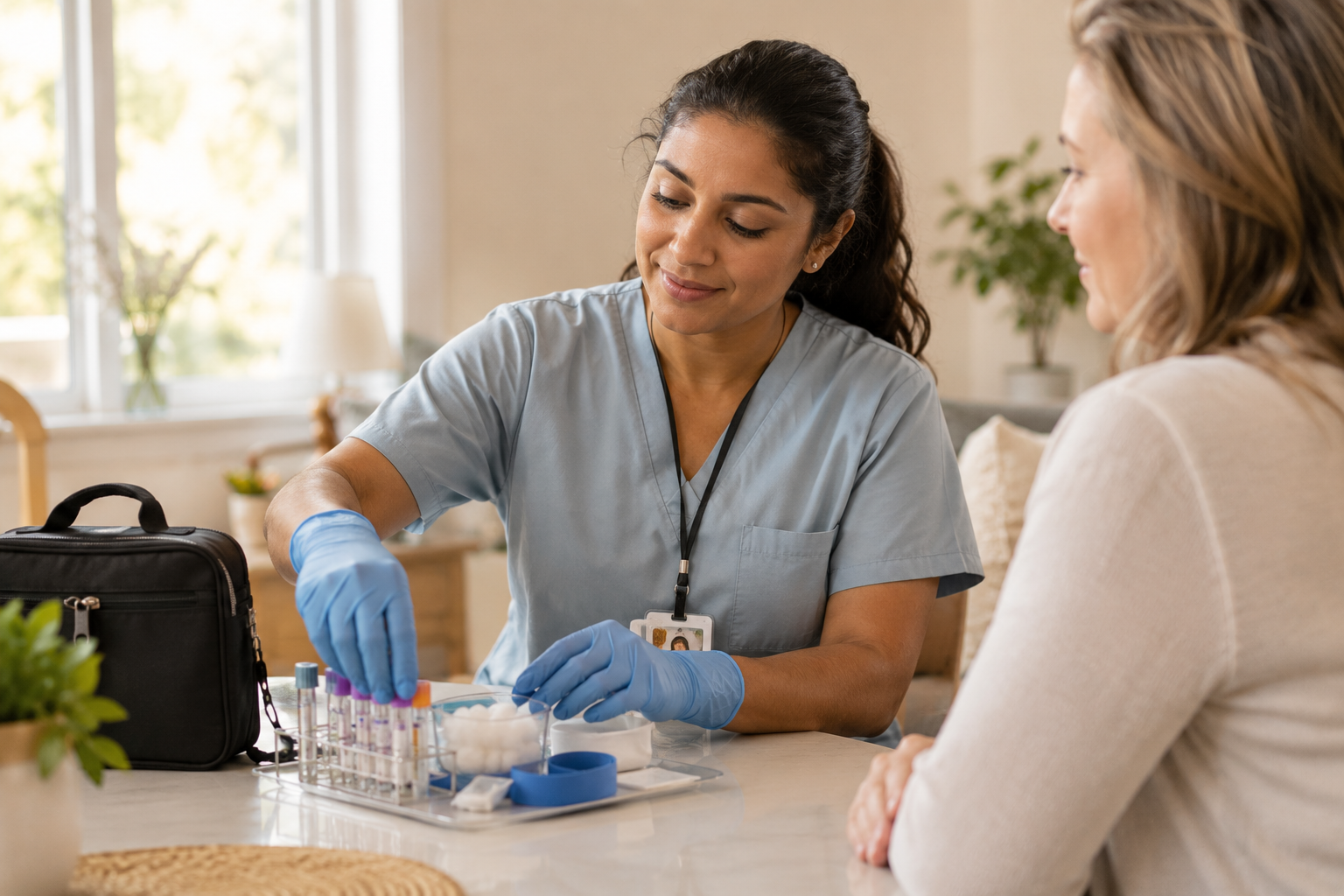
At-Home Hormone Testing vs. In-Clinic Blood Draws
The phrase at home hormone test covers several different arrangements, and the differences matter for both accuracy and which markers can be measured. Three distinct things often get grouped under the same label:
Arrangement | Who Collects the Sample | Where Analysis Happens |
At-home professional collection | A trained phlebotomist travels to you | Accredited laboratory |
At-home self-collection | You collect the sample yourself using a supplied kit | Accredited laboratory |
In-clinic draw | A phlebotomist at a patient service center or clinic | Accredited laboratory |
In all three cases the analysis is performed by a laboratory, not in your home. A hormone kit test that arrives in the post is a collection device rather than a testing device, and no arrangement means the test itself happens at your kitchen table.
The practical differences come down to sample type and volume. Professional collection and in-clinic draws both obtain venous blood, which supports the widest range of markers. Self-collection typically obtains a smaller capillary sample, which works well for some analytes and less well for others. At home estrogen test using self-collection is not automatically equivalent to a venous estrogen blood test, and which is appropriate depends on the marker and the clinical question.
Our guide to direct to consumer lab testing covers collection methods, laboratory standards, and costs in more depth than fits here.
How to Choose Hormone Testing Near You
Searches for hormone testing near me usually reflect a practical constraint rather than a clinical preference: someone wants testing without a long drive or a long wait. Proximity is a reasonable filter, but it is rarely the most useful one. These questions matter more:
Question | Why It Matters |
Who selects the markers? | A panel chosen around your clinical question tends to produce more usable results than one selected from a menu |
Is provider interpretation included? | A result without a clinical conversation leaves you with numbers rather than answers |
What collection method is used? | Sample type partly determines which markers can be reliably measured |
Where is the sample analyzed? | Analysis should be performed by an accredited laboratory in every case |
Will you be told when to collect? | Timing affects several markers, and guidance on it is frequently omitted |
What happens after an abnormal result? | A flagged value is a common outcome. Knowing the pathway in advance is worth more than it sounds |
Is telehealth or at-home collection available where you are? | This often removes the proximity constraint entirely |
That last point matters most for anyone in a rural area or without easy transport. Distance to a facility becomes far less relevant when the collection comes to you.
When Should Women Consider Hormone Testing?
Testing is generally considered when there is a specific question it can help answer. Common situations include:
Menstrual changes that are new, persistent, or unusual for you
Symptoms associated with the menopausal transition, particularly when they begin earlier than expected
Fertility evaluation, where testing is typically part of a broader assessment
Unexplained symptoms where a clinician considers hormonal factors worth investigating
Monitoring during certain treatments, where testing tracks response over time
Not every symptom calls for hormone testing. Testing in the absence of a clinical question is one of the more common ways people end up with results that create uncertainty rather than resolving it, and a clinician deciding not to order a panel is making a clinical judgment rather than dismissing a symptom.
Why Hormone Test Results Need Clinical Context
A hormone result is a measurement, not a conclusion. What turns it into useful information is everything sitting around it.
Context | What It Changes |
Symptoms | Which markers are relevant, and whether a value fits or contradicts the picture |
Menstrual status | Whether cycle-dependent markers can be interpreted at all, and against what expectation |
Age | What is expected for the stage someone is at |
Medications and supplements | Whether a value reflects physiology, a medication effect, or both |
Collection timing | Whether the number represents a typical level or a high or low point |
Previous results | Whether this represents a change, and under what conditions the comparison was made |
Within a functional and integrative medicine approach, these factors are considered together rather than sequentially, and testing sits inside that process rather than preceding it. This is intended to work alongside appropriate conventional medical care rather than in place of it.

Reading Your Results Without Self-Diagnosing
Getting hormone levels tested is the straightforward part. Interpreting them is where most of the difficulty lives.
Reference ranges describe populations, not individuals
Reference ranges are developed from data collected from defined populations and can vary by laboratory, testing method, and patient characteristics. Always use the range printed on your own report rather than comparing your result to a range found elsewhere online.
Normal does not always answer the question
A result can sit within the reference range and still represent a change from your own previous results that may warrant interpretation in the context of symptoms, timing, and other clinical information. It can also sit slightly outside the range and be unremarkable in context. Neither situation is resolved by the flag on the report.
Context changes what a number means
Cycle day, time of collection, recent illness, medications, supplements, and stress can all influence results. This is why the same value can lead to different conclusions for two different people, and why a provider will ask questions that seem unrelated to the number itself.
Do not change medication or supplements based on a result alone
This applies particularly to anything hormonal. Adjusting a dose, stopping a medication, or starting a supplement based on a laboratory value without clinical guidance can create problems the original result did not indicate.
When to discuss results with a provider
Any result you do not understand, any flagged value, and any result that conflicts with how you feel are all reasons to have the conversation rather than reach a conclusion independently.
When Does Repeat Hormone Testing Make Sense?
The previous section covered what a single result means. This one covers a different question: when comparing several results is it worth doing at all.
A single panel is a snapshot. Interest in hormone tracking women can use to follow patterns over months has grown alongside at-home collection becoming more available, and the logic is sound in principle. There are conditions attached, though, and they matter.
Comparisons need consistent conditions
Results are most comparable when tests were performed under similar conditions and, where possible, by the same laboratory. Different laboratories may use different methods, different units, and different reference ranges for the same marker, which can make a side-by-side comparison misleading even when the trend appears obvious.
Cycle timing has to be consistent too
Comparing a progesterone result from one point in the cycle against a result from a different point measures the cycle as much as it measures any change over time. For cycle-dependent markers, consistent timing is what makes the comparison meaningful.
More frequent is not automatically better
Retesting without a reason to expect change tends to produce variation rather than information. Normal biological fluctuation, small differences in collection conditions, and ordinary laboratory variation can all move a number slightly.
How often to retest, if at all, depends on the clinical question and is a decision worth making with a provider rather than on a fixed schedule.
Frequently Asked Questions
What is included in a hormone panel for women?
It depends on the clinical question. Panels commonly include estradiol, progesterone, FSH, LH, testosterone, DHEA-S, SHBG, prolactin, and thyroid markers, though few include all of them. The selection should follow from what the testing is meant to answer.
Do you need to fast before a hormone blood test?
It depends on the panel. Some tests require fasting and others do not, and requirements can also vary by laboratory. Follow the specific preparation instructions provided for your test rather than assuming one rule applies to all of them.
Does birth control affect hormone test results?
Hormonal contraception can affect hormone measurements. Do not stop taking it in order to test. Tell your provider what you are taking so the panel and its interpretation can account for it.
What is the best time to test female hormones?
It varies by marker. Progesterone is typically measured in the second half of the cycle. FSH and estradiol are often measured early in the cycle. Testosterone and cortisol are commonly collected in the morning. Your provider will specify timing based on the panel.
Can you get a hormone test at home?
Yes, through either professional at-home collection, where a phlebotomist comes to you, or a self-collection kit you use yourself. In both cases the sample is analyzed by a laboratory rather than at home.
How accurate are at-home hormone tests?
Analysis is performed by accredited laboratories in both cases. Test reliability can depend on the analyte, specimen type, collection method, sample handling, timing, and laboratory method. Self-collected capillary samples are well suited to some markers and less suited to others.
What blood work is done for menopause?
Testing may include FSH, estradiol, and thyroid markers, though assessment during the transition often relies more on symptoms and menstrual history than on laboratory values, since hormone levels can fluctuate considerably during this period.
Can hormone tests diagnose a hormonal imbalance?
Not on their own. A hormonal imbalance test result is one input into a clinical assessment that also considers symptoms, history, and examination. Testing supports a diagnosis rather than producing one.
Final Thoughts
The question worth asking is not which panel is the most comprehensive. It is which markers answer the question you actually have, and when they should be measured to give a usable answer.
A targeted panel collected at the appropriate time may be more useful than a much larger panel ordered without a clear clinical question or appropriate timing. Testing that is not anchored to a question tends to generate findings that need explaining rather than information you can act on.
If you are considering testing for hormonal imbalance, the useful first step is a conversation that establishes what you are trying to find out. The panel follows from that, not the other way around.
Testing Chosen Around Your Question, Not a Menu
THRYVE Wellness Medical builds provider-ordered panels around your symptoms and goals, offers at-home blood draws by licensed phlebotomists, and reviews every result with a board-certified provider by telehealth visit. Available to patients in Texas, South Carolina, and North Carolina.
Book your hormone panel with THRYVE
This article is for educational purposes and is not medical advice. Individual results vary. Always consult a licensed healthcare provider before starting, stopping, or changing any treatment or testing plan.