

THRYVE Team
Wellness Clinic
Is HRT safe for menopause? Explore the FDA's 2026 labeling changes, remaining risks, and what San Antonio patients should know.
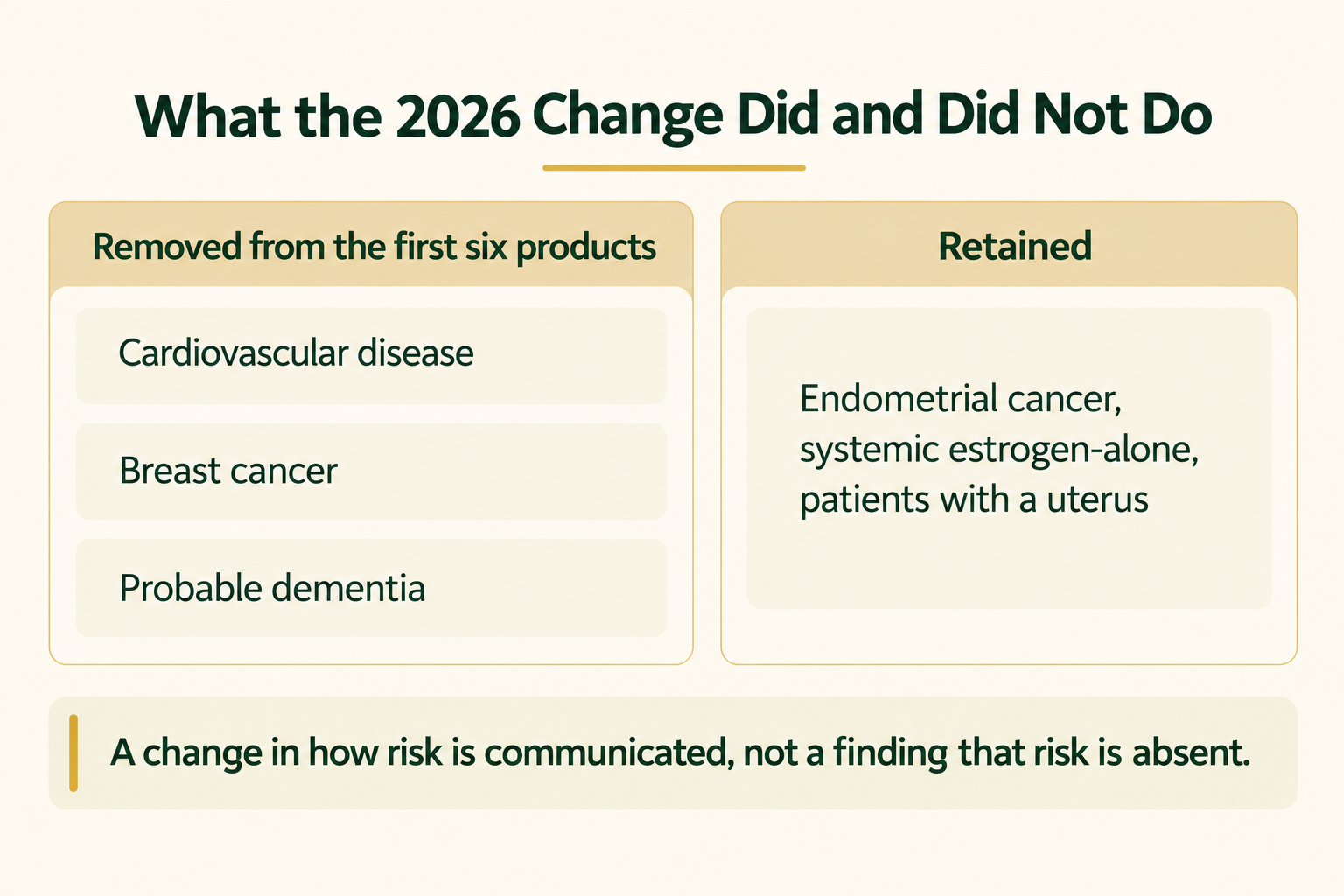
In February 2026 the FDA removed boxed warnings about cardiovascular disease, breast cancer and probable dementia from the first six menopause hormone therapy products. A boxed warning about endometrial cancer was retained for systemic estrogen-alone products in patients with a uterus. Whether hormone therapy is appropriate depends on individual age, time since menopause, medical history and symptoms.
For anyone weighing hormone replacement therapy for menopause, that labeling change is the most significant development in more than twenty years, and it is recent enough that much of what you will find online was written before it happened.
Hormone replacement therapy for menopause is also being reported in two directions at once: as proof the therapy was always safe, and as a regulatory decision that changes nothing clinically. Neither is quite right, and the difference matters if you are weighing this up.

What Changed in February 2026
On 12 February 2026, the FDA approved new labeling for the first six menopause hormone therapy products, removing boxed-warning statements about cardiovascular disease, breast cancer and probable dementia. The decision followed an announcement from HHS and the FDA on 10 November 2025 and a scientific review that included an expert panel convened in July 2025.
A boxed warning is the FDA's most prominent safety alert, and these particular warnings had been attached to menopause hormone therapy products since 2003.
Further products are still moving through the labeling review process, so not every product carried the updated labeling at the time of writing.
What Did Not Change
The removal of these boxed warnings does not mean the risks have disappeared. The FDA retained the endometrial cancer boxed warning for systemic estrogen-alone products and kept cardiovascular disease and breast cancer risk information elsewhere in the labeling for systemic therapies.
Two further points are worth holding onto.
A labeling change reflects how risk information is communicated. It does not alter an individual's own medical history, which is what determines whether a therapy is appropriate for them
The Menopause Society, which endorsed the change, also noted that systemic estrogen still carries potential risks in certain individuals that should be reviewed in detail before starting therapy
So the accurate reading is narrower than either headline. The regulatory position on how risks are presented has changed. The clinical work of deciding whether it suits a particular person has not.
Why the Warnings Were There
Briefly, because history explains the strength of the reaction in both directions.
The boxed warnings were introduced in 2003, following a large federally funded study whose initial findings suggested increased risks of breast cancer, stroke and heart disease. Subsequent analysis of that data, along with later research, led to a more nuanced understanding of how those risks vary by age and by how long after menopause therapy is started.
The FDA described its 2025 and 2026 action as reflecting that reassessment. The Menopause Society's medical director has described the boxed warning as having acted as a deterrent to the use of all hormone therapy, including formulations where the evidence was different.
What Safety Actually Depends On
This is the part the labeling change does not answer for any individual, and it is the part a consultation exists to work through.
If you are still deciding whether treatment is worth discussing, understanding the signs you may need hormone replacement therapy How do you determine whether laboratory testing can help you prepare questions for your provider.
The Menopause Society's position is that risks are low for younger, healthy women initiating hormone therapy closer to the menopause transition, and greater when therapy is initiated in older women or those further from menopause onset.
Factor | Why it matters |
Age at initiation | A recognized factor in how risk and benefit are assessed |
Time since menopause began | Related to age at initiation and considered alongside it |
Personal medical history | Including cardiovascular history, clotting history and hormone-sensitive conditions |
Family history | Reviewed as part of the overall assessment |
Which formulation | Systemic and low-dose vaginal preparations are not equivalent, and the FDA treated them differently |
Symptoms and goals | What the therapy is intended to address |
Note the formulation row particularly. The FDA and The Menopause Society both singled out low-dose vaginal estrogen as the clearest case for the labeling change, because the amount absorbed into the bloodstream is minimal compared with systemic therapy.
Who It May Not Be Appropriate For
Hormone therapy is not suitable for everyone, and the labeling change did not alter that.
Conditions and histories commonly reviewed before starting therapy include a history of certain cancers, cardiovascular events, blood clots, liver disease, and unexplained vaginal bleeding. Whether any of these rules out therapy, or changes which formulation is considered, is a clinical judgment rather than a checklist.
This is not a list to assess yourself against. It describes the kind of history a clinician reviews, and the presence of an item on it does not automatically mean therapy is unsuitable, any more than its absence means therapy is indicated.

Hormone Replacement Therapy in San Antonio
If you are considering hormone replacement therapy for menopause in San Antonio, you may encounter several types of providers, including gynecology practices and clinics focused on hormone care. Beyond comparing treatment options, it is worth understanding how each practice evaluates your medical history, discusses potential risks, and plans ongoing follow-up.
Three questions are worth asking any hormone therapy provider in San Antonio, and they can help you understand how the practice approaches treatment decisions:
How do you determine whether laboratory testing is needed before considering hormone therapy?
How often is therapy reviewed once started, and what triggers a reassessment
Whether the practice can work alongside your existing gynecologist or primary care provider
When testing is clinically appropriate, understanding what a hormone panel for women may measure can help you prepare for a discussion with your provider.
When laboratory testing is clinically appropriate, at-home blood collection may be available in supported service areas, with results reviewed through telehealth. Not every menopause hormone therapy evaluation requires routine hormone-level testing.
How THRYVE Approaches Hormone Therapy in San Antonio
Stage | What happens |
Evaluation | Symptoms, history and goals discussed with a provider by telehealth |
Testing when appropriate | A provider determines whether laboratory testing is needed based on the individual evaluation. When indicated, at-home collection may be available in supported service areas. |
Review | Results discussed with a provider in the context of your history rather than returned as a report |
Decision | Whether hormone therapy is appropriate, and if so which approach, decided together |
Ongoing review | Therapy reassessed over time rather than set once |
Frequently Asked Questions
Did the FDA say hormone replacement therapy is safe?
No. The FDA removed specific boxed warnings about cardiovascular disease, breast cancer and probable dementia from the first six menopause hormone therapy products in February 2026, and described the change as reflecting a more nuanced communication of risk. A boxed warning about endometrial cancer was retained for systemic estrogen-alone products in patients with a uterus. Removing a warning is a change in how risk is communicated rather than a finding that a therapy carries no risk for anyone.
Is hrt for menopause safe for everyone?
No therapy is appropriate for everyone. The Menopause Society describes risks as low for younger, healthy women starting closer to the menopause transition, and greater when therapy is started in older women or those further from menopause onset. Personal and family medical history, which formulation is used, and individual symptoms all form part of the assessment, which is why it is made with a clinician rather than from general information.
What should I ask a hormone replacement therapy provider in San Antonio?
Ask how baseline testing is decided, how often therapy is reviewed once started, and whether the practice will work alongside your existing providers. Those three questions reveal more about how a practice operates than a list of treatments does. When laboratory testing is appropriate, at-home blood collection may be available, and telehealth can support provider consultations and result reviews. Ask the practice which parts of your care require an in-person visit.
Final Thoughts
The February 2026 labeling change is real and significant. Boxed warnings that had been attached to menopause hormone therapy products since 2003 were removed from the first six products, on the basis of a reassessment of the underlying evidence.
The endometrial cancer boxed warning remains for systemic estrogen-alone products, and labeling changes for additional products have been under review. The Menopause Society's published hormone therapy position statement dates to 2022, while its November 2025 response separately addressed the FDA's proposed changes. The regulatory updates do not replace an individualized discussion of benefits and risks.
Which leaves the practical question where it has always been. Not whether hormone therapy is safe in general, but whether it is appropriate for you, given your age, your history and what you are trying to address. That assessment has not been changed by a label.
Hormone Care in San Antonio, With the Assessment Included
THRYVE Wellness Medical provides provider-led hormone evaluation for eligible patients in supported San Antonio service areas, with at-home blood collection and care delivered through telehealth.
Explore Hormone Replacement Therapy in San Antonio
Medical Disclaimer: This article is for general educational purposes and is not a substitute for individualized medical advice, diagnosis, or treatment. Hormone replacement therapy is a prescription treatment requiring clinical evaluation. Do not start, stop or change any treatment based on general information.