

THRYVE Team
Wellness Clinic
Learn what BHRT means, how FDA-approved and compounded bioidentical hormones differ, and what San Antonio patients should ask a provider.
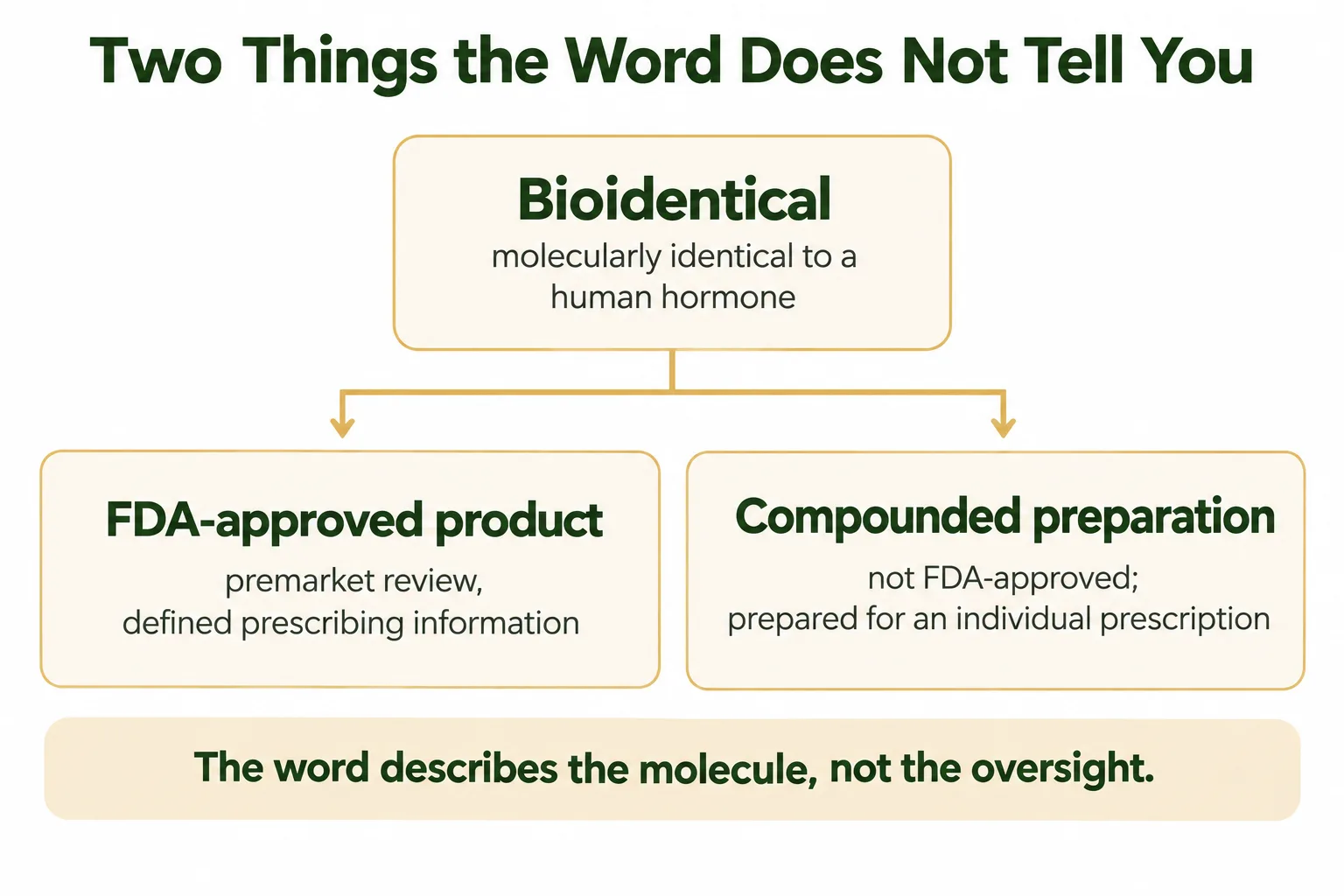
Bioidentical hormone replacement therapy uses hormones that are molecularly identical to those the body produces. The term describes molecular structure rather than regulatory status: some bioidentical hormones are FDA-approved products such as micronized progesterone and estradiol, while others are custom-compounded preparations that are not FDA-approved and do not undergo the same premarket review as FDA-approved drugs. Professional bodies including ACOG recommend FDA-approved formulations where they exist.
Most explanations of bioidentical hrt describe it as a natural alternative to conventional hormone therapy. That framing skips the distinction that actually matters.
For patients considering bioidentical hormone replacement therapy in San Antonio, this guide explains what the term means, how the two categories differ, what professional guidance says, and what an evaluation may involve.

What Does Bioidentical Mean?
A bioidentical hormone has a molecular structure identical to a hormone the human body produces. That is the whole definition.
It is a description of chemistry, not of sourcing, manufacturing or regulation. A bioidentical hormone can be produced by a pharmaceutical company, tested, and approved by the FDA. It can also be mixed by a compounding pharmacy to an individual prescription. Both are bioidentical.
Which is why the term on its own tells you less than it appears to. It describes the molecule and says nothing about the oversight behind the product containing it.
The Distinction That Matters
There are two categories of bioidentical hormone, and they differ substantially in how they are regulated.
Comparison Points | FDA-approved bioidentical | Compounded bioidentical (cBHT) |
What it is | Manufactured products approved by the FDA, including micronized progesterone and estradiol | Preparations mixed by a compounding pharmacy to an individual prescription |
FDA approval and premarket review | Yes | No. Compounded preparations do not undergo FDA premarket approval |
Testing for safety, efficacy and quality | Subject to FDA requirements | Not subject to the same testing requirements |
Dosage | Standardized strengths | Can be customized to an individual prescription |
Professional guidance | Recommended where an appropriate formulation exists | Recommended for limited circumstances rather than routine use |
Both are genuinely bioidentical. The difference is not the molecule. It is whether the product containing it has been through FDA review.
What Professional Guidance Says
Three major professional and scientific organizations have published guidance that generally favors FDA-approved hormone products when an appropriate option is available.
The National Academies of Sciences, Engineering, and Medicine reported in 2020 that evidence was insufficient to support the clinical utility of compounded bioidentical hormone therapy, and recommended limiting its use to patients with a documented allergy or hypersensitivity to an ingredient in an FDA-approved product, or who need a dosage form or strength that no FDA-approved product offers
The American College of Obstetricians and Gynecologists issued consensus recommendations in 2023 stating that compounded bioidentical menopausal hormone therapy should not be prescribed routinely when FDA-approved formulations exist, and that clinicians should counsel patients on the lack of FDA approval for compounded preparations
The Endocrine Society position supports FDA-regulated hormone products
These organizations emphasize limitations in the evidence, quality control, and regulatory oversight of compounded preparations, and generally recommend FDA-approved formulations when an appropriate option exists. Compounding may still have a role in specific circumstances, such as when a patient needs a formulation or ingredient profile that is not otherwise available.
Is Bioidentical Hormone Replacement Therapy Safe?
The honest answer separates the two categories again.
FDA-approved bioidentical products have been through premarket review and carry defined prescribing information. In February 2026 the FDA removed several boxed warnings from the first six menopause hormone therapy products, a change based on a reassessment of the underlying evidence. One boxed warning regarding endometrial cancer was retained for systemic estrogen-alone products in patients with a uterus.
Custom-compounded preparations do not carry FDA-approved prescribing labels in the same way as FDA-approved hormone products. The absence of the same boxed-warning language should not be interpreted as evidence that compounded preparations are safer.
For either category, whether a therapy is appropriate depends on individual history, age, symptoms and other factors. Our guide to hormone therapy safety covers that assessment in more detail.
Bioidentical vs Synthetic: The Comparison Is Not Quite Right
Searches for bioidentical hormone replacement therapy vs synthetic reflect a comparison that conflates two separate things.
Synthetic refers to how a substance is made. Bioidentical refers to what the resulting molecule looks like. A hormone can be synthesized in a laboratory and still be molecularly identical to a human hormone, which makes it both synthetic in origin and bioidentical in structure.
The meaningful contrast is between hormones that are molecularly identical to human hormones and those that are not, such as conjugated equine estrogens or certain progestins. Framing it as natural versus synthetic obscures that, and natural is not a regulatory or clinical category.
The Process, Step by Step
What a thorough evaluation typically involves, in order.
Step 1: Clinical evaluation and appropriate testing
Evaluation begins with the symptoms or concerns being investigated, relevant medical history, and testing selected for the clinical question. Some hormone measurements have timing requirements that affect when samples are collected.
Step 2: Consultation
A discussion covering symptoms, medical and family history, what you are hoping to address, and the results in context. This is where the distinction above becomes practical, because it is the point at which the specific products being considered should be named.
Step 3: The plan
If therapy is appropriate, a plan covering which preparation, which route of administration, what is being monitored and what to expect. Ask at this stage whether what is being proposed is an FDA-approved product or compounded preparation, and why that choice was made.
Step 4: Follow-up and review
Reassessment over time rather than a single prescribing decision. Hormone therapy is reviewed periodically, and what is appropriate can change.
What Does BHRT Cost?
Bioidentical hormone replacement therapy cost varies by preparation, route of administration, provider and whether insurance applies.
Two things worth knowing before comparing quotes:
Coverage for compounded preparations varies by health plan and prescription, and patients should verify benefits directly with their insurer
A quoted price may cover the consultation, the testing, the preparation, or some combination. Comparing a figure from one provider against a figure from another only works if they describe the same scope
Our guide to what lab testing costs covers the second point in more detail, including why the same service can carry very different totals.

BHRT in San Antonio
Patients considering bioidentical hormone replacement therapy in San Antonio may encounter hormone clinics, gynecology practices, and integrative medicine providers offering different approaches. An important distinction is the type of hormone product being proposed and how the provider determines whether it is appropriate.
Three questions to ask a BHRT provider in San Antonio:
Is what you are proposing an FDA-approved product or a compounded preparation, and why that one
What testing is done before a plan is made, and what is monitored afterward
Does the practice dispense or arrange compounded preparations directly, and how are product selection and pharmacy choice handled
The first question is the one that matters most, and a provider should be able to answer it directly. Both categories have legitimate uses, and the professional guidance above describes when each applies.
For eligible patients in supported San Antonio service areas, some baseline blood testing may be available through at-home collection, with results reviewed through telehealth when appropriate.
Frequently Asked Questions
What is bioidentical hormone replacement therapy?
What is bioidentical hormone replacement therapy? Therapy using hormones molecularly identical to those the body produces. The term describes molecular structure rather than regulatory status. Some bioidentical hormones are FDA-approved products including micronized progesterone and estradiol, while others are compounded preparations that are not FDA-approved and do not undergo the same premarket review as FDA-approved drugs.
Is bioidentical hormone replacement therapy safe?
The two categories differ. FDA-approved bioidentical products have been through premarket review and carry defined prescribing information. Compounded preparations are not FDA-approved and have not been subject to the same testing requirements, which is why NASEM and ACOG recommend FDA-approved formulations where an appropriate one exists. For either category, suitability depends on individual history and is a clinical judgment.
Does insurance cover bioidentical hormone replacement therapy?
Coverage varies by health plan, prescription, and product. Patients should check with both their insurer and provider before starting therapy to understand what may be covered and what costs may apply.
Is BHRT evaluation available by telehealth in San Antonio?
THRYVE Wellness Clinic provides provider-led hormone evaluation through telehealth for eligible patients in supported San Antonio service areas. When clinically appropriate and available for the tests ordered, at-home blood collection may also be coordinated. Whether hormone therapy is appropriate depends on individual history, symptoms, testing, and provider evaluation.
Final Thoughts
Bioidentical describes a molecule, not a product category and not a level of oversight. Some bioidentical hormones are FDA-approved. Others are compounded, and professional guidance recommends the approved options where an appropriate one exists.
That distinction does not make either category wrong. It makes the question specific: not whether to consider bioidentical hormone therapy, but which kind is being proposed and why.
Which is a question a provider should welcome, and one worth asking before anything else.
Hormone Evaluation in San Antonio
THRYVE Wellness Clinic provides provider-led hormone evaluation for eligible patients in supported San Antonio service areas, with at-home blood collection and care delivered through telehealth.