

THRYVE Team
Wellness Clinic
Learn when perimenopause typically starts, which early signs to watch for, how it differs from menopause, and when symptoms or bleeding changes may warrant evaluation.
Perimenopause most commonly begins in the forties, though it can start earlier or later, and the range is wide enough that age alone tells you very little. It is defined by fluctuating rather than steadily declining hormone levels, which is why symptoms often arrive inconsistently and why the transition is usually identified from menstrual history and symptoms rather than from a single blood test.
Most people searching for when does perimenopause start are not asking an academic question. They are asking whether what is happening to them is normal for their age, and often whether it is happening earlier than it should.
The short version: the age range is genuinely wide, most of what happens during the transition is expected even when it does not feel that way, and a small number of changes warrant a prompt conversation with a provider. This guide covers all three.

When Perimenopause Typically Begins
When does perimenopause begin is best answered as a range. Perimenopause is the transition leading up to menopause. The American College of Obstetricians and Gynecologists describes estrogen production beginning to fluctuate in a woman's thirties and forties, with the transition usually beginning in the mid-forties and the timing varying considerably from person to person. ACOG gives the average age of the final menstrual period in the United States as 51.
Asking what age does perimenopause start has an unsatisfying answer, because the honest one is a range rather than a number. Two people the same age can be at completely different points, and neither is unusual.
What makes the transition distinctive is not that hormone levels fall, but that they fluctuate. Levels can move considerably from one cycle to the next, and sometimes within a single cycle. This is the mechanism behind most of what follows, including why symptoms come and go rather than arriving steadily.
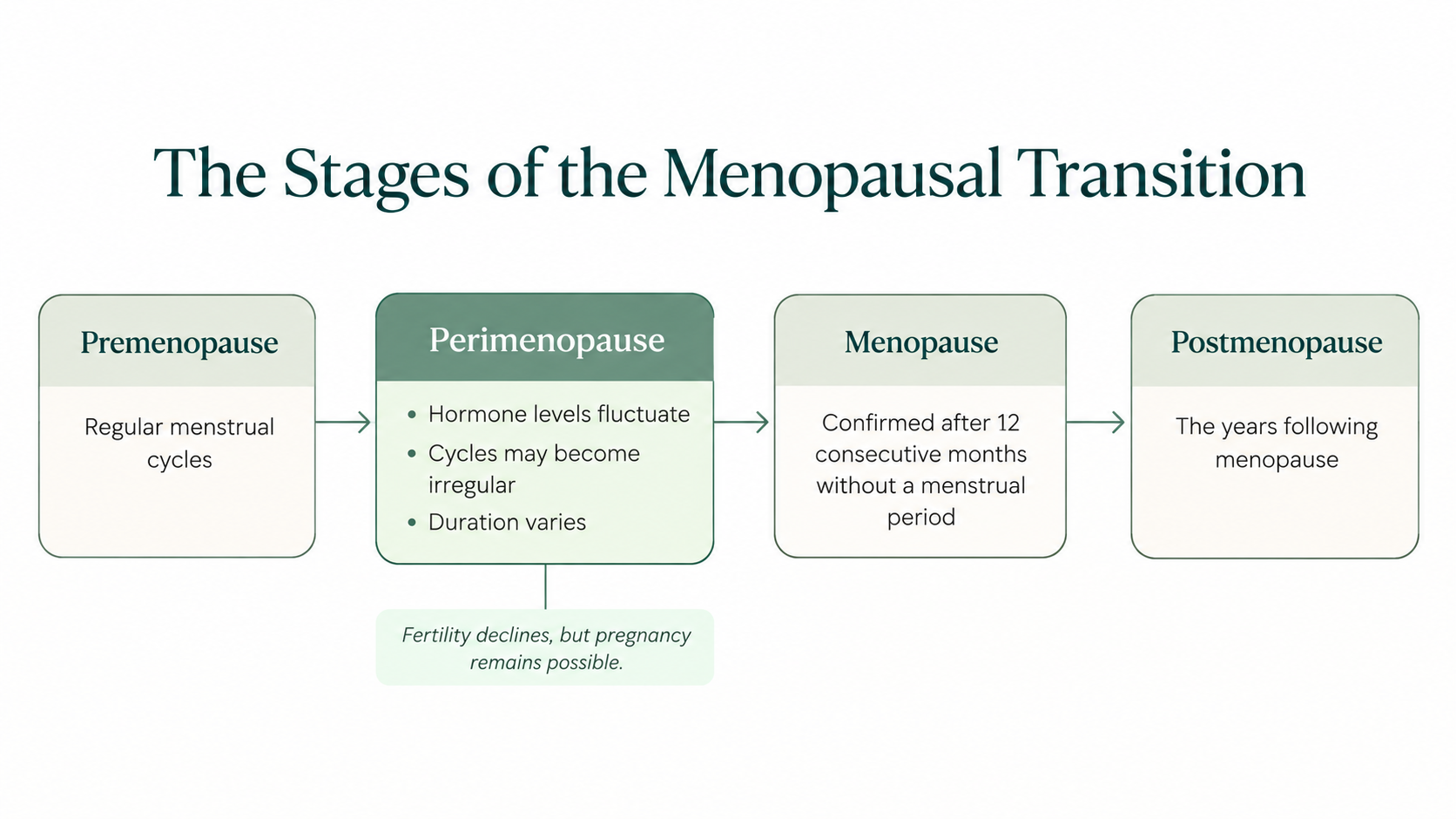
The Difference Between Perimenopause and Menopause
These terms get used interchangeably, and the confusion matters practically rather than just terminologically.
Stage | What Defines It | What Hormones Are Doing |
Premenopause | Regular cycles, no transition symptoms | Cycling in a typical pattern |
Perimenopause | The transition. Cycles become irregular, symptoms may appear | Fluctuating, sometimes considerably |
Menopause | Confirmed after twelve consecutive months without a period | Generally lower and more stable than during the transition |
Postmenopause | All the time after that point | Generally stable at lower levels |
The difference that matters most in practice is that perimenopause is a process while menopause is confirmed only in hindsight. Menopause is dated to your final menstrual period, but that date can only be identified after twelve months have passed without another one.
What Age Can Perimenopause Start?
Most people begin in their forties, and some notice changes in their thirties. The range is wide enough that age on its own is a poor guide to where anyone actually is, which is why two people the same age can be at completely different points and neither is unusual.
Asking when can perimenopause start earlier than usual, or how early can perimenopause start, has a more consequential answer than the general age question. Symptoms consistent with the transition appearing before age 40 warrant evaluation rather than being assumed to represent early perimenopause, because several other causes are possible and some have implications beyond symptom management.
Why Does Perimenopause Start Earlier for Some Women?
Several factors have been associated with the timing of the transition, and most of them are not within anyone's control:
Family history, which is often the strongest available indicator
Smoking, which has been associated with an earlier transition
Certain medical treatments, including some cancer therapies
Surgical removal of the ovaries, which causes an immediate rather than gradual change
Some autoimmune and genetic conditions
Smoking has been the most consistently reported of these in the research literature. The others vary in how well established they are, so this list is framed as factors that have been associated with timing rather than as established causes.
What Are the First Signs of Perimenopause?
The first noticeable changes are frequently not the ones people expect. Hot flashes get the attention, but they often arrive later than several quieter changes that are easier to explain away at the time.
There is no fixed order, and not everyone experiences all of these. What follows is roughly the sequence people describe most often.
Cycle length changes
ACOG describes cycle changes as a common early sign, noting that cycles may become longer or shorter than usual for you, that periods may be skipped, and that flow may become lighter or heavier. Cycles becoming shorter surprises people who expect the opposite. Some people may even notice periods arriving about every two weeks as cycles temporarily become shorter.
Spotting between periods
Perimenopause spotting between periods can occur during the transition. Some people notice spotting instead of a period, where an expected period arrives as light spotting only. This can be part of the transition, though it is also one of the changes worth mentioning to a provider rather than assuming, particularly if it is new or persistent.
Sleep changes
Waking at consistent hours, difficulty returning to sleep, or waking unrefreshed. Sleep disruption often precedes night sweats and can contribute to fatigue and mood changes on its own.
Periods becoming heavier or more frequent
Perimenopause and heavy periods do occur together, and flow can change in either direction. Heavier bleeding is common enough during the transition that people often assume it needs no attention, though it is worth raising rather than enduring. See the bleeding section below.
Temperature changes and night sweats
Hot flashes and night sweats are the symptoms most associated with the transition, and they do occur, but they frequently arrive after several of the changes above rather than announcing the start of the process.
Changes in premenstrual symptoms
Premenstrual symptoms become more pronounced than they used to be, including breast tenderness, mood changes, and bloating. Some people also notice sore breasts without a period arriving, which reflects hormonal fluctuation rather than an absent cycle specifically.
Mood and concentration changes
Irritability, low mood, or difficulty holding a thought. These are among the most commonly attributed to circumstances rather than physiology, partly because there is usually a plausible external explanation available.
Can Perimenopause Cause Nausea?
Nausea is not listed among the common symptoms of perimenopause by major professional bodies including ACOG, whose symptom list covers cycle changes, hot flashes, sleep problems, vaginal dryness, and mood changes. Some people do report it during the transition, and there are plausible indirect routes, but nausea should not be attributed to perimenopause without considering other causes first, particularly pregnancy.
Can perimenopause cause nausea, or does perimenopause cause nausea, is a common question with an answer more nuanced than most articles give it.
The direct answer is that nausea does not appear on the standard symptom lists published by professional bodies. That is worth knowing, because a great deal of content online treats it as an established perimenopause symptom, and the evidence for that is thinner than the confidence with which it is usually stated.
There are indirect routes, however. ACOG describes anxiety as something some women report during perimenopause, and notes that anxiety can produce physical symptoms including nausea. Sleep disruption and changes in migraine patterns are also plausible contributors, since both can produce nausea independently.
Put together, the possible contributors look like this:
Anxiety, which ACOG identifies as producing physical symptoms including nausea, and which some women report during the transition
Sleep disruption, which can produce nausea independently
Migraine patterns changing during the transition, since nausea frequently accompanies migraine
Medications, including some used to manage menopausal symptoms, which list nausea among their adverse effects
Perimenopause nausea that is persistent, severe, or accompanied by other digestive changes should be evaluated rather than attributed to hormones. Nausea has a long list of possible causes, several more common than hormonal transition and more straightforward to treat.
The most important of those alternatives, if there is any possibility of it, is pregnancy. Which leads directly to the next question.
Perimenopause or Pregnancy? How to Tell
This is a genuinely difficult distinction, and the overlap is larger than most people expect. A missed or late period, breast tenderness, fatigue, nausea, and mood changes are consistent with either.
Symptom | In Perimenopause | In Early Pregnancy |
Missed or late period | Common, and often irregular rather than absent | Typically absent rather than irregular |
Breast tenderness | Can occur, often fluctuating | Can occur, often persistent |
Fatigue | Common, often linked to sleep disruption | Common |
Nausea | Possible for some people | Common, often with a daily pattern |
Hot flashes | Common | Less typical, though temperature changes can occur |
Mood changes | Common | Common |
The hot flashes and pregnant combination is a common search for a reason. Temperature changes can occur in early pregnancy, and someone experiencing both hot flashes and a late period may reasonably suspect either explanation. The overlap is real, which is exactly why a symptom comparison cannot resolve it.
A symptom list cannot distinguish between these. If there is any possibility of pregnancy, take a pregnancy test. That is the only way to answer the question, and searching perimenopause vs pregnancy symptom comparisons is not a substitute for it.
This applies equally to a period that is late by several days when cycles have previously been regular. Cycle irregularity is expected during the transition, but a late period in someone who could conceive is a reason to test rather than to assume.
Can You Get Pregnant During Perimenopause?
Yes. This is one of the more consequential misunderstandings about the transition, and it is worth stating plainly.
Can you get pregnant during perimenopause, and can you still get pregnant during perimenopause once cycles become irregular, both have the same clear answer: fertility declines during the transition, but it does not reach zero until menopause is confirmed. Ovulation becomes less predictable rather than stopping outright, which means conception remains possible even when cycles have become irregular.
Why this causes problems in practice
Irregular cycles are easy to read as a sign that conception is no longer possible. Someone who has not had a period in three months may reasonably conclude that contraception is no longer needed. During the transition, that conclusion is premature, because an unpredictable cycle is not the same as an absent one.
Cleveland Clinic states this directly: although periods become irregular during perimenopause, the ovaries can still ovulate, so contraception is still needed to prevent pregnancy. Anyone asking can you be premenopausal and get pregnant, or wondering whether contraception can be stopped, should have that conversation with a provider rather than reaching a conclusion from cycle patterns, since the answer depends on age, cycle history, and individual circumstances.
Once menopause is confirmed, meaning twelve consecutive months without a period, natural conception is not expected. That is a separate question from this one, and it warrants its own article rather than a subsection here.
If pregnancy occurs during the transition
Pregnancy during perimenopause is possible and does occur. Whether it is dangerous to get pregnant during perimenopause has a more useful answer than "it depends."
ACOG and the Society for Maternal-Fetal Medicine recommend that pregnancy with anticipated delivery at age 35 or older be recognized as a risk factor for adverse maternal, fetal, and neonatal outcomes when counseling patients and planning care. They note that risk sits on a continuum rather than switching on at a particular birthday, and that it increases with age and with the presence of other medical conditions.
That does not mean a healthy pregnancy is unlikely. It means care is planned differently, and that early, consistent prenatal care matters more rather than less. Providers may recommend additional monitoring and screening, and specific guidance depends on age and individual health history.
Anyone who becomes pregnant during the transition should seek care early rather than delaying.

What to Track, and Why It Helps More Than It Sounds
Because the transition is identified from history rather than from a single test, what you can describe about your own cycles is genuinely useful clinical information. It is also the thing most people cannot recall accurately under time pressure in an appointment.
Four things are worth recording, and none of them takes more than a moment:
Cycle start dates
Just the first day of bleeding, each time. From that, cycle length calculates itself, and a pattern of shortening or lengthening becomes visible over several months in a way it never is from memory.
Flow, in rough terms
Lighter than usual, typical, or heavier than usual is enough. Precision is not required, and a rough note is far more useful than nothing, particularly given that changes in volume matter more clinically than changes in timing.
Symptoms and roughly when they started
Month and year is sufficient. What matters is sequence rather than exact dates, since knowing that sleep changes preceded cycle changes by several months is more informative than knowing which week either began.
Anything unusual, even if it seems unrelated
Spotting between periods, bleeding after sex, or a period that arrives twice in one month. These are the details most often left out of a summary and most often relevant to whoever is interpreting the picture.
Any period tracking app will do this, and so will a note on your phone. The method matters far less than having something to refer to, because a pattern is visible on paper in a way it rarely is from inside the experience.
What's Normal, and When Should Perimenopausal Bleeding Be Checked?
Most bleeding changes during the transition are part of the process. Some are not, and the difference matters. This section exists because framing everything as normal does readers a disservice.
ACOG puts it plainly: although changes in menstrual bleeding are normal during perimenopause, they should still be reported to a health care professional, because abnormal bleeding may be a sign of a problem.
Contact a healthcare provider if you experience bleeding that is unusually heavy for you, bleeding lasting longer than usual, bleeding between periods, bleeding after sex, or any bleeding at all after menopause has been confirmed. ACOG advises seeing an ob-gyn to find the cause in each of these situations.
Knowing when to worry about perimenopausal bleeding is difficult precisely because irregularity is expected. A useful principle: irregularity in timing is common during the transition, while changes in volume and duration are more often worth evaluating.
Perimenopause and heavy periods do occur together, and heavy bleeding is common enough during the transition that people often assume it needs no attention. ACOG notes that heavy menstrual bleeding may signal an underlying condition requiring treatment, and that blood loss from heavy periods can lead to iron-deficiency anemia. It is worth evaluating rather than enduring.
How Clinicians Evaluate Possible Perimenopause
Evaluation is mostly a conversation rather than a test, which surprises people who expect a definitive answer from bloodwork. A typical assessment considers:
Your age and family history
Menstrual history, including how cycles have changed and over what period
Which symptoms are present and when they began
Whether pregnancy is possible
Current medications and supplements
Relevant medical history, including thyroid conditions and anemia
Physical examination where appropriate
Laboratory testing where it will answer a specific question
Testing appears last in that list rather than first, and that ordering is deliberate rather than a matter of convenience.
Where Lab Testing May Fit
A common expectation is that a blood test will confirm whether the transition has begun. In practice it often cannot, and understanding why saves both money and frustration.
Because hormone levels fluctuate considerably during the transition, a single measurement may capture a high point or a low point depending on the day it was taken. Two samples a week apart can look quite different in the same person. This is why the transition is generally identified from menstrual history and symptoms rather than from a laboratory value.
Testing tends to be more useful for specific purposes: investigating symptoms that begin unusually early, ruling out other conditions that produce similar symptoms such as thyroid dysfunction or iron deficiency, or clarifying an unclear picture. Within a functional and integrative medicine approach, results are considered alongside history, symptoms, lifestyle, and other relevant markers rather than read in isolation.
If testing does become part of the picture, our guide on how hormone testing is selected for women covers which markers are involved and why timing affects what a result can tell you.
Frequently Asked Questions
When does perimenopause begin?
Most commonly in the forties, and for some people in the late thirties. The range is wide, and age alone is not a reliable indicator of where someone is in the transition.
How early can perimenopause start?
Symptoms consistent with the transition appearing before age 40 warrant evaluation rather than being assumed to be early perimenopause. Several other causes are possible, and some have implications beyond symptom management.
Can you still get pregnant during perimenopause?
Yes. Fertility declines but does not reach zero until menopause is confirmed. Ovulation becomes unpredictable rather than stopping, so contraception remains relevant. Whether it can be discontinued is a decision to make with a provider.
Can perimenopause cause nausea?
Nausea is not generally listed as a standard perimenopause symptom by major professional bodies. Some people report nausea during the transition, but other factors such as pregnancy, migraine, anxiety, medications, or other medical conditions may also cause it. Persistent or severe nausea should be evaluated rather than automatically attributed to perimenopause.
Is spotting normal during perimenopause?
Spotting between periods can occur during the transition. It is also worth mentioning to a provider rather than assuming, particularly if it is new, persistent, or accompanied by other bleeding changes.
What is the difference between perimenopause and menopause?
Perimenopause is the transition, characterized by fluctuating hormone levels and irregular cycles. Menopause is a single point confirmed after twelve consecutive months without a period.
Final Thoughts
The answer to when the transition begins is a range rather than a number, and that is genuinely the answer rather than an evasion. Most people begin in their forties, some earlier, and two people the same age can be at completely different points.
Most of what happens during the transition is unremarkable, even when it does not feel that way. Cycle changes, sleep disruption, and shifting premenstrual symptoms are all part of the process for many people.
Three things in this article are particularly worth remembering: symptoms appearing before 40 warrant evaluation, unusual or concerning bleeding changes should be discussed with a healthcare provider, and conception remains possible during perimenopause.
Understand Where You Are in the Transition
An evaluation looks at your cycle history and symptoms in context, considers the conditions that can produce a similar picture, and includes testing where it will answer a specific question. THRYVE Wellness Medical offers provider-ordered panels, at-home blood draws by licensed phlebotomists, and telehealth review of every result, for patients in Texas, South Carolina, and North Carolina.
Book a consultation with THRYVE
Medical Disclaimer: This article is for general educational purposes and is not a substitute for individualized medical advice, diagnosis, or treatment. Symptoms should be evaluated in the context of your medical history and individual circumstances. Speak with a qualified healthcare professional about your own situation, and seek prompt care for any of the bleeding changes described above.