

THRYVE Team
Wellness Clinic
The tirzepatide dose schedule is published and fixed. What is less widely explained is why each step lasts four weeks, why the starting dose is not a maintenance dose, and why the top of the ladder is not the target.
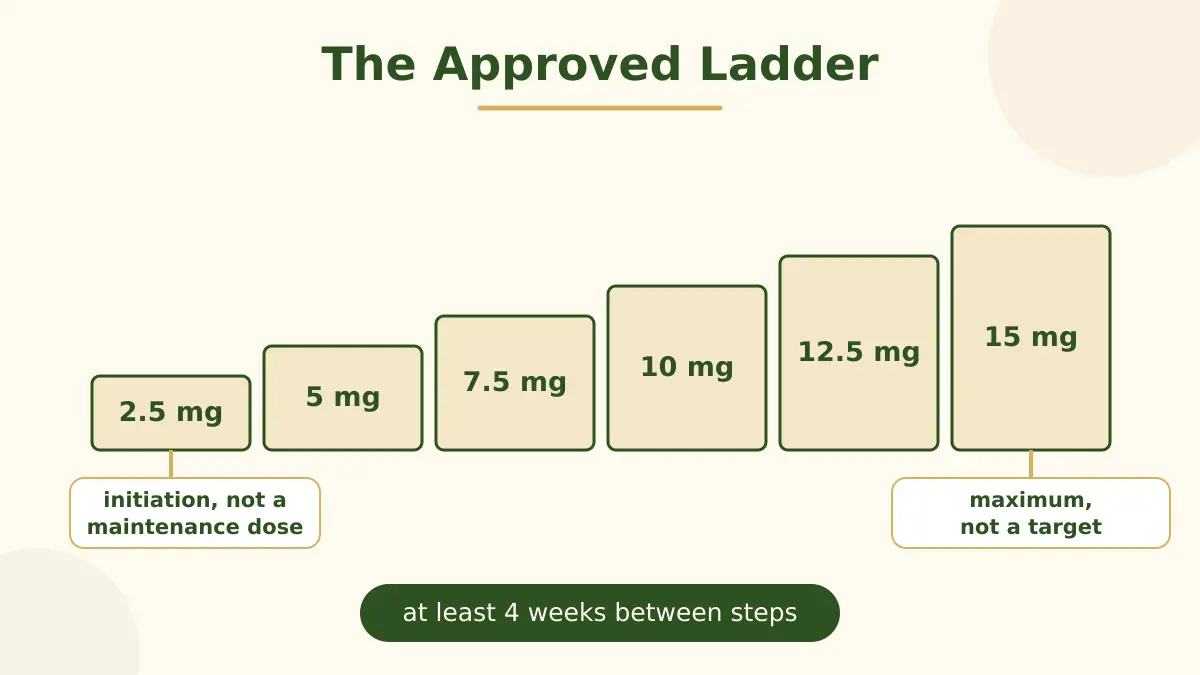
The FDA-approved tirzepatide dose schedule starts at 2.5 mg once weekly for four weeks, increases to 5 mg, then rises in 2.5 mg increments no sooner than every four weeks, up to a maximum of 15 mg once weekly. Mounjaro and Zepbound use the same tirzepatide strengths and the same stepwise escalation pattern, but their approved indications and maintenance-dose instructions differ. The label identifies 2.5 mg as a treatment-initiation dose rather than an approved maintenance dosage, and the four-week interval is a minimum rather than a schedule to be kept to.
Searches for tirzepatide dosing and mounjaro dosage return charts easily enough. What is harder to find is an explanation of why the ladder is shaped the way it is, which turns out to matter more than the numbers for anyone actually working through it.
This covers the approved schedule, the pharmacology behind the four-week step, three things the label says that most charts omit, and one category of dosing content this article deliberately does not provide.

The Approved Schedule
Tirzepatide is sold as Mounjaro for type 2 diabetes and Zepbound for chronic weight management. Both use the same tirzepatide strengths and the same 2.5 mg stepwise escalation pattern, but their approved indications and maintenance-dose instructions differ.
Step | Dose | Minimum time before increasing |
1 | 2.5 mg once weekly | 4 weeks |
2 | 5 mg once weekly | At least 4 weeks |
3 | 7.5 mg once weekly | At least 4 weeks |
4 | 10 mg once weekly | At least 4 weeks |
5 | 12.5 mg once weekly | At least 4 weeks |
6 | 15 mg once weekly | Maximum approved dose |
All doses are once weekly by subcutaneous injection. The rule governing the whole ladder is simple: increases of 2.5 mg, no sooner than every four weeks, to a maximum of 15 mg weekly.
The table above shows the escalation pattern. Maintenance-dose instructions differ between the two products: current Zepbound prescribing information identifies recognized maintenance dosages for weight management, while Mounjaro labeling ties further increases to additional glycemic control. Consult the labeling for the specific product prescribed.
Three Things the Label Says That Charts Usually Omit
2.5 mg is not a maintenance dose
The label identifies 2.5 mg once weekly as the treatment-initiation dose rather than an approved maintenance dose. It is the first step in the dose-escalation schedule, not a maintenance dosage against which the longer-term treatment plan should be judged. Current Mounjaro labeling states specifically that 2.5 mg is for initiation and is not intended for glycemic control.
Anyone looking up tirzepatide dosage for weight loss will find this first step listed without that qualification. It is worth knowing, because judging the longer-term treatment plan against the initiation step measures it at a point the label does not treat as a maintenance dosage. That is a common source of early discouragement and it is avoidable with one sentence of context.
The maximum is not the target
Zepbound has several recognized maintenance dosages rather than one. Reaching 15 mg is not the goal of treatment, and not everyone escalates that far.
In the SURMOUNT-1 trial, the difference in average weight reduction between the 10 mg and 15 mg arms was modest. Some patients may achieve an adequate response without reaching the maximum dose, and the appropriate maintenance dose is the one achieving the desired result at a tolerability the person can sustain.
Four weeks is a minimum, not a schedule
Every published dose schedule for tirzepatide shows four-week steps. The label says increases may occur after at least four weeks at the current dose. It does not say they should occur at four weeks.
A prescriber may hold someone at a dose considerably longer for tolerability, and doing so is following the label rather than falling behind it. Anyone comparing their own pace against a chart is comparing against a minimum interval rather than an expected timeline.
Why Four Weeks Specifically
The interval is not arbitrary and the reason is pharmacological rather than cautionary.
Tirzepatide has an elimination half-life of approximately five days, which supports once-weekly administration. With repeated weekly dosing, concentrations accumulate before reaching steady state.
The labeled escalation schedule therefore provides at least four weeks at a given dose before another increase is considered.
Gastrointestinal adverse reactions can occur during dose escalation, which is one reason tolerability is considered as treatment progresses. This is covered in more detail in our guide to tirzepatide side effects.
The Interaction Most Articles Miss
The prescribing information advises that patients using oral hormonal contraceptives switch to a non-oral contraceptive method, or add a barrier method, for four weeks after starting tirzepatide and for four weeks after each dose escalation. This is because delayed gastric emptying may reduce the effectiveness of oral contraceptives, and the effect is largest after the first dose.
This is directly tied to titration rather than to the medication generally, which is why it belongs in an article about the dose schedule. Every escalation restarts the four-week window.
It is also almost entirely absent from consumer dosage charts, which is a meaningful gap given the population taking these medications.
Missed Doses
The prescribing information includes specific instructions for missed doses, including a four-day window. Because timing matters, patients should follow the instructions supplied with their prescribed product and contact their prescribing provider when unsure rather than improvising from a dosage chart.
This is one of the more common practical questions and one where guessing has consequences.
How Semaglutide Titration Compares
Semaglutide titration follows the same principle with different numbers. Semaglutide products also use gradual dose escalation, although the specific starting doses, escalation schedules, and maintenance doses depend on the product and indication.
Both medications use gradual dose escalation, but the specific rationale, schedule, and maintenance dosing should be interpreted according to each product's prescribing information.
What differs between them is the specific ladder, which is set by each product's own labeling rather than transferable between them.

What This Article Does Not Provide, and Why
Three categories of dosing content are widely available online and are deliberately absent here.
Dose conversion charts
Charts converting between products, formulations, or units. These exist to let someone calculate a dose independently, which is the specific behavior associated with the most serious reported dosing errors in this medication class.
Milligram to unit conversions
Some sites publish reconstitution calculations and syringe unit conversions for vials. The FDA has received reports of patients receiving many times their intended dose from multidose vials, and unit conversion content is upstream of exactly that error.
Microdosing schedules
Microdosing is not an approved approach and is not described in the prescribing information for any of these products. Schedules published for it are not derived from labeling or from trial data.
The approved ladder above is published information that the FDA makes available on its own website. Conversion charts and microdosing protocols are not. That distinction is the reason one appears in this article and the others do not.
Frequently Asked Questions
What is the tirzepatide dose schedule?
Start at 2.5 mg once weekly for four weeks, increase to 5 mg, then increase in 2.5 mg increments no sooner than every four weeks, to a maximum of 15 mg once weekly. Both products use the same escalation pattern, though their maintenance-dose instructions differ.
Is mounjaro dosage the same as Zepbound?
Mounjaro dosage for weight loss is a common search, though Mounjaro is approved for type 2 diabetes rather than weight management. Both products use the same tirzepatide strengths and the same stepwise escalation pattern, but their approved indications and maintenance-dose instructions differ.
Do you have to reach 15 mg?
No. Several maintenance dosages are recognized, and the appropriate one is the dose achieving the desired result at a tolerability the person can sustain. Trial data showed a modest difference in average weight reduction between the 10 mg and 15 mg arms.
Can the four-week interval be longer?
Yes. The label describes four weeks as a minimum rather than a required schedule. A prescriber may hold a dose longer for tolerability, and that is following the label rather than delaying treatment.
What happens if a dose is missed?
The prescribing information includes specific instructions, including a four-day window. Because the guidance depends on how much time has passed, follow the instructions supplied with your prescribed product and contact your prescribing provider when unsure.
Why does the dose have to increase gradually?
Tirzepatide has an elimination half-life of approximately five days, and concentrations accumulate with repeated weekly dosing before reaching steady state. The labeled schedule provides at least four weeks at a given dose before another increase is considered, and gradual escalation is described in the labeling as reducing the risk of gastrointestinal adverse reactions.
Final Thoughts
The ladder itself is straightforward and published: 2.5 to 15 mg, in 2.5 mg steps, no sooner than every four weeks.
What the chart does not convey is that the first rung is an initiation dose rather than a maintenance dose, the top rung is not the destination, and the four-week interval is a floor rather than a timetable. Those three facts change how someone experiences the schedule considerably more than knowing the numbers does.
And the schedule is set by a prescriber against an individual's response and tolerability. A published ladder describes the approved path. It does not describe anyone's particular route along it.
A Schedule Set Against Your Response
THRYVE Wellness Medical provides provider-led medical weight management by telehealth, with dose escalation assessed against tolerability and response rather than a fixed calendar. Available to eligible patients in Texas, South Carolina, and North Carolina.
Book a consultation with THRYVE
Medical Disclaimer: This article is for general educational purposes and describes FDA-approved labeling. It is not a substitute for individualized medical advice, and it is not a dosing plan. Do not start, stop, adjust, skip, or calculate doses of any medication based on general information. Your dose schedule is set by the provider prescribing your treatment.