

THRYVE Team
Wellness Clinic
Learn the symptoms of low testosterone in San Antonio men, why diagnosis requires repeat morning blood tests, and when to discuss treatment with a provider.
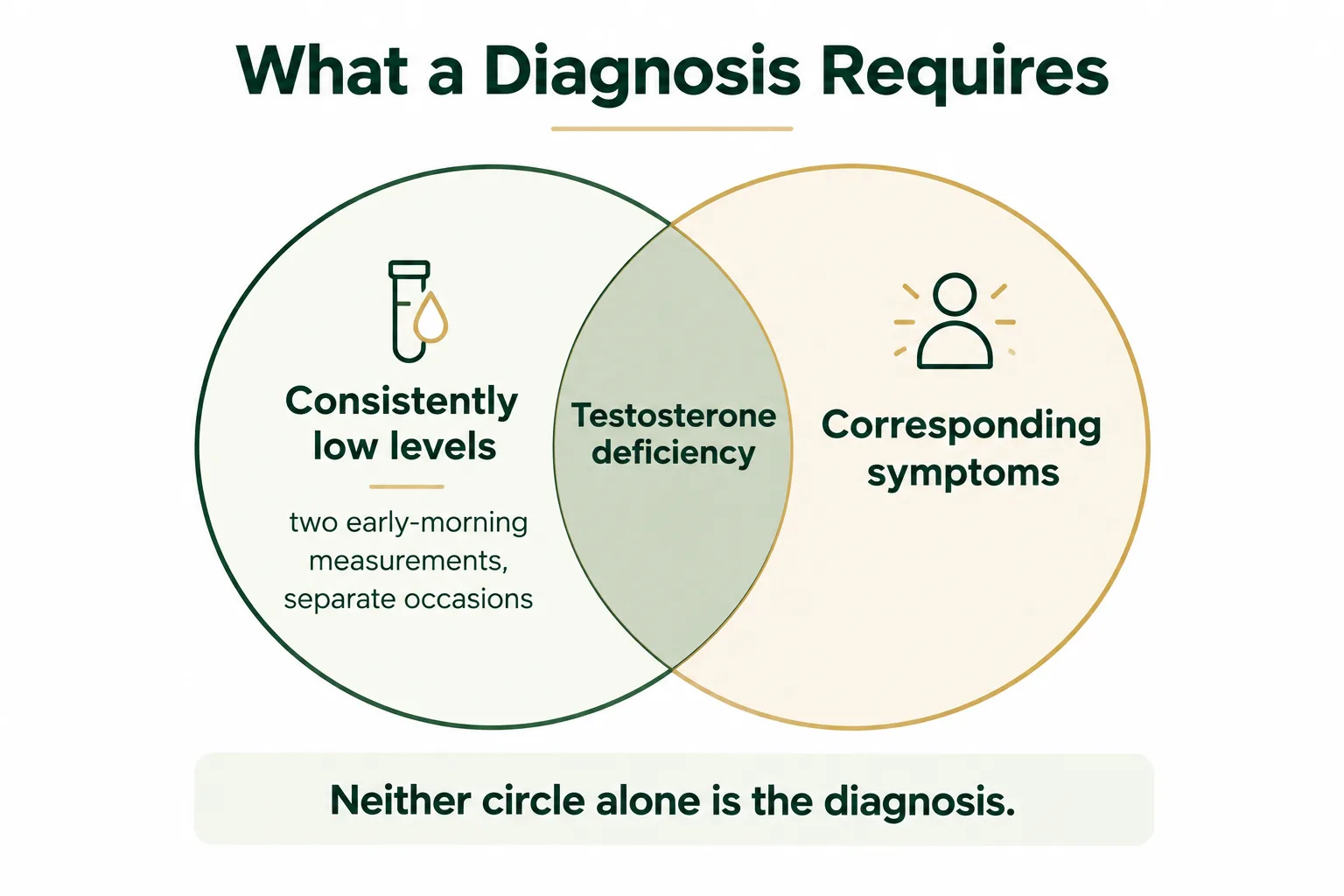
Low testosterone is diagnosed when a man has symptoms alongside consistently low blood levels. The American Urological Association uses a total testosterone level below 300 ng/dL as the cutoff, and requires at least two measurements taken on separate occasions, both in the early morning. A level below 300 ng/dL on its own does not establish the diagnosis without symptoms.
Men researching low testosterone treatment in San Antonio often begin with symptoms that have several possible explanations. The symptoms are real and worth investigating. They are also shared with several other conditions, which is the reason the diagnostic process looks the way it does.
This covers the symptoms associated with low testosterone, why a single test does not answer the question, and what testing involves for men in San Antonio.

What Is Low Testosterone?
Testosterone deficiency, sometimes called low T, is a condition in which the body produces insufficient testosterone, accompanied by symptoms.
Testosterone levels may decline gradually with age, but the rate varies between individuals. Age-related changes alone do not establish testosterone deficiency, which requires clinical evaluation of symptoms and laboratory findings.
What distinguishes a normal age-related decline from testosterone deficiency is the combination of a confirmed low level and symptoms that correspond to it. Neither element establishes the condition on its own.
12 Symptoms Associated With Low Testosterone
Some symptoms are more closely associated with testosterone deficiency, while others are common across several health conditions.
More specific indicators
Reduced sex drive
Changes in erectile function
Delayed ejaculation
Diminished facial or body hair growth
Loss of muscle mass or strength
Increased breast tissue
Less specific indicators
Reduced energy or persistent fatigue
Reduced endurance or physical performance
Low mood or reduced motivation
Poor concentration or impaired memory
Irritability
Increased body fat, particularly around the waist

This is not a checklist to score yourself against. Clinical sources describe the symptoms of testosterone deficiency as often non-specific, particularly in older men, and the second group above overlaps substantially with sleep disorders, thyroid conditions, depression, medication effects and ordinary aging. Matching several items is a reason to get evaluated, not a conclusion.
Why a Single Test Cannot Confirm It
This is the part most pages skip, and it changes what to expect from a provider.
The American Urological Association (AUA) recommends confirming low testosterone with two total testosterone measurements taken on separate occasions, both in the early morning. This is categorized as a Strong Recommendation at Evidence Level Grade A, the guideline's highest designation.
Three reasons the process works this way:
Testosterone follows a daily rhythm, with levels typically highest in the morning. A sample taken in the afternoon can read lower without indicating deficiency
Levels fluctuate between days. A single low reading may not reflect a consistent pattern, which is why the guideline requires measurements on separate occasions
A low number without symptoms does not establish the condition. The guideline is explicit that a total testosterone below 300 ng/dL alone does not define testosterone deficiency
An afternoon measurement alone is not sufficient to establish testosterone deficiency under the AUA diagnostic recommendations. Ask your provider whether repeat early-morning testing is needed before making treatment decisions.
When to Get Tested
Men considering low testosterone treatment in San Antonio may first need an evaluation to determine whether their symptoms are associated with testosterone deficiency.
Practical points about the test itself:
Element | What to expect |
Timing | Early morning. Clinical sources commonly specify between 7am and 11am, with exceptions considered for shift workers |
Number of draws | At least two, on separate occasions, both in the early morning. The interval between them is a clinical decision rather than a fixed rule |
What is measured | Total testosterone initially. Additional tests may follow depending on results |
Preparation | Follow the instructions supplied with your order, since some sources describe a fasting morning draw |
What confirms a diagnosis | Consistently low levels alongside corresponding symptoms, assessed together |
Our guide to fasting before a blood test covers the preparation question in more detail.
Treatment Options Compared
Option | How it is given | Considerations |
Injections | Intramuscular or subcutaneous, at intervals | Established route. Frequency varies by preparation |
Topical gels | Applied daily to the skin | Daily application. Transfer to others through skin contact is a documented consideration |
Pellets | Inserted under the skin, lasting months | Minor procedure. Less frequent administration |
Patches | Applied daily | Daily application. Skin reactions are a documented consideration |
Which option suits an individual depends on the clinical picture, lifestyle and preference. All are prescription treatments requiring evaluation first, and TRT for men describes a category of options rather than a single product.
Our comparison of peptides and testosterone therapy covers what testosterone replacement involves in more detail, including monitoring and fertility considerations.
Low Testosterone Treatment in San Antonio
Men in San Antonio can discuss testosterone concerns with several types of healthcare providers, including primary care clinicians, urologists and qualified hormone-care providers. The variation between them is less about which treatments are offered than about how the diagnosis is reached.
Three questions worth asking a provider about low testosterone treatment in San Antonio:
How many blood draws before a diagnosis, and at what time of day
What else is assessed to rule out other causes of the same symptoms
What monitoring follows once treatment starts, and how often
Before starting testosterone therapy, ask how your provider confirms the diagnosis. A guideline-based evaluation generally includes symptoms and at least two separate early-morning total testosterone measurements, along with assessment of other possible causes.
For eligible patients in supported San Antonio service areas, at-home blood collection may make repeat testing more convenient, depending on the tests ordered and appointment availability.
How THRYVE Approaches This in San Antonio
Stage | What happens |
Evaluation | Symptoms, history and other possible causes discussed with a provider by telehealth |
Baseline testing | Early-morning collection arranged, with at-home collection available in supported service areas |
Confirmation | Repeat early-morning total testosterone testing on a separate occasion when evaluating suspected testosterone deficiency, with findings interpreted alongside symptoms and clinical history. |
Review | Results discussed with a provider alongside symptoms rather than returned as a number |
Decision and monitoring | Whether treatment is appropriate decided together, with ongoing review if started |
Frequently Asked Questions
What testosterone level is considered low?
The American Urological Association uses a total testosterone level below 300 ng/dL as a cutoff supporting the diagnosis, which the guideline classifies as a Moderate Recommendation at Evidence Level Grade B. The requirement for two separate early-morning measurements carries a higher designation, a Strong Recommendation at Grade A. Other thresholds appear in the literature, commonly between 250 and 350 ng/dL, and the number alone does not establish the condition without symptoms.
Can one blood test diagnose low testosterone?
No. The AUA guideline specifies at least two total testosterone measurements on separate occasions, both taken in the early morning, alongside corresponding symptoms. Testosterone follows a daily rhythm and fluctuates between days, which is why a single reading is not considered sufficient.
How do I find low testosterone treatment in San Antonio?
Ask how many blood draws a provider requires before diagnosis and at what time of day, what else they assess to rule out other causes, and what monitoring follows if treatment begins. The first question is the most informative. For eligible patients in supported San Antonio service areas, at-home blood collection may be available for the required tests, depending on appointment availability and the tests ordered.
Final Thoughts
The symptoms associated with low testosterone are real, and for some men they reflect a genuine deficiency that responds to treatment. For others the same symptoms come from sleep problems, thyroid conditions, depression, medication or ordinary aging.
Which is why the diagnostic process requires two early-morning measurements plus symptoms rather than a single number. That process exists to tell those situations apart, and skipping it does not speed anything up. It just produces a less reliable answer.
So, the question worth asking a provider is not what treatments they offer. It is how they establish whether you need one.
Discuss Testosterone Testing With THRYVE
If you are experiencing symptoms associated with low testosterone, THRYVE can help you understand the next steps in a provider-led evaluation. Eligible patients in supported San Antonio service areas may have access to at-home blood collection when appropriate.