

THRYVE Team
Wellness Clinic
Learn what the evidence says about HRT and weight gain, whether hormone therapy helps with weight loss, and why body composition can change during menopause even when the scale does not.
Research summarized by the International Menopause Society indicates that hormone therapy is not associated with increased weight, so the common fear of weight gain from treatment is not well supported. Current evidence also does not support hormone therapy as a weight loss treatment. What the menopausal transition does change is body composition, meaning where fat is stored and how much lean mass is retained, which is a separate question from what the scale shows.
This topic sits between two claims that pull in opposite directions, and neither of them is accurate.
The first is that hormone therapy causes weight gain, which stops some people from starting treatment they might otherwise benefit from. The second is that it causes weight loss, which is promoted widely enough that a clinical review published in 2026 singled it out by name.
The reality is more interesting than either, and understanding it changes what you would reasonably expect from treatment.

Does Hormone Therapy Cause Weight Gain?
This is the more common fear, and the evidence does not support it.
The International Menopause Society's review of the literature concluded that menopausal hormone therapy is not associated with increased weight or increased visceral adiposity. Studies mostly indicated a reduction in overall fat mass with estrogen and estrogen-progestin therapy, along with improved insulin sensitivity.
So questions like does estradiol cause weight gain, does estrogen cause weight gain, or do estrogen patches cause weight gain have a reasonably consistent answer in the research: the association people worry about has not been demonstrated.
That does not mean nobody gains weight while taking it. People do, and there are explanations for that covered further down. But gaining weight during a period when you happen to be taking hormone therapy is not the same as the therapy having caused it, and separating those two things is most of what this article is about.
Does HRT Help With Weight Loss?
This is the more commercially promoted claim, and it is the one worth being most careful about. Searches for hrt for weight loss and hrt weight loss have grown considerably, and most of the content answering them overstates what the evidence shows.
A clinical review published in March 2026 concluded that current evidence does not support hormone therapy as a primary or adjunctive weight loss intervention. The same review noted that hormone therapy has become one of the most commercially distorted topics in women's health, and named direct-to-consumer platforms, medical spas, and social media as promoting claims beyond the evidence base, most prominently the assertion that it causes meaningful weight loss.
So does hrt help with weight loss, can hrt help with weight loss, does hrt help you lose weight, will hormone replacement help lose weight, and can hrt help lose weight all have the same answer, and it is not the one most content on this topic gives: hormone therapy is not a weight loss treatment and should not be started for that purpose.
Hormone therapy has well-established benefits for vasomotor symptoms, bone health, and quality of life in appropriately selected people. Weight loss is not among them. Anyone offering it as one is making a claim the evidence does not currently support.
That distinction matters practically. Starting a treatment for an outcome it does not reliably produce means disappointment, and it often means stopping a treatment that was helping with the symptoms it does address.
What Actually Changes During the Transition
Here is where it gets more useful, because the research draws a distinction most people have never been offered.
What Changes | What the Research Indicates |
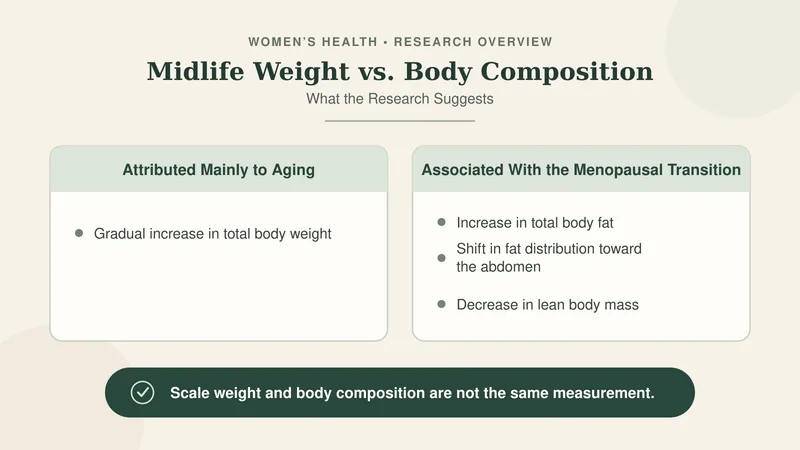
Total body weight | Weight gain in itself is generally attributed to aging rather than to the menopausal transition. The International Menopause Society notes a steady gain of roughly half a kilogram per year in midlife that is attributed to age |
Total body fat | Increases in association with the hormonal changes of the transition |
Fat distribution | Shifts toward the abdomen. This is the change most consistently linked to the transition rather than to age |
Lean body mass | Decreases, and this occurs independently of chronological age |
Read that table again, because it explains something people find genuinely confusing. Weight can stay the same while body composition changes considerably, and that is not a failure of measurement or effort. It is what the research describes happening.
So does low estrogen cause weight gain? The more accurate framing is that the hormonal changes of the transition are associated with a shift in where fat is stored and a reduction in lean mass, while the weight increase itself tracks more closely with age. Estrogen imbalance weight gain is a phrase that collapses two different things into one.
Why the Scale and the Mirror Disagree
If weight is stable and clothes fit differently, the explanation is usually in that table rather than in anything you did wrong.
Lean mass and fat mass weigh differently by volume
Losing lean mass while gaining fat mass can leave total weight roughly unchanged while changing shape noticeably. A scale measures one number and cannot distinguish between the two.
Fat distribution changes independently of quantity
The shift toward abdominal storage means the same amount of body fat can be distributed differently than it was ten years earlier. Nothing about the total needs to change for this to be visible.
Fluid retention fluctuates
Day-to-day fluid shifts can move the scale by more than most people expect, and they have nothing to do with fat mass in either direction.
Weighing conditions vary more than people account for
Time of day, hydration, recent meals, and cycle stage all affect the number. Comparing a morning weight to an evening weight measures the day rather than any underlying change.
The practical implication is that the scale is a poor instrument for the thing most people are actually trying to track during this period. How clothes fit, what you can lift, and how you feel doing it are all measuring something the scale cannot.
Why Am I Gaining Weight on HRT?
Population-level evidence does not show that hormone therapy generally causes weight gain. That is a different statement from saying no individual ever experiences a treatment-related effect, and the distinction is worth keeping clear. Several other explanations may need to be considered alongside the therapy itself:
Age-related weight gain continuing independently, which was happening before treatment started and does not stop because treatment began
Temporary fluid changes, which can affect scale weight in some people and may be perceived as weight gain even when they do not represent an increase in body fat. This is one consideration behind reports linking an estrogen patch and weight gain, or asking whether an estrogen patch cause weight gain
Improved symptoms leading to changes in appetite or activity, which is a real effect but an indirect one
Other medications started around the same time, some of which do affect weight
Thyroid function, which can change independently and produces overlapping effects
Sleep, stress, and activity changes that coincided with the same period
Attribution is genuinely difficult here, which is why this is worth raising with the prescribing provider rather than resolving alone. What it should not lead to is stopping treatment without that conversation.
Will I Lose Weight If I Stop HRT?
Will i lose weight if i stop hrt is a common follow-up, and the honest answer is that there is no good reason to expect it.
If hormone therapy is not associated with weight gain, stopping it would not be expected to produce weight loss. Stopping hormone therapy may allow the symptoms it was managing to return, which is another reason to discuss the decision with the prescribing clinician rather than stopping treatment solely because of weight concerns.
If weight is the concern, stopping a treatment that was managing hot flashes, sleep disruption, or genitourinary symptoms is an expensive way to test a hypothesis the evidence does not support. That decision belongs in a conversation with the prescriber.
What Actually Helps With Weight During the Transition
If hormone therapy is not the answer to this question, it is fair to ask what is. The honest response is that this is the same problem it is at any age, with one complication added.
The complication is the loss of lean mass, which occurs independently of age during the transition. Because lean mass contributes to resting energy expenditure, losing it makes the arithmetic harder even when nothing else has changed.
That points toward resistance training as more relevant during this period than it may have been previously, and toward adequate protein intake to support it. It also points away from approaches that reduce lean mass further, which is a known limitation of aggressive caloric restriction without resistance training.
Anyone looking at how to lose weight during perimenopause specifically, rather than at hormone therapy, is asking a better-framed question. Losing weight during perimenopause is a distinct clinical topic with its own approaches, and it is not addressed by hormone therapy.

Does Estrogen Help With Weight Loss?
Worth addressing separately, because it is a subtly different question from whether hormone therapy is a weight loss treatment, and the answer has a nuance the shorter version loses.
Does estrogen help with weight loss is usually asked because of the body composition finding. If the transition is associated with increased abdominal fat and reduced lean mass, and estrogen therapy appears to attenuate some of that, it is reasonable to wonder whether that amounts to weight loss.
It does not, and the distinction is the same one running through this whole article. Attenuating a change in fat distribution is not the same as reducing body weight, and the research that supports the first does not support the second. How to lose estrogen weight gain, as a phrase, assumes a category that does not quite exist.
What that finding does suggest is that people considering hormone therapy for symptom relief may see body composition effects as a secondary consequence. That is a different proposition from starting treatment in order to produce them, and the difference matters both clinically and legally.
When Weight Change Warrants a Broader Workup
Not every weight change during midlife is explained by the transition, and attributing it there by default can delay identifying something more straightforward.
Situation | Why It Warrants Evaluation |
Rapid or unexplained weight change in either direction | Several conditions can produce this, and speed of change is itself informative |
Weight change alongside fatigue, temperature sensitivity, or hair changes | Thyroid dysfunction produces overlapping effects and is straightforward to test for |
Weight change alongside marked thirst or urination changes | Warrants metabolic evaluation |
Weight change after starting a new medication | Several classes affect weight, and this is worth reviewing rather than assuming |
Weight change that does not respond to changes you would expect to work | Worth investigating rather than intensifying the same approach |
Depending on the clinical picture, evaluation may focus on thyroid function, metabolic markers, medications, and other potential contributors rather than assuming reproductive hormone levels explain the weight change.
Where Lab Testing Fits
Because hormone levels are not the mechanism behind midlife weight change in the way people often assume, a hormone panel is rarely the most informative test for this particular concern.
Hormone health and weight loss are related topics rather than the same one. What testing can usefully do is rule out the alternatives above, establish a baseline of metabolic markers, and identify contributing factors that are addressable. Within a functional and integrative medicine approach, those results are considered alongside history, symptoms, medications, activity, and sleep rather than read in isolation.
Our guide on how hormone testing is selected for women covers which markers are involved and when testing is most useful.
Frequently Asked Questions
Does hormone replacement therapy cause weight gain?
The International Menopause Society's review found that hormone therapy is not associated with increased weight or increased visceral adiposity, with most studies indicating a reduction in overall fat mass.
Does HRT help you lose weight?
Current evidence does not support hormone therapy as a weight loss intervention. It has established benefits for other symptoms, but weight loss is not among them and it should not be started for that purpose.
Does estrogen make you gain weight?
Current evidence does not support the general claim that estrogen therapy causes weight gain. Changes in body composition during the menopausal transition are a separate issue from treatment-related weight gain, and the transition is associated with a shift in fat distribution toward the abdomen and a reduction in lean mass.
Does progesterone help with weight loss?
There is no established evidence supporting progesterone and weight loss as a treatment relationship. Some people report fluid retention or bloating, which can affect the scale without reflecting fat mass. Searches for progesterone weight loss are common, but the evidence base behind them is thin.
How long does it take to lose weight on HRT?
How long does it take to lose weight on hrt assumes a relationship the evidence does not support. Hormone therapy is not a weight loss treatment, so there is no expected timeline for weight loss from it.
Will I lose weight if I stop HRT?
There is no good reason to expect it, since the therapy is not associated with weight gain in the first place. Stopping may allow the symptoms it was managing to return, so weight concerns are worth discussing with the prescribing clinician before changing treatment.
Final Thoughts
Two claims about hormone therapy and weight circulate widely, and the evidence supports neither. It does not appear to cause weight gain, and it is not a weight loss treatment.
What does change during the transition is body composition. Fat distribution shifts toward the abdomen, lean mass decreases, and both occur somewhat independently of the steady weight gain that tracks with age. That is a real change, it is worth understanding, and it is not measured well by a scale.
If the goal is symptom relief, hormone therapy is worth discussing on those terms. If the goal is weight, that is a separate conversation with separate approaches, and conflating the two tends to disappoint on both counts.
Two Questions, Two Conversations
THRYVE Wellness Medical offers both hormone evaluation and medical weight management, and treats them as the separate clinical questions they are. Provider-ordered panels, at-home collection by licensed phlebotomists, and telehealth review of every result, for patients in Texas, South Carolina, and North Carolina.
Book a consultation with THRYVE
Medical Disclaimer: This article is for general educational purposes and is not a substitute for individualized medical advice, diagnosis, or treatment. Do not start, stop, or change any treatment based on general information. Speak with a qualified healthcare professional about your own circumstances.