

THRYVE Team
Wellness Clinic
What over-the-counter estrogen supplements actually contain, how they differ from prescription HRT, and what the evidence shows about each.
Products sold as estrogen supplements generally do not contain estrogen. They contain plant compounds with mild estrogen-like activity, in a category the FDA does not approve for treating menopause. Prescription hormone therapy contains regulated hormones and requires a clinician. For San Antonio women comparing them, these are different categories rather than stronger and weaker versions of one thing.
That first sentence is the single most useful thing to know before buying anything, and it surprises most people who hear it.
This covers what is actually in these products, what the evidence shows, what the regulatory difference means in practice, and what to ask before deciding either way.
What Is Actually in an Estrogen Supplement?
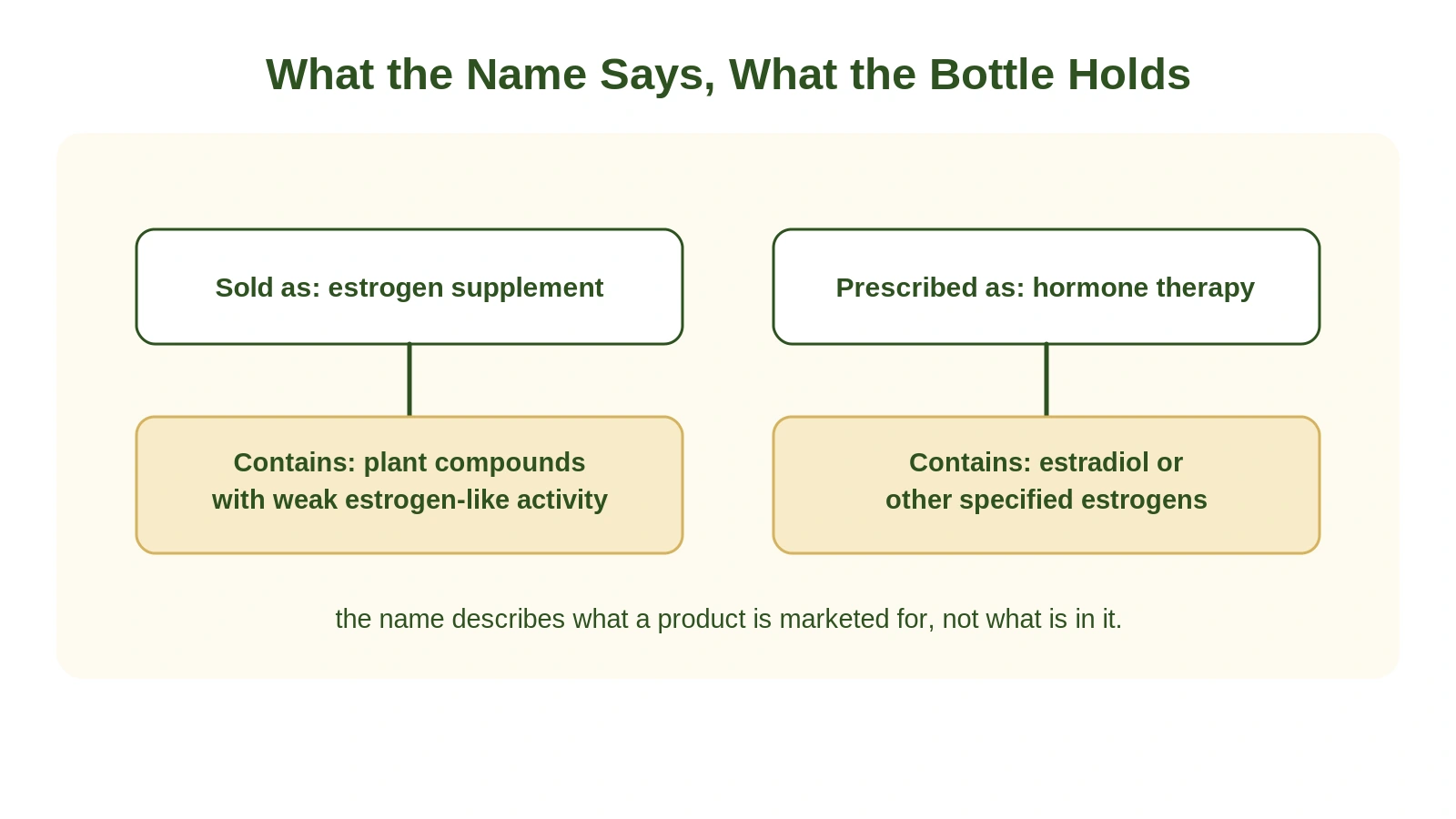
Plant compounds, not hormones. Products marketed as over-the-counter estrogen typically contain phytoestrogens, which are plant-derived substances with weak estrogen-like activity, or herbal ingredients marketed for menopausal symptoms. They do not contain estradiol, the estrogen the human body produces.
Ingredients commonly found in this category include:
Soy isoflavones, plant compounds structurally similar to estrogen
Red clover, a legume containing isoflavones
Black cohosh, a plant root long used for menopausal symptoms
Evening primrose oil
Wild yam, sometimes marketed as a hormone precursor
Dong quai and other traditional herbal preparations
Black cohosh is frequently described as a natural estrogen. Published evidence does not support that description. It was once thought to act like a plant estrogen, and research has not borne that out.
Can You Buy Estrogen Over the Counter in Texas?
No. FDA-approved estrogen requires a prescription in the United States, including in Texas. What is available on shelves at pharmacies, supermarkets and supplement retailers in San Antonio is the plant-based supplement category described above, not estrogen.
This is a point of genuine confusion, and the labeling does not help. A product can be called an estrogen supplement, sit in the pharmacy aisle and contain no estrogen at all, because the word describes what it is marketed to support rather than what is in it.
FDA-approved estrogen medications used for hormone therapy require a prescription and an appropriate clinical evaluation. Our guide to estrogen replacement therapy covers what that involves.
What the Evidence Shows
The clearest statement comes from the professional body most directly concerned.
The Menopause Society's 2023 nonhormone therapy position statement does not recommend supplements or herbal remedies for treating menopausal vasomotor symptoms, such as hot flashes and night sweats, because the available evidence does not support their use for this purpose.
Individual ingredients have been studied. A 2012 Cochrane review examining sixteen randomized trials involving 2,027 women found black cohosh no better than placebo for the daily number of hot flashes.
None of this means nobody feels better taking these products. People do report improvement, and placebo response in menopausal symptom trials is substantial. It means the improvement has not been shown to come from the ingredient, which is a different claim from saying nothing happens.
What FDA Oversight of Supplements Actually Means
Dietary supplements are regulated differently from prescription medications. The FDA generally does not approve supplements for safety and effectiveness before they are marketed. Manufacturers must follow applicable safety, labeling and manufacturing requirements, while FDA oversight also includes inspections and enforcement. These differences matter when evaluating product claims and quality.
Common assumption | What consumers should understand |
The FDA verifies every supplement's ingredient before sale | The FDA generally does not review or approve each supplement's composition before marketing. Manufacturers remain responsible for complying with applicable requirements |
Products with similar names contain identical doses | Ingredients and quantities can differ between products. Labels should identify dietary ingredients and their declared amounts |
Natural ingredients cannot cause adverse effects | Natural products can have adverse effects and interact with medications. Published guidance notes rare reports of liver injury involving products labeled black cohosh, with causation uncertain |
Supplements cannot contain undeclared substances | Products may be adulterated or mislabeled. Specific findings about undeclared hormones require source verification |
A product sold as a dietary supplement should not automatically be assumed safe because it is described as natural. Product quality, ingredients, medication interactions and individual medical history all matter. People with a history of hormone-sensitive cancer should discuss supplements with their treating clinician before use, particularly when products are marketed as having estrogen-like effects.
Published guidance also advises against blended menopause complex products containing many ingredients, because where a reaction occurs it cannot be traced to any one component.
How Prescription Hormone Therapy Differs
Three differences matter in practice, beyond the question of what is in the bottle.
It contains regulated hormones
Prescription therapy contains estradiol or other specified estrogens, manufactured to standards covering purity, potency and dose consistency, in forms including tablets, skin patches, gels and vaginal preparations.
It involves evaluation and monitoring
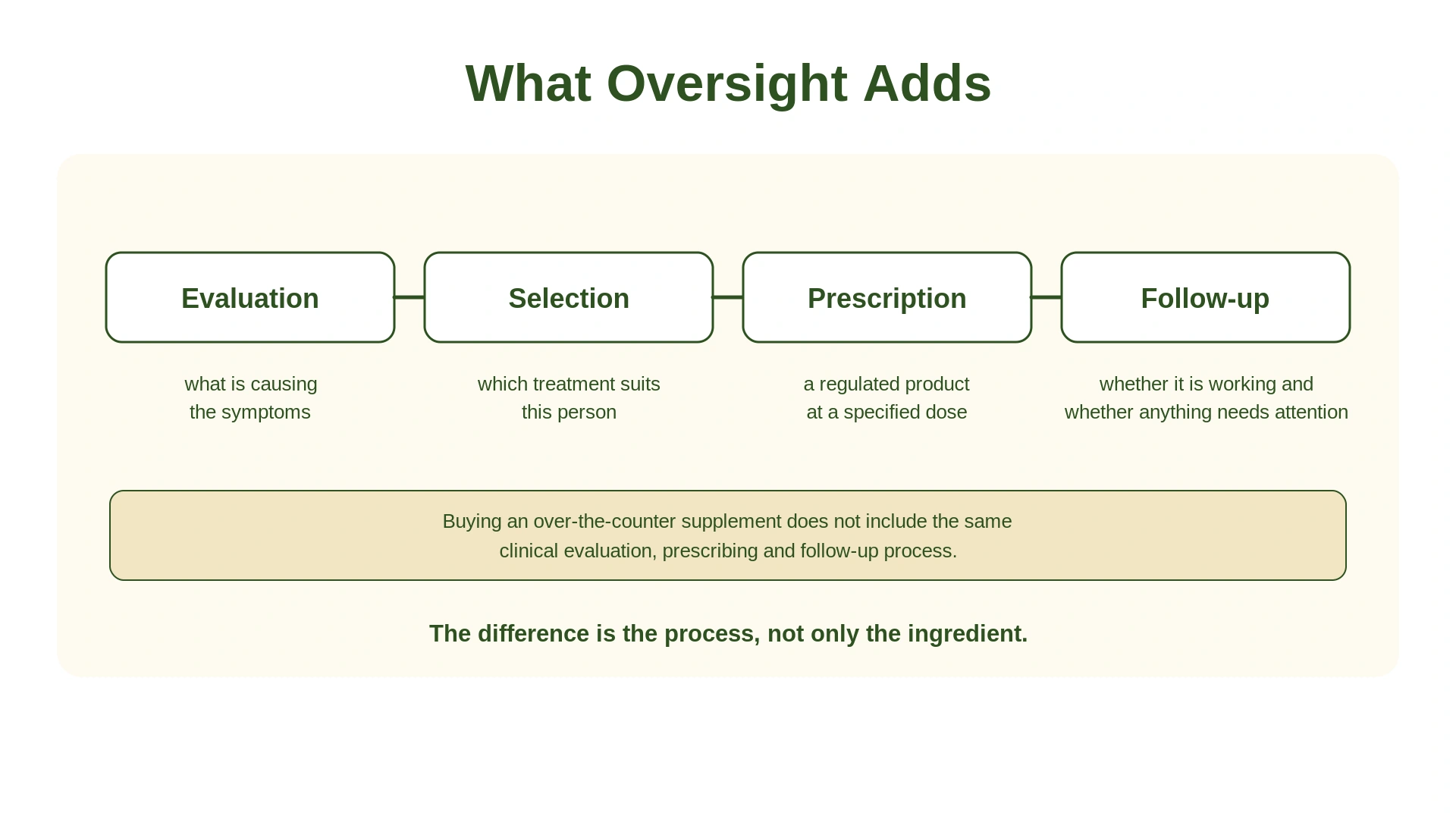
A clinician establishes whether treatment is appropriate, which preparation suits the situation, and what follow-up is needed. That process also identifies when hormone therapy is not the right answer, which a shelf cannot do.
Endometrial protection is considered
For systemic estrogen therapy, women with a uterus generally also need a progestogen to reduce the risk of endometrial hyperplasia and cancer. Low-dose vaginal estrogen used for local symptoms is considered separately and does not routinely require a progestogen. This is a central reason hormone therapy is a prescribing decision rather than a purchase. Our guide to estrogen replacement therapy covers that distinction in detail.
Side by Side
Comparison Terms | Over-the-counter supplements | Prescription hormone therapy |
What it contains | Plant compounds with weak estrogen-like activity, or herbal ingredients | Estradiol or other specified estrogens, and a progestogen where indicated |
Regulatory status | Not FDA-approved for treating menopause; not reviewed for effectiveness before sale | FDA-approved medications reviewed for safety and effectiveness |
Consistency | Formulation and content can vary between brands and batches | Manufactured to specified standards |
Evidence for symptom relief | The Menopause Society does not recommend supplements or herbal remedies for menopausal vasomotor symptoms. | Established for moderate to severe vasomotor symptoms |
Oversight | No prescription generally required; subject to applicable supplement manufacturing, labeling and safety requirements | Clinician evaluation, prescription and follow-up |
Endometrial protection | Not addressed | Considered as part of prescribing |
These are different categories rather than a weaker and a stronger version of the same thing. Comparing them with potency alone misses what the second column provides.
Why Some Women Look at Supplements First
Worth taking seriously rather than dismissing, because the reasons are usually reasonable ones.
Concern about hormone therapy risks
Many women formed a view about hormone therapy safety from coverage of research published more than two decades ago. Professional guidance has been updated since, and the current position is considerably more detailed than what reached the public at the time. Our guide to estrogen replacement therapy covers what changed.
Access and cost
A supplement requires no appointment and can be bought the same day. That is a real advantage in convenience terms, and it is also the reason nothing in the process checks whether the product suits the person buying it.
A preference for something natural
This preference is widely held and understandable. It is worth knowing that it naturally describes the origin of an ingredient rather than its effect or its safety, and that estradiol used in prescription therapy is molecularly identical to the estrogen the body produces.
Having been told hormone therapy is not an option
Where someone has been advised against hormone therapy, that advice usually has a specific reason. It is worth asking what the reason was and whether it still applies, since circumstances and guidance both change.
If You Are Already Taking One
Many people reading this will already have something in a cupboard. A few practical points apply.
Tell your clinician, including if it seems minor
Supplements can interact with prescribed medications, and herbal products are frequently not mentioned because people do not think of them as medicines. A clinician cannot account for something they have not been told about, and the omission is common enough that most will ask directly.
Single-ingredient products are easier to reason about
Published guidance advises against blended menopause complex products for a practical reason: where something goes wrong, or goes right, there is no way to tell which of a dozen ingredients was responsible. A single named ingredient at least allows the question to be asked.
If you are considering stopping, ask first
Whether a supplement can be stopped without additional considerations depends on its ingredients, other medications and the person's circumstances. If you are unsure, ask your healthcare professional or pharmacist before making changes.
A product that seems to be helping is still worth mentioning
Improvement is worth reporting whatever its source, because it is information about your symptoms. It also matters if you later start a prescribed treatment, since the clinician will want to know what else is in the picture.
A Note on Supplements Marketed to Lower Estrogen
A separate category of product is marketed for the opposite purpose, to reduce or balance estrogen, frequently under the heading of estrogen dominance.
Estrogen dominance is not a recognized clinical diagnosis in the way the term is used in marketing. Symptoms attributed to it have a range of possible causes, and whether hormone levels are involved is something testing and clinical assessment establish rather than something a product category answers.
The regulatory points above apply equally here: these products are not reviewed for effectiveness before sale, and content cannot be assumed to match the label. If symptoms prompted the search, those symptoms are the thing worth evaluating.

Questions to Ask Before Deciding Either Way
What specifically am I trying to improve, and how much is it affecting me
Have the symptoms been evaluated, or am I assuming the cause
If I am considering a supplement, what single ingredient is in it and what does the evidence say about that ingredient
Do I have any condition, including a history of hormone-sensitive cancer, that makes hormone exposure a specific concern
What else do I take that this could interact with
If hormone therapy was ruled out previously, what was the reason and does it still apply
Tell any clinician what supplements you are taking, including ones bought over the counter. They can interact with prescribed medications, and a clinician cannot account for something they do not know about.
Hormone Evaluation in San Antonio
San Antonio has supplement retailers, pharmacies and supermarkets stocking the products described here, alongside gynecology practices, hormone clinics, primary care and telehealth services providing prescription evaluation. The two sit in the same city and answer different questions.
THRYVE Wellness Clinic is a provider-led telehealth service with mobile phlebotomy, offering access to 300+ lab tests, with at-home blood collection available in supported San Antonio service areas when appropriate for the tests ordered.
Frequently Asked Questions
Do estrogen supplements contain estrogen?
Generally, no. Products sold over the counter as estrogen supplements typically contain phytoestrogens, which are plant compounds with weak estrogen-like activity, or herbal ingredients marketed for menopausal symptoms. They do not contain estradiol. FDA-approved estrogen requires a prescription in the United States.
Are natural estrogen supplements safer than prescription HRT?
Natural describes where an ingredient comes from rather than its safety. The FDA generally does not approve supplements for safety and effectiveness before they are marketed, which means content and dose can vary between products, and products may be adulterated or mislabeled. Prescription therapy carries known risks that a clinician assesses against an individual's circumstances. Neither is automatically safer; they are differently understood.
What supplements increase estrogen?
Foods and supplements containing phytoestrogens, including soy and red clover, contain plant compounds with weak estrogen-like activity. Published evidence does not establish that they raise the body's estrogen levels in the way prescription therapy does, and the Menopause Society's position statement does not identify any supplement as effective for menopause relief. If the goal is addressing symptoms, that is worth discussing with a clinician rather than approaching through supplementation.
Final Thoughts
A product labeled as an estrogen supplement generally contains no estrogen. It contains plant compounds in a category that is not reviewed for effectiveness before sale, and published position statements do not identify any of them as effective for menopausal symptoms.
Because supplements generally do not undergo FDA review for safety and effectiveness before sale, content and quantity can differ between products, and products may be adulterated or mislabeled.
None of which makes prescription therapy automatically right for any individual. It makes the comparison a different one than most people think they are making, and worth having with a clinician who can assess the situation.
Hormone Evaluation in San Antonio
THRYVE offers provider-led telehealth and laboratory testing options for people exploring hormone-related concerns in San Antonio. Mobile blood collection may be available depending on the test order, collection address and provider coverage. Contact THRYVE to learn more about available services.