

THRYVE Team
Wellness Clinic
What natural means across supplements, FDA-approved bioidentical hormones and compounded preparations, and why the distinction changes the decision.
Updated October 2026.
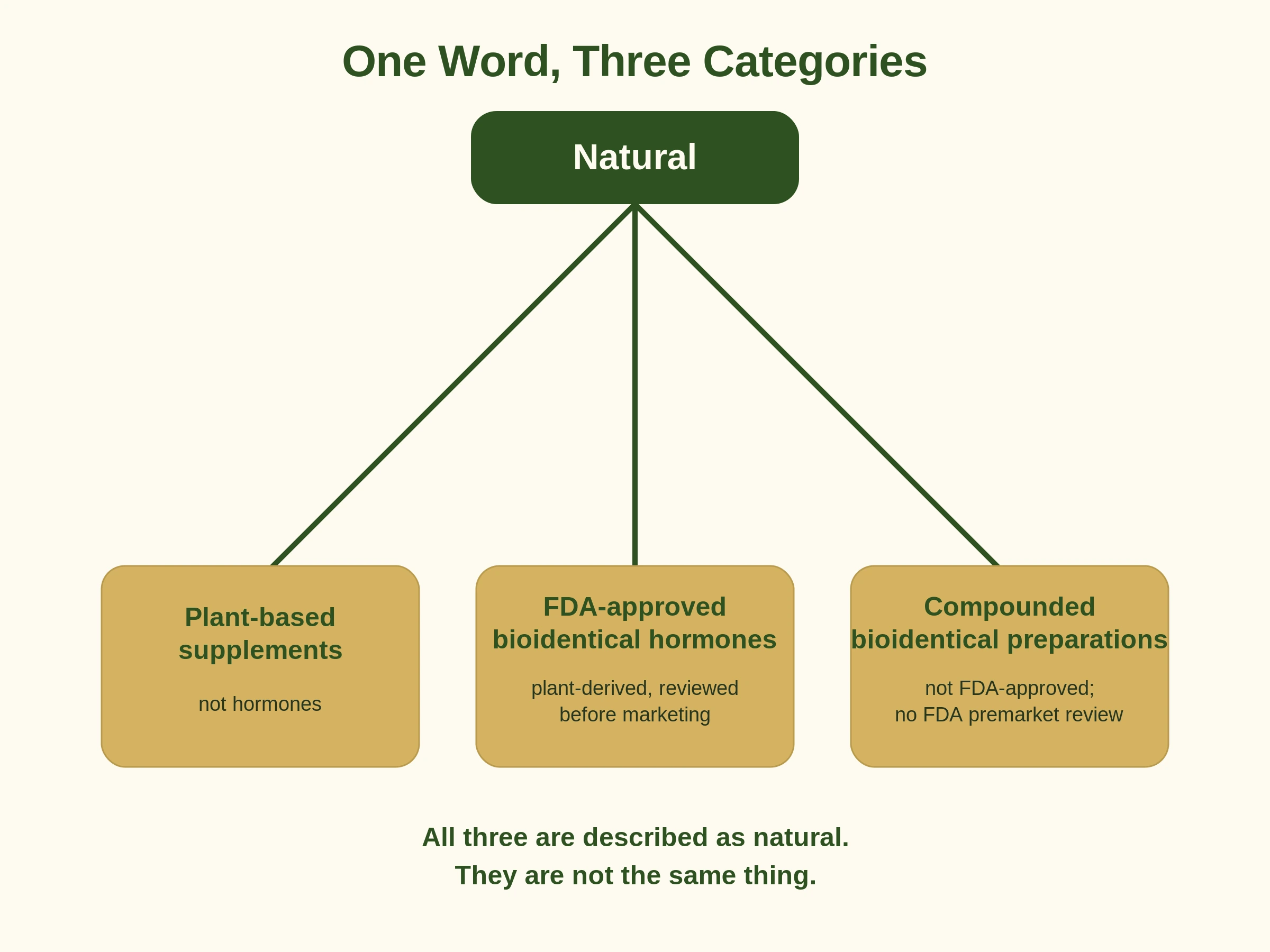
Natural hormone replacement therapy in San Antonio includes several approaches commonly described as natural, including plant-based supplements, FDA-approved bioidentical hormones, and compounded bioidentical hormone preparations. However, these options differ significantly in how they work, how they are regulated, and what evidence supports their use.
For women experiencing menopause symptoms, such as hot flashes, night sweats, or vaginal dryness, understanding these differences can help guide conversations about treatment. Importantly, FDA-approved bioidentical hormones are already a form of hormone replacement therapy.
This guide explains natural hormone therapy options, BHRT versus HRT, potential benefits and risks, treatment costs, and questions to ask before choosing a provider in San Antonio, Texas.
What Are Bioidentical Hormones and How Do They Work?
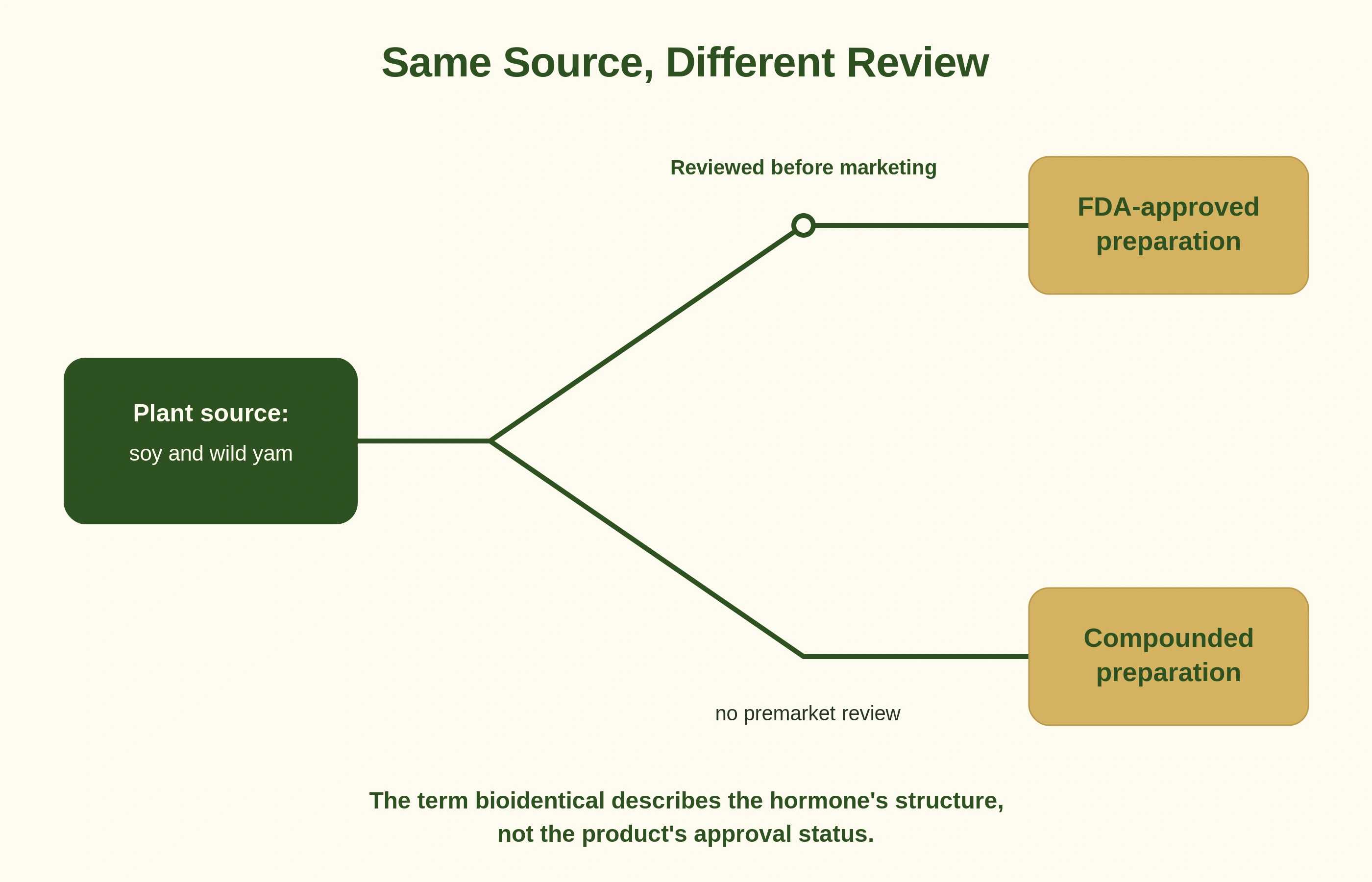
Bioidentical hormones are hormones with the same molecular structure as hormones naturally produced by the human body. They may be available as FDA-approved prescription medicines or compounded preparations. The term bioidentical describes molecular structure, not whether a product is FDA-approved. Bioidentical hormones used in therapy are typically derived from plant steroids found in soy and wild yams, then processed in a laboratory.
Bioidentical is not an official regulatory term. It describes structure and nothing about approval status, quality control or evidence
Laboratory processing is required either way, which means plant-derived and laboratory-made are not opposites
Why Do Women Consider Natural Hormone Replacement Therapy?
Women often explore natural hormone replacement therapy when experiencing symptoms associated with perimenopause or menopause.
Common concerns include hot flashes, night sweats, disrupted sleep, and vaginal dryness. Some women also report changes in mood or concentration, although these symptoms can have multiple causes and do not automatically indicate a need for hormone therapy.
The appropriate treatment depends on the symptoms being addressed, medical history, individual risk factors, and whether hormone therapy is suitable. For example, systemic hormone therapy and low-dose vaginal estrogen serve different treatment purposes. A clinician can help determine which approach, if any, is appropriate.
Our guide to perimenopause and menopause covers how the stage affects the clinical picture.
This section must not suggest that hormone therapy is routinely indicated for nonspecific symptoms such as fatigue, weight gain or difficulty concentrating. The wording deliberately notes these have multiple causes.
What Are the Three Types of Natural Hormone Therapy?
Comparison Terms | What it is | Regulatory status |
Plant-based supplements | Phytoestrogens and herbal preparations such as soy isoflavones, red clover and black cohosh. These are not hormones | Sold as dietary supplements. The FDA generally does not approve them for safety and effectiveness before marketing |
FDA-approved bioidentical hormones | Hormones structurally identical to the body's own, derived from plant sources, available as tablets, patches, gels, sprays and vaginal preparations | FDA-approved prescription medicines, reviewed for safety and effectiveness for their approved uses |
Compounded bioidentical preparations | Hormones structurally identical to the body's own, derived from the same plant sources, custom-mixed by a compounding pharmacy | Not FDA approved. Compounded preparations are not reviewed for safety or effectiveness before being supplied |
FDA-approved and compounded bioidentical preparations may contain the same hormone molecules, though formulations and available combinations can differ. The key distinction is that FDA-approved medicines undergo review for safety and effectiveness for their approved uses, whereas compounded drugs do not undergo that same premarket review.
Our guide to estrogen supplements and prescription hormone therapy covers the first row in detail.
[MEDICAL REVIEW REQUIRED: this table in full. Verify the regulatory characterizations for each row.]
BHRT vs HRT: What's the Difference?
BHRT is a type of hormone replacement therapy, not a separate alternative to HRT. The term describes hormones that are structurally identical to those produced by the body. Both FDA-approved and compounded bioidentical hormone products exist, but they differ in regulatory review and quality requirements. The meaningful distinction is not bioidentical against HRT but FDA-approved against compounded.
This matters because of where the mistaken framing leads. Someone who believes HRT means synthetic hormones may choose a compounded preparation specifically to avoid a prescription medicine that is already bioidentical and already plant-derived.
What synthetic actually refers to
Some hormone preparations use compounds that differ structurally from the body's own hormones, including conjugated equine estrogens and certain progestins. Comparing those with bioidentical preparations is a real comparison.
But synthetic against bioidentical is not the same comparison as HRT against BHRT, because FDA-approved bioidentical options sit inside HRT rather than outside it.
What Forms of Bioidentical Hormone Therapy Are Available?
FDA-approved bioidentical hormone treatments are available in several formulations, depending on the hormone and intended use.
Estradiol patches, which deliver estrogen through the skin
Estradiol gels and sprays, which provide transdermal estrogen delivery
Oral estradiol, an oral prescription estrogen option
Micronized progesterone, an FDA-approved oral progesterone preparation
Vaginal estrogen, available in formulations intended primarily for certain genitourinary symptoms of menopause
The appropriate formulation depends on treatment goals, medical history, individual risks and clinical evaluation. Compounded preparations may use additional formulations, but availability does not establish that they are safer or more effective than approved alternatives.
Are Compounded Bioidentical Hormones Safe?
A published analysis describes earlier FDA surveys in which 33 percent of the compounded products tested failed potency testing, with measured concentrations ranging from 67.5 percent to 268.4 percent of the expected amount. These findings concerned compounded products tested in those surveys and should not be interpreted as a current estimate for every compounded hormone preparation.
Compounded preparations can contain more or less active ingredients than intended. Unlike FDA-approved medicines, they do not undergo FDA premarket review for safety, effectiveness and quality, so patients should discuss product-specific uncertainties with their prescribing clinician and compounding pharmacy.
Compounded hormone preparations are not FDA-approved and do not undergo the same premarket review for safety, effectiveness and quality as FDA-approved medicines. However, drug compounding is subject to applicable regulatory requirements. Published guidance from major medical organizations, including the Mayo Clinic and the NHS, notes the absence of that premarket review alongside concerns about consistent dosing quality and the clinical safety trials approved products undergo.
For more detail on the evidence and clinical considerations, see ACOG's clinical guidance on compounded bioidentical hormone therapy.
A note on saliva testing
ACOG states that salivary hormone testing does not provide an accurate or precise basis for tailoring compounded menopausal hormone therapy. Evidence supporting the use of adjunct hormone testing to determine doses is limited, and such testing is not recommended for that purpose. Testing decisions should be based on the clinical question and the patient's circumstances.
Is Natural Hormone Replacement Therapy Safe?
Natural hormone replacement therapy is not automatically safer because it is plant-derived or bioidentical. Safety depends on the specific hormones, formulation, dose, route of administration, medical history, and individual risk factors. FDA-approved and compounded preparations also differ in regulatory review and quality-assurance requirements, so they should not be assumed to have equivalent evidence or safety profiles.
A hormone structurally identical to the body's own is still a hormone, with the effects that implies
For women with a uterus using systemic estrogen therapy, endometrial protection is a consideration regardless of whether a preparation is described as natural
Certain herbal preparations can interact with prescription medications, so natural does not mean free of interactions
Our guide to estrogen replacement therapy covers the risk picture for approved preparations in detail.
[MEDICAL REVIEW REQUIRED: this entire section, particularly the three bullets and the endometrial protection point, which specifies systemic estrogen therapy deliberately.]
Natural Hormone Replacement Therapy Options and Costs
Treatment option | FDA status | Key consideration | Cost considerations |
Plant-based supplements | Not FDA-approved as treatments for menopause symptoms | Evidence for symptom relief is limited. Content and quantity can vary between products | Retail price, bought directly. No consultation or testing cost unless sought separately |
FDA-approved bioidentical hormones | FDA-approved prescription products | Established regulatory review for approved uses. Requires a prescription and appropriate clinical evaluation | Preparation and route, whether insurance applies, plus evaluation and monitoring. Generic versions are available for some preparations |
Compounded bioidentical hormones | Not FDA-approved | May address specific patient needs when approved options are unsuitable. Does not undergo the same premarket review | Preparation, pharmacy and provider arrangement, and whether insurance applies, which it frequently does not |
Hormone pellets | Depends on the product; many marketed hormone pellets are compounded | Dosing is less readily adjustable after insertion than with some other formulations. Our guide covers this in detail | Billed per insertion rather than monthly, so the annual total depends on how many insertions a year |
NO SAN ANTONIO PRICES ARE REPRODUCED HERE. Local providers advertise figures that change, and reproducing them would date the article within months and turn it into a competitor price list. Our guide to hormone replacement therapy costs covers what drives the variation and how to make quotes comparable.
How to Increase Estrogen Naturally: What Actually Works?
Phytoestrogens in foods such as soy and flaxseed can interact with estrogen-related pathways, but they should not be treated as equivalent to prescription hormone therapy. The Menopause Society's 2023 position statement does not recommend dietary supplements or herbal remedies for treating menopausal vasomotor symptoms, such as hot flashes and night sweats.
This question deserves a fuller answer than yes or no, because the underlying goal is usually symptom relief rather than a laboratory value.
Dietary patterns and lifestyle factors matter in their own right. What they have not been shown to do is substitute for hormone therapy where that is clinically indicated.
People searching this are generally experiencing symptoms and looking for an option that does not involve a prescription. It is worth knowing that one of the options described above is a prescription and is also plant-derived, which may change how the choice looks.
Natural Remedies for Menopause: Evidence and Limitations
Published position statements on nonhormone approaches do not recommend herbal remedies for treating menopausal vasomotor symptoms, because the available evidence does not support their use for that purpose.
Nonhormone options that published guidance does address are a different matter from herbal supplements, and are worth asking a clinician about where hormone therapy is unsuitable or unwanted. Our guide to estrogen supplements and prescription hormone therapy covers the supplement category in detail.
When Might Compounded Bioidentical Hormones Be Appropriate?
Compounding allows a preparation to be made where an approved product does not suit a particular patient. FDA guidance describes compounding a medication for a patient who cannot use an ingredient in an approved medicine, and compounding is a patient-specific clinical decision rather than automatically the preferred option.
The distinction worth holding is between compounding used to solve a specific clinical problem, and compounding used as a default approach for patients an approved product would have suited. The first is what compounding is for. The second is where the concerns in this article apply.
If a compounded preparation is proposed, asking what makes an approved alternative unsuitable in your case is a fair question. A specific clinical reason is a good answer; a general preference for custom formulation is a different kind of answer and worth exploring.
What Is Bioidentical Progesterone?
An FDA-approved bioidentical progesterone exists as oral micronized progesterone, structurally identical to the progesterone the body produces. Synthetic progestins are different compounds and the two are not interchangeable in the literature.
So, a woman said that bioidentical progesterone is only available compounded is being given inaccurate information. An approved option exists.
For women with a uterus who use systemic estrogen therapy, a progestogen is generally needed to protect the endometrium. The appropriate regimen depends on the therapy and the individual's clinical circumstances.
How Is Hormone Replacement Therapy Evaluated?
An evaluation for menopausal hormone therapy generally begins with a review of symptoms, menstrual history, medical history, medications and individual risk factors.
Hormone blood tests are not routinely necessary to diagnose menopause in otherwise healthy women over age 45 with typical symptoms. Testing may be appropriate in selected situations, such as suspected early menopause or when another medical condition needs investigation.
When laboratory testing is clinically appropriate, the provider determines which tests are needed and how the results should be interpreted. Treatment decisions should not be based solely on a hormone level without considering symptoms and medical history.
Our guide to blood tests before hormone therapy covers what the evaluation typically involves.
How to Choose a Natural Hormone Therapy Provider in San Antonio
Women exploring natural hormone replacement therapy in San Antonio may encounter several care models, including gynecology practices, specialty hormone therapy providers, wellness clinics and telehealth services.
These services can differ in the types of hormones prescribed, whether they use FDA-approved or compounded preparations, how evaluations are conducted, and what follow-up care includes.
Before choosing a provider, ask whether treatment recommendations are based on your medical history and symptoms, whether FDA-approved options are available, and how ongoing monitoring is handled.
For patients considering telehealth, it is also worth confirming whether the provider serves their location, how prescriptions are managed, and whether any necessary laboratory testing can be arranged locally.
Questions worth asking any provider here
Is what you are proposing an FDA-approved product or a compounded preparation
If compounded, what makes that necessary in my case rather than an approved alternative
How will the dose be determined, and what testing is that based on
If I have a uterus, how is endometrial protection being handled
What monitoring follows, and how often
The first question determines which of the three categories above you are being offered, and a provider should be able to answer it immediately.
Where THRYVE fits
THRYVE Wellness Clinic is a provider-led telehealth service with mobile phlebotomy, offering access to 300+ lab tests, with at-home blood collection available in supported San Antonio service areas when appropriate for the tests ordered.
Frequently Asked Questions
What is the most natural hormone replacement therapy?
The question assumes a ranking that does not exist. FDA-approved bioidentical hormones and compounded bioidentical preparations are both derived from plant sources and both structurally identical to the body's own hormones. Neither is more natural than the other in origin. They differ in whether the preparation has been reviewed for safety, effectiveness and dose consistency. Plant-based supplements are a separate category again and are not hormones.
Is BHRT the same as HRT?
FDA-approved bioidentical hormones are hormone replacement therapy. The term BHRT is most often used commercially to describe compounded preparations, which are not FDA approved. So the answer depends on which the person asking means, and clarifying that is more useful than treating the two terms as opposites.
Are bioidentical hormones safer than synthetic hormones?
Structural identity to the body's own hormones does not by itself establish a safety advantage, and published guidance notes that plant-derived and bioidentical hormones can carry risks comparable to other hormone therapy. Where a difference has been examined, it concerns specific preparations and routes rather than the bioidentical category. This is worth discussing with a clinician in relation to your own circumstances.
Does natural hormone replacement therapy help with menopause symptoms?
Systemic FDA-approved menopausal hormone therapy can effectively treat certain menopause symptoms, particularly hot flashes and night sweats. Plant-based supplements and compounded preparations should not be assumed to provide equivalent benefits or evidence. Treatment suitability depends on individual circumstances and is a clinical decision.
Do I need hormone blood tests before starting BHRT?
Not always. Menopause can often be assessed through symptoms and menstrual history without routine hormone blood testing. A clinician may recommend testing when the diagnosis is uncertain or another condition needs investigation. Where testing is appropriate, results are interpreted alongside symptoms and history rather than used alone.
Can you get FDA-approved bioidentical hormones?
Yes. FDA-approved bioidentical hormone medications include certain estradiol formulations and oral micronized progesterone. These are prescription medicines and are distinct from custom-compounded hormone preparations. Whether any of them suits an individual is a clinical question.
How much does BHRT cost monthly?
It depends on the preparation, whether it is compounded or FDA-approved, whether insurance applies, and what a quoted figure includes. Compounded preparations are frequently not covered by insurance, while generic versions exist for several approved preparations. A first-year total including evaluation and monitoring is a more useful figure than a monthly one.
Can I take something instead of hormone replacement therapy?
Nonhormone approaches exist and published guidance addresses them, which is a different thing from herbal supplements marketed as alternatives. If hormone therapy is unsuitable or unwanted in your case, that is a conversation worth having with a clinician who can set out what the evidence supports for your situation.
Final Thoughts
Natural describes where a hormone came from, and in this market almost everything came from a plant. It tells you nothing about whether preparation has been reviewed or what evidence supports it.
The comparison that matters is not bioidentical against hormone replacement therapy, because FDA-approved bioidentical options are hormone replacement therapy. It is approved against compounded, and that is a question about regulation rather than about origin.
Which means a woman who wants something natural and plant-derived may already be describing a prescription medicine.
Explore Hormone Evaluation Options in San Antonio
Understanding whether FDA-approved bioidentical hormone therapy or another approach is appropriate begins with an individualized clinical evaluation.
THRYVE Wellness Clinic provides provider-led telehealth services, with access to laboratory testing and mobile blood collection in supported San Antonio service areas when clinically appropriate.
Contact THRYVE to learn about available hormone evaluation services and next steps.